Getting more visitors to your contractor website is valuable. But what happens when those visitors arrive, browse your services, look at a few project photos, and leave without requesting an estimate?
For HVAC companies, roofing contractors, electricians, plumbers, remodeling businesses, pool builders, and landscaping companies, this is a common digital marketing challenge.
Your website may already appear in Google Search. You might be investing in local SEO, Google Ads, content marketing, or Google Business Profile optimization. Yet the number of qualified inquiries doesn’t always reflect the traffic you’re generating.
The missing piece may be contractor website conversion optimization.
A conversion-focused WordPress website does more than display your services. It helps potential customers understand what you offer, evaluate your credibility, explore relevant projects, and take the next step toward hiring your company.
In this guide, we’ll explore how WordPress website design, conversion rate optimization (CRO), mobile usability, service-page structure, and lead capture work together to turn existing contractor website traffic into meaningful business opportunities.
What Is Contractor Website Conversion Optimization?
Contractor website conversion optimization is the process of improving a construction or home service website so that more of its visitors complete valuable actions.
Those actions may include:
Requesting a project estimate or consultation.
Calling your business about a service.
Scheduling an inspection or appointment.
Submitting a remodeling or construction project inquiry.
Requesting emergency HVAC, plumbing, or electrical assistance.
Sharing project details through an online form.
The objective isn’t simply to generate more form submissions. It’s to encourage qualified inquiries from people who need the services your business actually provides.
For example, a luxury remodeling contractor may prefer five well-qualified whole-home renovation inquiries over twenty requests for small handyman repairs.
Similarly, a commercial roofing company may want inquiries from property managers and building owners rather than homeowners looking for minor residential roof repairs.
Effective conversion optimization considers the visitor’s intent, the contractor’s business model, and the types of projects worth pursuing.
Why Contractor Websites Get Traffic but Fail to Generate Enough Leads
Not every conversion problem is caused by poor design. Some websites attract the wrong audience, target informational keywords rather than service-related searches, or receive traffic from areas they don’t serve.
However, when relevant visitors are arriving but few are contacting the business, website usability and conversion pathways deserve closer attention.
1. The website looks professional but doesn’t guide visitors
A visually attractive website isn’t necessarily an effective lead-generation website.
A contractor homepage might feature beautiful project photography, animations, and detailed company information without clearly explaining:
Which services are available.
Where the company operates.
What types of projects it accepts.
Why a visitor should choose the company.
How to request an estimate.
Visitors shouldn’t have to search through multiple menus to understand whether your business can help them.
A conversion-focused WordPress design establishes a clear path from the initial landing page to the appropriate service, supporting proof, and contact opportunity.
2. Service pages are too broad
A general “Our Services” page may describe everything from roof replacement to gutter installation, but it rarely addresses every visitor’s specific concerns.
Someone searching for commercial roof replacement has different expectations from someone looking for an emergency roof leak repair.
The same principle applies to contractors offering several services.
An HVAC company may need separate experiences for AC repair, system replacement, maintenance, and commercial HVAC work.
A remodeling contractor may need distinct pages for kitchen renovations, bathroom remodeling, additions, and whole-home renovations.
Specific service pages help connect search intent with the information and conversion action visitors expect.
3. Mobile visitors encounter unnecessary friction
Many home service inquiries begin on smartphones, particularly when a customer needs urgent assistance.
Common mobile usability problems include:
Contact buttons that are difficult to tap.
Large images that delay page loading.
Forms requiring excessive typing.
Navigation menus that hide important services.
Text that is difficult to read.
Popups that interrupt the browsing experience.
WordPress websites should be evaluated on actual mobile devices, not just desktop previews.
4. Calls to action are unclear or poorly positioned
A single “Contact Us” link in the navigation isn’t always enough.
Visitors may need different actions depending on their stage of consideration.
For example:
Emergency plumbing: Call for Emergency Plumbing Service
Roofing replacement: Request a Roof Inspection
Custom home building: Discuss Your Construction Project
Landscaping design: Schedule a Landscape Consultation
Pool construction: Request a Pool Design Consultation
The best CTA matches the service and the visitor’s immediate objective.
How WordPress Website Design Improves Contractor Conversion Rates
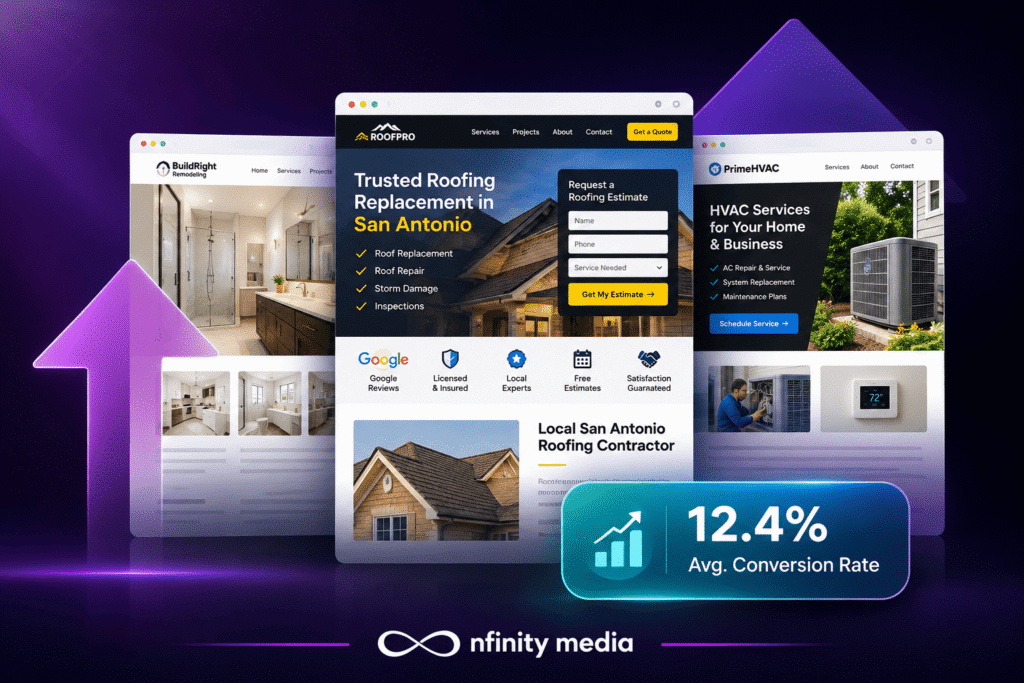
WordPress provides a flexible foundation for building contractor websites with service-specific layouts, project galleries, estimate forms, local landing pages, and lead-generation integrations.
However, using WordPress alone doesn’t guarantee better conversions.
The difference comes from how the website is planned, structured, designed, and maintained.
1. Build service pages around customer intent
A contractor service page should answer the questions visitors are likely to ask before contacting the business.
For example, a roof replacement page might explain:
Residential or commercial roofing options.
Available roofing materials.
Inspection and estimate processes.
Service areas.
Relevant completed projects.
Warranty information, where applicable.
How to request an assessment.
Instead of using the same generic template for every service, WordPress allows page sections to be adapted to the type of project and the information a prospective customer needs.
This creates a more relevant experience without requiring a completely separate website for each trade.
2. Make the first screen immediately useful
The first visible section of a contractor website should communicate the service, location, and next action without unnecessary distractions.
A useful hero section often includes a descriptive heading, concise supporting text, a relevant project or service image, and a prominent CTA.
For example, an HVAC company might use:
Air Conditioning Repair & Replacement in Tampa Bay
Residential AC repair, system replacement, and maintenance services throughout Tampa and surrounding communities.
CTA: Schedule an AC Service Appointment
This is more informative than a generic headline such as “Quality You Can Trust.”
The visitor immediately understands what the company offers and where it operates.
3. Use project galleries to support buying decisions
Project photography is particularly valuable for contractors whose work involves significant financial commitments.
Custom home builders, pool contractors, kitchen remodelers, deck builders, and outdoor living companies benefit from showing the actual quality and scope of their work.
A useful WordPress project gallery can include:
Before-and-after comparisons.
Project locations or service areas.
Project type and scope.
Materials or construction methods.
Brief explanations of challenges and solutions.
Relevant links to service pages.
A gallery shouldn’t function only as a collection of attractive images. It should help visitors decide whether the contractor has experience with projects similar to theirs.
For higher-value construction services, detailed project pages can also strengthen the website’s internal linking and topical relevance.
4. Design estimate forms around the service
Not every contractor needs the same contact form.
An emergency electrician may benefit from a short form requesting a name, phone number, location, and description of the issue.
A luxury home builder may need a more detailed inquiry process covering project location, approximate scope, timeline, and budget range.
The goal is to collect enough information to qualify the opportunity without creating unnecessary friction.
For WordPress websites, form solutions can be integrated with email notifications, CRM platforms, scheduling systems, and automated follow-up workflows.
A well-designed form should also confirm successful submission and make clear what happens next.
Contractor Website Conversion Strategies by Industry
Different contractor industries have different buying journeys. That means conversion optimization should reflect the service rather than relying on a universal website template.
| Contractor industry | Important website elements | Primary conversion opportunity |
|---|---|---|
| HVAC | Emergency service information, repair/replacement pages, mobile calling | Service booking or call |
| Roofing | Inspection process, materials, warranties, project evidence | Roof inspection or estimate |
| Plumbing | Emergency availability, service-area information, clear phone access | Service call |
| General contracting | Project scope, credentials, portfolio, process | Project consultation |
| Luxury remodeling | Detailed project galleries, design process, qualification forms | Remodeling consultation |
| Pool construction | Pool designs, completed projects, construction process | Pool project inquiry |
| Landscaping and outdoor living | Design galleries, service categories, project scope | Design consultation |
| Electrical and EV charging | Installation details, service coverage, relevant qualifications | Installation estimate |
The underlying principle is the same: the website should make it easier for the right customer to understand the service and take an appropriate next step.
For a broader look at how contractor websites can be structured around commercial services, explore our WordPress design and redesign services for California contractors and related WordPress website resources.
Why Mobile WordPress UX Matters for Contractor Lead Generation

Mobile usability affects more than the appearance of a website.
A visitor may be standing outside a property, comparing contractors between appointments, or searching for emergency service while dealing with an active problem.
In these situations, convenience matters.
Make phone calls easy
Contractors who depend on phone inquiries should ensure that phone numbers are accessible and clickable on mobile devices.
A persistent mobile call button may be appropriate for emergency services, provided it doesn’t obscure content or interfere with other controls.
For longer-consideration projects, a consultation or estimate CTA may be more suitable.
Keep navigation focused
Mobile navigation should prioritize important services, project examples, service areas, and contact information.
Avoid forcing visitors to navigate through several layers of menus just to find a relevant service page.
Optimize WordPress performance
Large hero images, unnecessary scripts, excessive plugins, and poorly configured page builders can contribute to slow or unstable experiences.
WordPress performance improvements may involve:
Properly sized and compressed images.
Efficient loading of scripts and styles.
Caching and hosting configuration.
Reducing unnecessary plugin overhead.
Improving responsive layouts.
Reviewing Elementor or other page-builder assets.
Google’s Core Web Vitals evaluate loading performance, responsiveness, and visual stability. These measurements provide useful technical benchmarks, although a good score alone doesn’t guarantee more leads.
A contractor website should be both technically efficient and easy to use.
How SEO and Conversion Optimization Work Together
Search engine optimization and conversion rate optimization solve related but different problems.
SEO helps relevant customers discover your website. CRO helps those customers take meaningful action once they arrive.
Consider a roofing contractor receiving organic visits from searches involving roof replacement, roof repair, and roofing estimates.
The SEO strategy may successfully bring these visitors to the website. But if every search lands on a generic homepage, the customer must do additional work to find the relevant information.
A better approach connects keyword intent, landing-page content, internal navigation, and conversion actions.
Match search intent to the landing page
Visitors searching for “emergency AC repair” should reach content that clearly addresses repair availability and the appropriate next step.
Visitors searching for “custom home builder” may expect project examples, construction capabilities, and a consultation process.
A WordPress website can support both journeys through carefully planned service-page architecture.
Connect local SEO with service-area relevance
Contractors often serve multiple cities or communities.
A location-focused page should provide meaningful local context rather than simply repeating the same content with different city names.
Relevant details may include service coverage, local project examples, service availability, and specific regional considerations.
This helps visitors determine whether the contractor operates in their area and offers the service they need.
Preserve SEO value during WordPress redesigns
If an established contractor website already earns organic traffic, a redesign should protect that visibility.
Before changing page structures or URLs, evaluate:
Existing organic landing pages.
Search queries and page performance.
Important service URLs.
Internal links.
Backlinks and redirects.
Metadata and content relevance.
Indexability and technical configuration.
A redesigned website may look better while performing worse if valuable search pages are removed or important URLs are changed without proper planning.
This is why WordPress website redesign and SEO preservation should be considered together, especially for established construction and home service companies.
How to Measure Contractor Website Conversion Performance
Conversion optimization should be based on evidence rather than design preferences alone.
Google Analytics 4, Google Search Console, call-tracking systems, and CRM data can help identify where visitors come from and whether those visits produce business opportunities.
Useful metrics include:
Organic landing-page traffic.
Estimate form submissions.
Qualified phone inquiries.
Consultation bookings.
Conversion rate by service page.
Lead quality by traffic source.
Mobile versus desktop performance.
Qualified leads that become customers.
Google Analytics 4 supports lead-generation events such as generate_lead, qualify_lead, and close_convert_lead, which can help businesses distinguish initial inquiries from qualified leads and completed sales when tracking is configured appropriately.
Example: What a conversion improvement could mean
Imagine a contractor website receives 2,000 visits per month.
At a 1.5% visitor-to-lead conversion rate, that produces approximately 30 inquiries.
If improvements to page relevance, mobile usability, forms, and calls to action raise the rate to 2.5%, the same traffic would produce approximately 50 inquiries.
That’s 20 additional inquiries without increasing website traffic.
This is a hypothetical illustration, not a guaranteed outcome. Actual performance depends on traffic quality, services, competition, seasonality, and the changes implemented.
The most important measurement is not simply how many people complete a form, but how many become qualified opportunities and paying customers.
Should You Redesign Your Contractor Website or Optimize the Existing One?
A complete WordPress redesign isn’t always necessary.
Some contractor websites have a strong technical foundation and established search visibility but need targeted improvements to their conversion experience.
In those situations, updating service-page layouts, improving estimate forms, reorganizing navigation, or adding stronger project evidence may be more appropriate than rebuilding the entire website.
However, a broader redesign may make sense when:
The website is difficult to use on mobile.
Important service pages lack clear structure.
The design no longer reflects the company’s services or project quality.
The site relies on outdated or difficult-to-maintain functionality.
Performance issues are widespread.
The current architecture makes SEO and content expansion difficult.
The decision should begin with an audit of the existing website, not an assumption that every contractor needs a new design.
A strong WordPress website redesign strategy should preserve useful content and existing SEO value while improving usability, page structure, and lead-generation opportunities.
A Practical Contractor Website Conversion Optimization Checklist
Before investing in more advertising or expanding your SEO campaign, review these areas of your existing WordPress website.
Website clarity
Does the homepage immediately explain the main services?
Are primary service areas visible?
Can visitors find relevant service pages quickly?
Does the website communicate what makes the company a suitable choice?
Conversion experience
Does every important service page have an appropriate CTA?
Are forms easy to complete on mobile?
Are phone numbers clickable?
Are successful form submissions confirmed?
Is there a clear next step after contacting the business?
Trust and project evidence
Are relevant completed projects featured?
Are genuine reviews and testimonials available?
Are licenses, certifications, and warranties accurately represented where applicable?
Can visitors understand the company’s process?
SEO and performance
Are important service pages accessible and indexable?
Does the content match the intent of the searches attracting visitors?
Are images and scripts optimized?
Are internal links useful and descriptive?
Are conversions measured accurately?
These questions can help identify practical improvements before committing to a full website rebuild.
How Nfinity Media Approaches WordPress Design and Contractor Lead Generation
At Nfinity IT Media, we approach contractor website design as a combination of search visibility, user experience, technical performance, and business-focused conversion pathways.
Our work spans WordPress website design and redesign, technical SEO, service-page architecture, local search optimization, and lead-generation integrations.
Rather than treating every contractor website as a generic brochure, we evaluate how visitors find the business, which services they are looking for, what information supports their decision, and how the website can make the next step easier.
For established contractor websites, this also means considering the organic visibility and content value already built before recommending significant changes.
A roofing company, HVAC contractor, luxury home builder, or landscaping business may need a different conversion strategy depending on its services, project values, service areas, and sales process.
The objective is to build a WordPress experience that supports both discoverability and qualified customer inquiries.
Frequently Asked Questions About Contractor Website Conversion Optimization
What is a good conversion rate for a contractor website?
There isn’t one universal benchmark. Conversion rates vary by contractor industry, traffic source, service type, location, and what counts as a conversion. Emergency repair calls and luxury construction consultations have very different buying journeys. Evaluate qualified leads and booked projects alongside website conversion rates.
Can WordPress improve contractor website lead generation?
Yes. WordPress can support conversion-focused service pages, responsive designs, project galleries, estimate forms, booking tools, and CRM integrations. Results depend on how these features are implemented and how well they match customer intent.
Does a contractor need a complete website redesign to improve conversions?
Not necessarily. Some websites benefit from focused improvements to mobile layouts, navigation, calls to action, forms, or service-page content. A full redesign becomes more appropriate when structural, technical, or usability limitations affect much of the website.
How do SEO and conversion rate optimization work together?
SEO helps attract relevant visitors from search engines, while CRO improves the experience those visitors have after arriving. Aligning search intent, service-page content, internal links, and conversion actions helps connect visibility with business inquiries.
Which WordPress pages should contractors optimize first?
Start with pages receiving meaningful traffic or showing strong commercial intent, such as the homepage, major service pages, and high-performing local landing pages. Prioritize using Google Search Console, analytics, and lead-quality data.
How important are project galleries for contractor conversions?
Project galleries can help prospective customers evaluate experience, workmanship, and suitability. They’re especially useful for remodeling, pool construction, landscaping, outdoor living, and custom home building, where visual evidence can influence the buying decision.
Can website speed affect contractor lead generation?
Slow or unstable pages can create friction for visitors, especially on mobile devices. Improving performance supports usability, but speed should be evaluated alongside content relevance, page structure, trust signals, and conversion pathways.
How can contractors track leads from their WordPress websites?
Contractors can use Google Analytics 4, Google Tag Manager, call tracking, form submission events, and CRM integrations to measure inquiries. Connecting qualified leads and completed projects to their sources provides a more useful picture than counting form submissions alone.
Turn Your Existing Contractor Website Traffic Into Better Opportunities
More traffic isn’t always the next investment your contractor business needs.
If your WordPress website already attracts potential customers, improving the experience between their first visit and their decision to contact you may create opportunities that your current design is missing.
That might mean clearer service pages, stronger project evidence, simpler estimate forms, better mobile usability, or a more comprehensive WordPress redesign that protects existing SEO performance.
Nfinity Media helps contractors connect WordPress website design, SEO, user experience, and lead-generation strategy.
Explore our WordPress design and redesign services or schedule a digital growth consultation to discuss your website’s current performance, conversion challenges, and potential improvements.