Getting more website traffic is often treated as the primary goal of digital marketing. Businesses invest in search engine optimization, increase Google Ads budgets, launch Facebook and Instagram campaigns, and monitor their impressions, clicks, and rankings.
But what happens when the traffic arrives and doesn’t convert?
A contractor might rank for valuable service keywords yet receive very few estimate requests. A professional services company might spend thousands on Google Ads while struggling to generate qualified consultations. An eCommerce business might attract visitors through Instagram advertising but lose potential customers before checkout.
These are not always traffic problems. They may be conversion problems.
Conversion rate optimization (CRO) for SEO, Google Ads, and Meta Ads focuses on improving what happens after someone discovers your business. It connects search intent, advertising messages, landing-page experience, website usability, trust signals, and conversion tracking to create a clearer path from visitor to customer.
At Nfinity Media, we view SEO, paid advertising, website development, and conversion optimization as connected parts of a broader digital growth strategy.
The objective isn’t simply to attract more visitors. It’s to make the traffic you’re already earning or paying for more commercially valuable.
What Is Conversion Rate Optimization, and Why Does It Matter?
Conversion rate optimization (CRO) is the process of improving a website, landing page, or digital customer journey so that a greater proportion of relevant visitors complete a desired action.
That action depends on the business.
For a roofing contractor, it might be requesting an inspection. For an HVAC company, it could be booking a service appointment. A luxury home builder might prioritize qualified project consultations, while an eCommerce store measures completed purchases.
Common website conversions include:
Phone calls from prospective customers
Contact form submissions
Estimate and quote requests
Appointment bookings
Consultation requests
Product purchases
Demo registrations
Qualified lead submissions
The basic conversion rate formula is:
Conversion Rate = (Conversions ÷ Visitors) × 100
For example, consider a website receiving 5,000 visitors each month.
| Website performance | Before CRO | After CRO |
|---|---|---|
| Monthly visitors | 5,000 | 5,000 |
| Visitor-to-lead conversion rate | 2% | 3.5% |
| Monthly leads | 100 | 175 |
| Additional leads | — | +75 |
Illustrative scenario, not an actual client result or guaranteed improvement.
The website generates 75 additional leads without increasing visitor volume.
However, the business still needs to evaluate lead quality, sales conversion rates, acquisition costs, and customer value. A higher form-submission rate isn’t necessarily better if the additional inquiries are unqualified.
This is where CRO becomes more than changing button colors or rearranging a page.
Effective conversion optimization connects customer intent, website experience, and business outcomes.
Why More SEO Traffic Doesn’t Always Generate More Leads
Search engine optimization can improve visibility for valuable keywords, but ranking well doesn’t automatically mean visitors will become customers.
Consider a remodeling company that ranks for kitchen renovation searches.
The visitor arrives expecting information about kitchen remodeling services, project capabilities, service areas, and how to request an estimate.
Instead, the page presents a generic company introduction, several unrelated services, limited project examples, and a contact button buried near the footer.
The website has successfully attracted a relevant visitor but hasn’t made the next step easy.
Search Intent and Landing-Page Experience Must Match
Someone searching for “emergency AC repair” has different expectations from someone researching “cost to replace an HVAC system.”
The emergency visitor may prioritize:
Immediate service availability
Clear service-area coverage
Click-to-call functionality
Licensing and business credibility
A short path to requesting assistance
The replacement customer may want pricing context, equipment options, financing information, service comparisons, and an estimate request.
Both visitors can be valuable, but they shouldn’t necessarily receive identical experiences.
SEO and CRO work together when the landing page answers the searcher’s question and supports the next logical action.
For businesses targeting geographically specific searches, local SEO services can help connect service-area visibility with relevant website content and conversion pathways.
Informational Traffic and Commercial Traffic Behave Differently
Not every organic visitor is ready to purchase.
A person researching roof replacement costs may be several weeks away from contacting a contractor. Someone searching for a specific roofing installation company may be much closer to making a decision.
CRO shouldn’t force every visitor into an immediate sales conversation.
Instead, it should create useful pathways for different stages of the buying journey.
An informational article might provide a service comparison, project examples, or a relevant consultation option. A commercial service page should make it straightforward to request a quote or speak with the company.
This distinction is especially important when evaluating conversion rates across different organic landing pages.
A blog article and a high-intent service page shouldn’t automatically be judged against the same conversion benchmark.
CRO for Google Ads: Stop Paying for Clicks That Go Nowhere
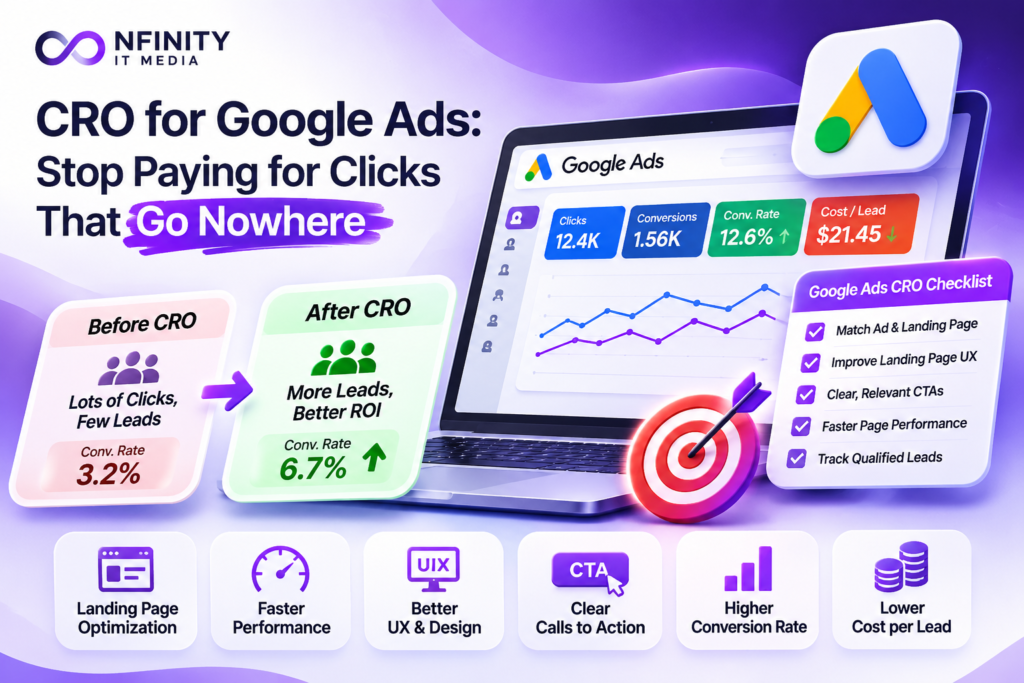
Google Ads can capture demand from people actively searching for products, services, and solutions.
But a paid click is only the beginning of the customer journey.
If the advertisement promises one thing and the landing page delivers something different, the business may lose a valuable opportunity.
1. Match the Ad to the Landing Page
Imagine an electrical contractor running a Google Ads campaign targeting “EV charger installation.”
The advertisement highlights residential EV charging installation, but the visitor lands on a general electrical services homepage.
The customer now has to search through the website to find the service they originally requested.
A dedicated EV charger installation landing page could provide a more relevant experience through:
A headline matching the advertised service
Residential installation details
Compatible charging solutions
Service-area information
Relevant project examples
A clear estimate request
A mobile-friendly contact option
This alignment is known as message match.
It helps visitors recognize that they’ve reached the right place.
2. Improve the Experience Before Increasing Ad Spend
When Google Ads campaigns underperform, increasing the budget isn’t always the best solution.
First, investigate whether the problem involves:
Irrelevant search terms
Broad or poorly structured keyword targeting
Weak advertisement messaging
An unsuitable landing page
Slow mobile performance
Unclear calls to action
Broken forms or phone links
Incorrect conversion tracking
A business spending $3,000 per month on advertising should understand whether its campaigns are attracting the wrong visitors or losing the right visitors after the click.
These problems require different solutions.
3. Build Landing Pages Around the Offer
A dedicated paid-search landing page doesn’t need to be visually complicated.
It needs to communicate the offer clearly.
For a contractor, that might include a headline describing the exact service, a concise explanation of what is included, evidence of completed work, relevant qualifications, geographic coverage, and a straightforward estimate form.
For professional services, it might include expertise, client-fit information, consultation expectations, and a clear appointment booking process.
The objective is to reduce unnecessary decision-making while preserving the information visitors need to feel confident.
4. Measure Qualified Leads, Not Just Conversions
A campaign generating 50 inquiries isn’t automatically more successful than one generating 20.
If most of those 50 inquiries are spam, outside the service area, or unrelated to the business, the campaign may be optimizing toward the wrong outcome.
Google Ads conversion tracking should distinguish meaningful business actions wherever possible.
For example, a contractor may want to separate:
Calls lasting long enough to indicate a real conversation
Submitted estimate forms
Booked consultations
Qualified sales opportunities
Closed projects
Where suitable, offline conversion imports or CRM integrations can help connect advertising performance with later sales outcomes.
The most useful Google Ads management and optimization decisions are based on the quality and value of the opportunities being generated, not simply the number of recorded clicks.
Meta Ads Conversion Optimization: Turning Facebook and Instagram Attention Into Action
Meta Ads operate differently from traditional search advertising.
Someone using Google may already be searching for a service. A person browsing Facebook or Instagram may discover that service through an advertisement before actively looking for it.
This difference influences how businesses should approach conversion optimization.
Cold Audiences Need More Context
A homeowner searching for “pool renovation contractor near me” has already expressed interest.
A homeowner seeing a pool renovation advertisement on Instagram may not have been considering a project at that exact moment.
The second visitor may need more information before submitting an inquiry.
A strong Meta Ads conversion experience can connect:
A relevant advertisement and creative concept
A clear explanation of the service or offer
Visual examples that demonstrate quality
Credible information about the business
A suitable next step based on buying intent
For landscaping, outdoor living, luxury remodeling, and other visually driven services, project photography and before-and-after examples can be particularly useful.
Facebook Lead Forms vs Website Landing Pages
Meta advertisers often choose between native lead forms and sending visitors to their websites.
Both approaches have advantages.
Meta instant forms allow users to submit information without leaving Facebook or Instagram. This can reduce friction and may increase submission volume.
However, a simple form may also attract people who haven’t fully evaluated the service.
Website landing pages provide more room to communicate expertise, pricing expectations, project requirements, case studies, and business credibility.
They may be more appropriate when a customer needs to understand a complex or expensive service before making contact.
The better approach depends on the offer, audience, lead quality, sales process, and measurement capabilities.
For higher-value services, adding a few relevant qualification questions may improve the usefulness of incoming inquiries, even if it reduces the raw number of submissions.
Retargeting Should Continue the Conversation
Not everyone converts on the first visit.
A prospective customer might discover a remodeling company through Instagram, browse its website, review completed projects, and return several days later through Google Search.
Retargeting can help reconnect with eligible visitors who have already interacted with the business.
Rather than repeating the same advertisement, businesses can use retargeting to provide additional value through project examples, service explanations, testimonials, or consultation invitations.
Retargeting should respect platform policies, consent requirements, and audience eligibility.
Meta Pixel and Conversions API Support Better Measurement
Meta Pixel can help record supported website events, while Conversions API can provide an additional server-side or integration-based method for sending permitted conversion information.
A correctly configured implementation should account for event definitions, consent requirements, data quality, and deduplication when browser and server events describe the same action.
The purpose isn’t to collect as many events as possible.
It’s to provide useful, reliable information about the actions that matter to the business.
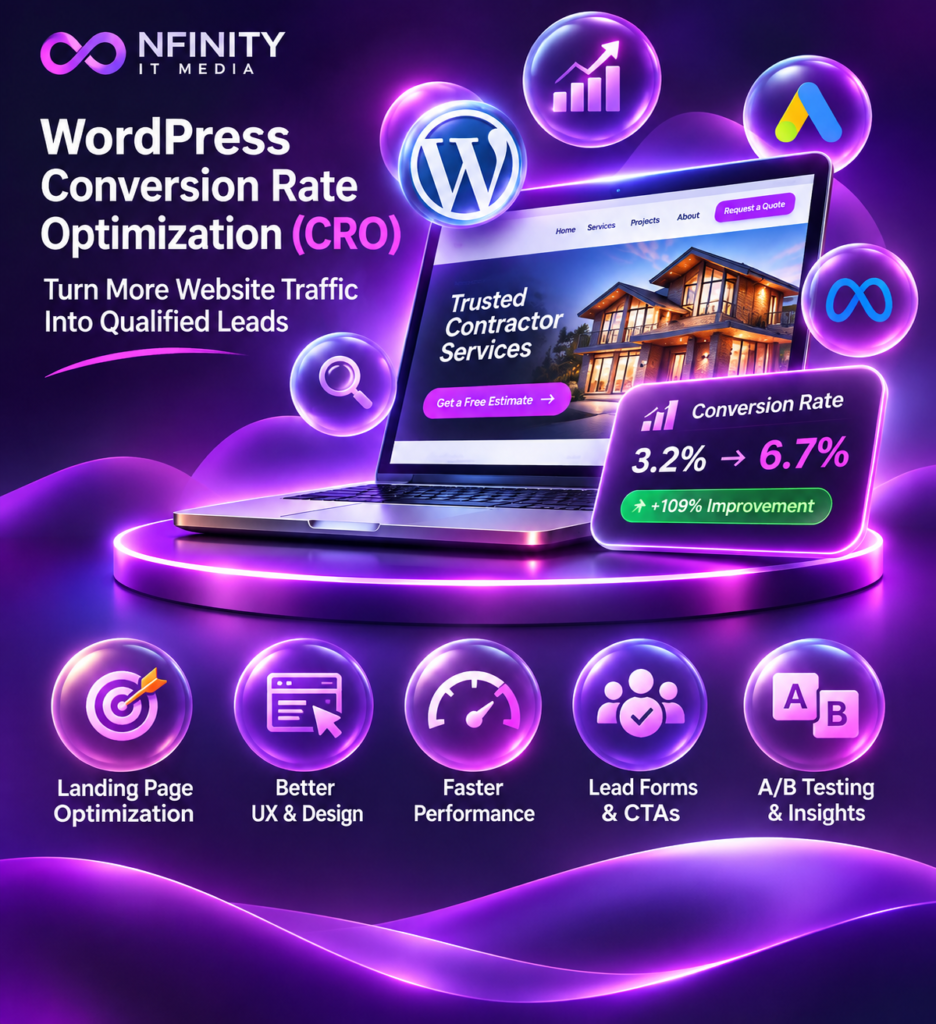
The Website Conversion Moat: Why UX, Trust and Technical Performance Matter
Advertising platforms can change. Search rankings can fluctuate. Competitors can increase their budgets.
But a business can continue improving the website experience it owns.
That makes website conversion rate optimization an important part of a more durable digital marketing strategy.
A strong conversion foundation is built around several connected elements.
Clear Positioning
Visitors should quickly understand what the business offers, who it serves, and why the service is relevant to them.
A vague headline such as “Providing Excellence Through Innovation” communicates little about the actual service.
A more specific heading, such as “Commercial HVAC Installation and Maintenance for Tampa Bay Businesses,” helps the visitor identify the service and market.
Clarity is particularly important for paid traffic because every irrelevant or confusing interaction can represent wasted advertising spend.
Trust and Credibility
Before contacting a business, visitors may evaluate its experience, qualifications, reviews, project examples, service guarantees, and professional presentation.
Trust signals should be authentic and relevant.
A luxury home builder might benefit from detailed project portfolios, architectural photography, and information about its construction process.
An emergency plumbing company may need prominently displayed service availability, licensing details, and customer reviews.
The right trust signals depend on the customer’s perceived risk and the complexity of the purchase.
Mobile Experience
A significant portion of local service research happens on mobile devices.
If visitors struggle to read content, navigate menus, tap phone numbers, or complete forms, the website creates unnecessary friction.
Mobile CRO should consider readable typography, appropriately sized controls, straightforward navigation, accessible forms, and page performance.
Website Speed and Technical Reliability
A visually impressive website can still underperform when it loads slowly or contains technical problems.
Large unoptimized images, excessive scripts, unstable layouts, and broken interactive elements can disrupt the customer journey.
Technical improvements should be based on actual performance diagnostics rather than assuming every website needs a complete rebuild.
Nfinity Media’s technical SEO implementation services address technical website foundations that can influence search accessibility and user experience.
Calls to Action That Match Customer Readiness
Not every visitor is ready to “Buy Now.”
A service business may need different actions for different stages of the journey:
Request an Estimate
Schedule a Consultation
View Recent Projects
Explore Service Options
Speak With Our Team
The goal isn’t to place as many buttons as possible on a page.
It’s to make the most appropriate next step easy to find and understand.
SEO and CRO: Protect Existing Rankings While Improving Conversions
One of the biggest mistakes businesses can make is treating conversion optimization as permission to remove large amounts of existing website content.
A service page may already rank for valuable searches because of its content depth, internal links, headings, geographic relevance, and topical coverage.
Replacing it with a short landing page focused only on a form could unintentionally weaken its search relevance.
SEO-focused CRO should preserve valuable search signals while improving the visitor experience.
That may involve:
Reorganizing existing content rather than deleting it
Improving headings without losing keyword relevance
Adding clearer calls to action within established sections
Strengthening service explanations and project proof
Improving internal navigation
Refining forms and consultation pathways
Optimizing mobile layouts
Preserving valuable URLs and internal links
When larger structural changes are necessary, an SEO-focused website redesign can help address conversion problems while accounting for existing search equity.
The important distinction is that CRO and SEO have overlapping goals but different measurements.
SEO focuses on helping relevant pages become discoverable in search.
CRO focuses on helping relevant visitors take meaningful action after arriving.
Improving conversion rate does not, by itself, guarantee better organic rankings.
How SEO, Google Ads and Meta Ads Can Support One Conversion Journey
Businesses frequently manage SEO, paid search, paid social, and website development as separate activities.
Each channel has its own reports, metrics, and optimization decisions.
But the customer doesn’t necessarily experience these channels separately.
Consider a homeowner planning a major outdoor living renovation.
They may initially discover a landscaping company through an Instagram advertisement. Later, they search Google for patio construction costs, compare local contractors, review project galleries, and eventually submit a consultation request.
That journey may involve multiple marketing touchpoints before the lead is created.
| Channel | Main contribution | CRO opportunity |
|---|---|---|
| Organic SEO | Relevant search visibility | Improve service-page clarity and inquiry paths |
| Google Ads | Capture active search demand | Align advertisements with landing pages |
| Meta Ads | Discovery and audience engagement | Improve creative-to-page continuity and qualification |
| Retargeting | Re-engage eligible prospects | Address objections and provide additional proof |
| Website UX | Help visitors evaluate the business | Reduce friction and strengthen trust |
| Analytics and CRM | Measure actions and outcomes | Identify which leads become real opportunities |
These channels shouldn’t be forced into one identical strategy.
Each has a different role, and not every business needs to invest in all of them simultaneously.
For a broader explanation of channel coordination, see our guide to SEO and Meta Ads for local businesses.
CRO for Contractors and Home Service Businesses
Contractors often compete in markets where one qualified project can represent meaningful revenue.
For these businesses, conversion optimization should reflect the type of service, urgency, project value, and customer decision process.
HVAC, Plumbing and Electrical Services
Urgent service customers may prioritize immediate availability, service coverage, and phone contact.
CRO opportunities include prominent click-to-call buttons, mobile-friendly service pages, concise request forms, and clear information about availability.
For replacement and installation projects, customers may need more detailed service information, financing options, and estimate expectations.
Roofing and General Contractors
Homeowners considering roof replacement or renovation projects often evaluate multiple companies.
Relevant project photographs, materials information, warranties, qualifications, and clear estimate processes can support that evaluation.
Landscaping, Pool Builders and Outdoor Living
Visual presentation can play a major role in the customer journey.
Project portfolios, service categories, design-build explanations, geographic coverage, and realistic project qualification can help attract better-fit inquiries.
Luxury Home Builders and High-Value Services
Higher-value projects often involve longer sales cycles and more detailed comparisons.
These businesses may benefit from consultation-oriented conversion paths, premium positioning, case studies, project-fit information, and a carefully structured qualification process.
Our approach to SEO for high-ticket service businesses explores why commercial relevance, trust, and qualified opportunities matter more than traffic volume alone.
CRO for eCommerce, SaaS and Professional Services
Although contractors provide useful examples, conversion optimization extends well beyond local lead generation.
eCommerce CRO
For Shopify and WooCommerce businesses, the conversion journey may involve product discovery, category navigation, product information, cart experience, shipping expectations, and checkout.
Important optimization areas include product-page clarity, mobile usability, shipping transparency, payment options, trust signals, and checkout friction.
An increase in add-to-cart events doesn’t necessarily indicate better business performance if completed purchases remain unchanged.
SaaS and B2B CRO
SaaS and B2B websites often prioritize demo requests, free trials, consultations, and sales-qualified opportunities.
Visitors may need use cases, integration information, pricing context, implementation details, and proof of business value before converting.
A successful CRO strategy should consider both the initial signup and what happens afterward.
Professional Services CRO
Consultants, agencies, legal service providers, and other professional businesses frequently rely on credibility and relationship-building.
A clear description of expertise, relevant experience, consultation expectations, and contact pathways can make the difference between casual interest and a serious inquiry.
Conversion Tracking: How to Know Whether CRO Is Working
Conversion optimization becomes much more useful when businesses can measure what happens before and after the lead is generated.
A website may record dozens of button clicks without knowing whether those interactions resulted in actual customers.
A more complete measurement strategy connects website behavior with meaningful business actions.
Google Analytics 4
Google Analytics 4 can help businesses evaluate traffic acquisition, landing-page performance, user interactions, and key events.
Useful questions include:
Which landing pages generate meaningful inquiries?
How do organic and paid visitors behave differently?
Which devices or pages have unusually low conversion rates?
Which traffic sources generate the most valuable recorded actions?
Where are visitors leaving the journey?
GA4 data should be interpreted alongside consent settings, attribution limitations, and tracking implementation quality.
Google Tag Manager
Google Tag Manager can help organize supported event tracking without requiring every marketing tag to be manually embedded throughout the website.
Examples include form submissions, consultation bookings, click-to-call interactions, and other relevant website events.
However, a tag firing successfully doesn’t automatically mean the recorded event is accurate.
Testing and validation remain essential.
Google Ads and Meta Conversion Events
Advertising platforms need conversion information that reflects the actions the business actually values.
Tracking every page view as though it were a qualified lead can create misleading performance signals.
Instead, conversion events should be defined around meaningful stages of the customer journey.
CRM and Lead Qualification
A form submission is often only the beginning of a sales process.
Connecting website inquiries with CRM outcomes can help answer more commercially useful questions:
Did the prospect respond?
Was the inquiry relevant?
Did the lead book a consultation?
Was an estimate issued?
Did the opportunity become a customer?
What revenue or value was associated with the outcome?
Businesses should also account for privacy requirements and avoid sending prohibited or unnecessary personal information to advertising platforms.
Conversion Rate vs Cost Per Lead vs Customer Acquisition Cost
CRO performance shouldn’t be evaluated using one metric in isolation.
Three important measurements are conversion rate, cost per lead, and customer acquisition cost.
Conversion rate measures the proportion of visitors who complete a defined action.
Cost per lead (CPL) measures advertising expenditure relative to the number of leads generated.
Customer acquisition cost (CAC) measures the cost of acquiring customers, based on the expenses included in the calculation.
Consider this hypothetical Google Ads scenario:
| Metric | Before optimization | After optimization |
|---|---|---|
| Monthly ad spend | $4,000 | $4,000 |
| Website visits | 1,000 | 1,000 |
| Lead conversion rate | 3% | 5% |
| Leads | 30 | 50 |
| Cost per lead | $133.33 | $80 |
| Qualified lead rate | 50% | 60% |
| Qualified leads | 15 | 30 |
| Cost per qualified lead | $266.67 | $133.33 |
Illustrative scenario with assumed performance improvements; not a forecast or client case study.
The example shows how a higher conversion rate and improved lead quality could change acquisition economics without increasing advertising spend.
Actual results depend on traffic quality, competition, the offer, sales follow-up, measurement accuracy, and customer behavior.
For businesses evaluating search investment more broadly, our SEO ROI calculator provides a framework for exploring how traffic, conversion rates, customer value, and marketing investment interact.
A Practical CRO Audit: What Should You Fix First?
Not every underperforming website needs a redesign, and not every advertising campaign needs a larger budget.
A useful CRO audit begins by identifying the specific problem.
Step 1: Identify Your Highest-Value Traffic Sources
Review the pages and channels already attracting commercially relevant visitors.
Prioritize high-intent service pages, paid landing pages, product pages, and important consultation pathways.
Step 2: Verify Conversion Tracking
Before making major decisions, confirm that forms, calls, purchases, and other important actions are recorded correctly.
Check for duplicate events, missing conversions, broken tags, and misleading reporting.
Step 3: Evaluate Search Intent and Advertisement Alignment
Review whether the page actually delivers what the visitor expected.
A landing page shouldn’t require customers to search for the service or offer that brought them there.
Step 4: Review Mobile Usability and Technical Performance
Test important pages on real mobile devices where possible.
Evaluate loading behavior, forms, navigation, phone links, and interactive elements.
Step 5: Assess Trust and Qualification
Determine whether the page provides enough information for a visitor to make a confident decision.
For high-value services, this may include project examples, qualifications, consultation details, and realistic service expectations.
Step 6: Prioritize Changes by Potential Impact
A broken estimate form deserves attention before a minor button-color experiment.
Likewise, a high-traffic service page with weak conversion performance may deserve attention before a low-traffic informational page.
Prioritization should consider traffic relevance, business value, severity of the issue, and implementation effort.
Step 7: Test, Measure and Refine
Where sufficient traffic and reliable measurement are available, controlled experiments can help evaluate changes.
For lower-traffic businesses, qualitative research, usability testing, session analysis, customer feedback, and carefully monitored improvements may be more practical than relying on statistically weak A/B tests.
Document changes and compare outcomes over appropriate periods, accounting for seasonality and traffic-mix changes.
CRO is an ongoing improvement process, not a one-time website adjustment.
When Should a Business Invest in CRO Instead of More Traffic?
The answer depends on where the current customer acquisition system is underperforming.
If a business has little relevant traffic, improving the conversion rate alone may not create enough opportunities. SEO, advertising, or other acquisition work may still be necessary.
If the website already attracts qualified visitors but generates few inquiries, conversion optimization may deserve immediate attention.
If the business generates plenty of inquiries but very few become customers, the problem could involve lead quality, pricing expectations, qualification, sales processes, or follow-up.
And if tracking is unreliable, improving measurement may be the first priority.
The goal is to identify the actual constraint rather than automatically recommending more SEO, more advertising, or a complete redesign.
Frequently Asked Questions About Conversion Rate Optimization
1. What is conversion rate optimization for SEO?
Conversion rate optimization for SEO involves improving the experience of visitors arriving through organic search. It focuses on relevant landing-page content, usability, trust, calls to action, and conversion pathways that help turn qualified organic traffic into leads or customers.
2. Does CRO improve Google rankings?
CRO does not directly guarantee higher Google rankings. Some improvements, such as better mobile usability, content clarity, and technical performance, can support both search experience and conversions. However, ranking performance and conversion performance should be measured separately.
3. How does CRO help Google Ads campaigns?
CRO can improve the experience after a paid search click by strengthening landing-page relevance, messaging, usability, trust, and lead-capture pathways. Better conversion performance may improve acquisition economics, although results depend on traffic quality and other campaign factors.
4. What is Meta Ads conversion optimization?
Meta Ads conversion optimization involves aligning advertising creative, audiences, offers, landing pages or instant forms, and conversion tracking with meaningful business actions. It also includes evaluating lead quality rather than relying solely on submission volume.
5. Should Facebook Ads use lead forms or website landing pages?
Both can work. Native lead forms reduce friction, while website landing pages provide more room for qualification, service details, and credibility. The right choice depends on the offer, audience, sales cycle, tracking, and quality of the resulting leads.
6. What is a good website conversion rate?
There is no universal conversion rate that applies to every business. Rates vary by industry, traffic source, device, conversion definition, and buying intent. A high-intent service page and an informational article may have very different expectations. Businesses should establish reliable baselines and evaluate conversion quality alongside volume.
7. Can CRO reduce advertising costs?
Improving the proportion of qualified visitors who convert can reduce effective cost per lead or cost per qualified lead when other conditions remain comparable. However, CRO does not guarantee lower CPCs, lower advertising spend, or better campaign results.
8. Do small businesses need CRO?
Yes, although the scope should match the business. A small local service company may benefit from clearer contact information, mobile-friendly forms, stronger service descriptions, and reliable conversion tracking before investing in advanced experimentation.
9. Is website redesign necessary for CRO?
Not always. Many conversion problems can be addressed through focused improvements to existing pages, forms, navigation, content, or tracking. A larger redesign becomes more relevant when the website’s underlying structure or functionality limits meaningful improvement.
10. How do GA4 and Google Tag Manager support CRO?
GA4 helps analyze traffic, events, and user journeys, while Google Tag Manager can support the implementation and management of tracking tags. Together, they can provide useful measurement when events are configured, validated, and interpreted correctly.
11. How long does conversion rate optimization take?
Some technical or usability fixes can be implemented quickly. Reliable evaluation may take longer depending on traffic volume, conversion frequency, sales cycles, and testing requirements. CRO should be treated as a continuous process of identifying, prioritizing, implementing, and measuring improvements.
12. Can SEO, Google Ads and Meta Ads share the same landing page?
Sometimes, but not always. Visitors arriving from different channels may have different expectations and levels of buying intent. Shared pages can work when the offer and audience align, while dedicated landing pages may be more appropriate for distinct campaigns or services.
Turn Your Existing Traffic Into More Valuable Business Opportunities
Your business may already have useful search rankings, established service pages, advertising campaigns, and visitors who are interested in what you offer.
The next opportunity isn’t necessarily to start over.
It may be to improve how those existing assets work together.
At Nfinity Media, we connect SEO, Google Ads, Meta Ads, website UX, technical performance, conversion tracking, and lead generation optimization around the customer journey.
That can mean improving an existing WordPress service page, refining paid advertising landing pages, strengthening mobile conversion pathways, validating GA4 and GTM events, or identifying where qualified prospects are dropping out before contacting the business.
We start by understanding what is already working, what should be preserved, and where a focused improvement could create the most value.
Ready to Improve Your Website’s Conversion Performance?
Schedule a digital growth consultation to review your website, organic search visibility, advertising campaigns, conversion pathways, and lead-tracking setup.
We’ll help identify whether the next priority should be conversion rate optimization, SEO, paid advertising, website improvements, or better measurement — based on your actual business needs.
Explore Nfinity Media’s Digital Growth Services
Better traffic matters. Better conversion matters. The strongest strategy connects both to qualified business opportunities.