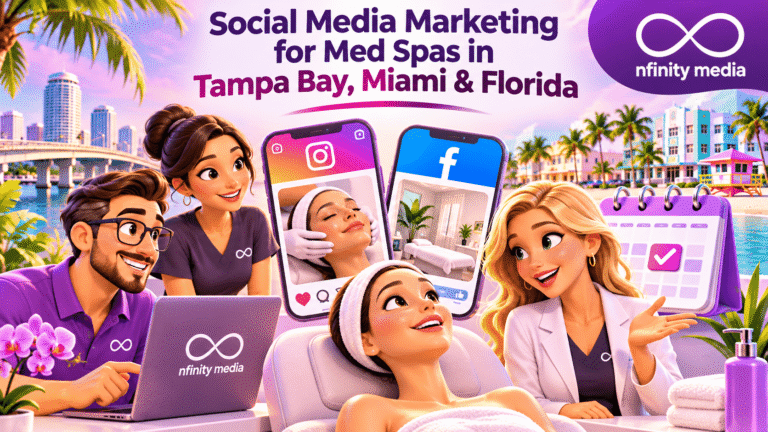
Medical spas invest in Instagram content, Facebook advertising, promotional campaigns, treatment videos, and social media management because they want more than online attention. They want qualified consultations, returning clients, and a reliable appointment pipeline.
Yet many aesthetic clinics experience a frustrating disconnect: their Instagram account looks attractive, Facebook Ads generate inquiries, and their website receives visitors, but the appointment calendar does not reflect that activity.
The problem is not necessarily the advertising platform. It is often the system connecting social media discovery, treatment education, paid Meta Ads, local search visibility, website conversion, and patient follow-up.
At Nfinity Media, we approach med spa social media marketing as a connected acquisition strategy. Facebook and Instagram management establish a consistent presence. Meta Ads introduce treatment services to relevant local audiences. Search engine optimization helps clinics remain discoverable when prospective clients research treatments and providers. Conversion-focused WordPress landing pages and booking systems help turn that interest into meaningful business opportunities.
This guide explains how those components work together, why med spa advertising campaigns sometimes underperform, how much to consider spending, what Instagram posting discipline actually means, and how to measure success beyond followers and low-cost leads.
1. Why Med Spa Social Media Marketing Requires a Different Strategy
Medical spas occupy an unusual position in digital marketing.
They provide appearance-related and sometimes medical services, but customers frequently discover them through visual, lifestyle-oriented platforms such as Instagram and Facebook.
A prospective client may encounter a Reel about a facial treatment, watch a practitioner explain a procedure, examine the clinic’s Instagram profile, compare local providers on Google, read reviews, and finally schedule a consultation.
That process is rarely completed through one advertisement.
Med spa marketing must address several different questions:
Does the clinic offer the treatment the prospective client is researching?
Who performs the procedure, and what are their qualifications?
What should someone expect during the consultation?
Does the clinic appear professional, trustworthy, and established?
Is the location convenient?
Are appointment availability and the next steps clear?
Does the website provide useful treatment information?
Can the prospective client contact the clinic without unnecessary friction?
A successful Facebook and Instagram marketing strategy answers these questions across multiple touchpoints.
This is why simply purchasing Meta Ads traffic or scheduling a few attractive social posts may not produce consistent appointments.
The underlying customer journey needs attention.
2. Social Media Management vs. Meta Ads for Med Spas
Social media management and Meta Ads management are related, but they serve different purposes.
Organic social media management focuses on building and maintaining the clinic’s Facebook and Instagram presence. It includes content planning, publishing, profile optimization, audience engagement, practitioner visibility, and consistent communication.
Meta Ads management focuses on paid advertising through Facebook and Instagram. It includes campaign objectives, audience selection, advertising creative, budget allocation, lead acquisition, testing, and performance optimization.
An aesthetic clinic may need both, but the appropriate balance depends on its existing visibility and business objectives.
| Marketing component | Primary responsibility | Meaningful outcome |
|---|---|---|
| Instagram management | Reels, posts, Stories, treatment education | Trust and engagement |
| Facebook management | Business presence, local content, community communication | Familiarity and inquiries |
| Facebook Ads | Paid reach and consultation campaigns | Qualified leads |
| Instagram Ads | Visual treatment advertising and discovery | Consultation interest |
| WordPress landing pages | Treatment information and conversion | Bookings and inquiries |
| Local SEO | Google Search and Maps visibility | Relevant organic discovery |
| CRM and follow-up | Lead response and appointment management | Confirmed consultations |
The strongest strategy does not assume that every clinic needs the same monthly posting package or advertising budget.
It identifies the weakest part of the acquisition process and improves that component first.
3. Why Facebook and Instagram Ads for Med Spas Sometimes Don’t Work
When a medical spa says its Facebook Ads are not working, the immediate reaction is often to change the audience, increase the advertising budget, or replace the creative.
Those changes may be appropriate, but they do not address every possible problem.
The campaign generates inquiries instead of qualified prospects
Meta’s advertising system can optimize toward measurable events such as form submissions. However, someone who submits a form is not necessarily ready to schedule or purchase a treatment.
An advertisement promoting a broad discount may attract people who are primarily interested in the promotion.
A more specific campaign explaining the treatment, consultation process, clinic location, and relevant expectations may produce fewer inquiries but better-qualified conversations.
Lead quality matters more than lead volume alone.
The advertisement and landing page don’t match
Imagine an Instagram advertisement introducing laser hair removal consultations.
A visitor clicks and reaches a generic homepage containing every service the clinic provides.
The visitor must search for the relevant treatment, find information, and locate the booking option.
That extra work creates unnecessary friction.
A dedicated treatment landing page should continue the conversation started by the advertisement.
The clinic responds too slowly
A prospective client may contact several aesthetic providers during the same research period.
If a lead enters the CRM but nobody responds promptly, the advertising campaign has done its job while the booking process has failed.
Clinics should establish a defined follow-up workflow, appropriate communication permissions, and clear ownership of incoming inquiries.
The creative emphasizes discounts without building trust
A discount may attract attention, but aesthetic treatments often require more consideration than ordinary consumer purchases.
Prospective clients may care about practitioner qualifications, consultation quality, treatment suitability, and the clinic’s professional environment.
Educational creative can help establish these considerations before someone submits an inquiry.
The campaign lacks enough testing
One image, one audience, and one headline provide limited information.
A structured campaign can test practitioner videos, educational explanations, clinic experience content, and different calls to action.
However, testing must be proportional to budget. Dividing a small monthly spend across too many ad sets can make it difficult to learn anything meaningful.
The clinic measures the wrong results
A low cost per lead can look impressive in a dashboard while the actual appointment calendar remains empty.
The correct response is to connect advertising performance with consultation bookings and other business outcomes.
4. Instagram Posting Discipline: Why Consistency Matters for Med Spas
One of the most common social media management problems is inconsistent publishing.
A clinic may post several Instagram Reels during a promotional week, disappear for two weeks, publish a treatment photo, and then resume activity when appointment demand slows.
That approach makes it difficult to build a recognizable content identity or evaluate which subjects attract relevant engagement.
Consistency does not mean publishing constantly.
It means establishing a realistic process that the clinic can maintain.
A practical Instagram posting framework
A med spa could begin with:
Three Instagram feed posts or Reels per week.
Several Stories distributed across the working week.
One practitioner-led educational video each week.
One clinic-experience or frequently asked question feature.
Regular profile, comment, and message reviews.
This is an illustrative operating schedule, not a required Instagram ranking formula. Some clinics can sustain more frequent publishing; others will benefit from a smaller schedule with better production quality.
The objective is to create repeatable content without overwhelming the medical team.
Build content pillars instead of improvising every post
An effective med spa Instagram calendar can organize content around five themes.
Treatment education: Explain what a treatment involves, how consultations work, and what questions clients commonly ask.
Practitioner expertise: Introduce qualified providers and explain their roles, training, and approach.
Clinic experience: Show the environment, appointment process, technology, and service standards.
Patient questions: Address common concerns with accurate, professionally reviewed information.
Booking guidance: Explain how to schedule a consultation, what to prepare, and how the clinic evaluates treatment suitability.
These pillars provide enough variety to maintain interest without turning every Instagram post into a sales promotion.
Batch content production
A med spa does not need to film every day.
A planned monthly content session can capture practitioner introductions, educational answers, treatment-room footage, and general clinic visuals.
Content can then be edited into several Reels, Stories, and feed posts.
This reduces operational interruptions and helps the clinic maintain a consistent visual identity.
Evaluate Instagram performance beyond likes
Useful measures include profile visits, relevant website visits, saves, shares, qualified messages, booking-link interactions, and consultations associated with social media.
Follower growth can provide context, but it should not be the only measure of progress.
A smaller local audience interested in the clinic’s services may be more commercially valuable than a much larger audience outside its service area.
5. Instagram SEO and Social Discovery Signals for Medical Spas
Instagram visibility is not determined by one universal ranking factor.
Different discovery surfaces, including Search, Explore, Reels, and the home feed, use different recommendation and relevance systems.
For med spas, practical optimization begins with helping both users and the platform understand what the account represents.
Optimize the Instagram profile
The account name, username, biography, category, and visible service information should communicate the clinic’s identity clearly.
A useful biography can describe the clinic’s location, general treatment focus, and consultation pathway without making unsupported claims.
The booking link should lead to a relevant, mobile-friendly destination.
Use descriptive captions
A caption explaining a laser treatment consultation provides more context than a generic caption such as “Another beautiful day at the spa.”
Treatment names, relevant terminology, and geographic context can be incorporated naturally.
However, repeatedly inserting the same city and service keywords does not guarantee better Instagram discovery.
Make Reels useful
Reels that answer real questions can serve as ongoing educational resources.
Examples include:
What happens during an initial aesthetic consultation?
How does a clinic evaluate treatment suitability?
What questions should clients ask about laser treatments?
How should clients prepare for a skincare consultation?
What should someone know about treatment recovery discussions?
Qualified providers should review medical information before publication.
Improve the content experience
Clear video framing, readable captions, useful explanations, and strong opening context make content easier to understand.
The aim is not to manipulate a ranking algorithm. It is to create material that prospective clients find useful enough to watch, save, share, or explore further.
Connect Instagram to Google discovery
Instagram content may introduce the clinic, but prospective clients can subsequently search Google for its name, location, reviews, or treatments.
This makes consistent business information and a well-developed website important.
Instagram activity should complement local SEO, not replace it.
6. Facebook Social Media Management for Aesthetic Clinics
Instagram receives considerable attention in the aesthetics industry, but Facebook can still contribute to a med spa’s local marketing system.
A professionally maintained Facebook page can provide business information, educational posts, service updates, and another communication channel.
For clinics serving established local communities, Facebook may also support awareness through relevant local engagement.
A Facebook management strategy should include accurate contact details, a consistent business identity, useful service descriptions, and a clear appointment destination.
Posts can introduce practitioners, explain clinic services, highlight educational resources, and communicate appropriate events or announcements.
Facebook content should not simply be treated as an automatic copy of every Instagram post.
Some content can be shared across both platforms, but formatting, captions, and calls to action may benefit from adjustments.
For paid campaigns, Facebook and Instagram can be managed through Meta’s advertising platform, allowing coordinated creative and performance evaluation.
7. Meta Ads Campaign Strategy for More Med Spa Bookings
A med spa Meta Ads strategy should begin with the business objective.
Is the clinic trying to introduce a new service, increase consultation volume, fill available appointment capacity, or acquire clients for a specific treatment category?
Each objective can require a different campaign structure.
Treatment awareness campaigns
These campaigns introduce the clinic’s services to relevant audiences.
Creative may focus on practitioner education, clinic experience, and an explanation of the consultation process.
The immediate objective is not necessarily an appointment. It may be to generate informed interest.
Consultation acquisition campaigns
These campaigns provide a clearer conversion opportunity.
The advertisement explains the relevant service and invites prospective clients to request information or schedule a consultation.
The destination should support that action without unnecessary steps.
Creative testing
Testing can compare:
Practitioner-led educational videos.
Treatment explanation graphics.
Clinic environment photography.
Consultation process videos.
Different informational headlines.
Appropriate appointment calls to action.
Performance should be evaluated using meaningful downstream outcomes whenever available.
Local audience strategy
A medical spa generally needs clients who can realistically visit its location.
Campaign geography should reflect the clinic’s actual market, not simply the largest audience available.
Targeting decisions also need to comply with Meta’s advertising policies, including applicable age and sensitive-category restrictions.
Ongoing optimization
Campaign management should include reviewing lead quality, creative performance, budget distribution, conversion paths, and booking feedback.
The goal is not to make changes every day for the sake of activity.
It is to identify patterns and make informed adjustments.
8. How Much Should Med Spas Spend on Facebook and Instagram Ads?
There is no universal advertising budget that works for every medical spa.
A clinic’s budget should reflect its treatment economics, market competition, appointment capacity, existing conversion performance, and ability to respond to inquiries.
For planning purposes, consider these illustrative monthly media-spend scenarios, excluding management fees and creative production.
| Monthly ad spend | Planning approach |
|---|---|
| $750–$1,500 | Focused initial test with limited campaign complexity |
| $1,500–$3,000 | More room for creative testing and one or two treatment priorities |
| $3,000–$6,000 | Broader testing across established treatment categories |
| $6,000+ | Potential for multiple campaign initiatives, subject to performance and clinic capacity |
These are example planning bands, not market benchmarks, minimum requirements, or promises of results.
Calculate what an appointment is worth
Before increasing spend, the clinic should understand its approximate economics.
Suppose a campaign spends $2,000 and produces 40 inquiries.
The cost per lead is:
$2,000 ÷ 40 = $50
If 12 of those inquiries become booked consultations, the cost per booked consultation is:
$2,000 ÷ 12 = $166.67
If eight appointments are attended, the cost per attended consultation becomes:
$2,000 ÷ 8 = $250
Those are three very different measurements of the same campaign.
The clinic must then consider how many attended consultations become paying clients, the contribution margin of the services purchased, and the likelihood of repeat visits.
A $50 lead is not automatically profitable. A more expensive lead is not automatically unprofitable.
Avoid increasing budget before fixing conversion problems
If the clinic receives inquiries but fails to respond promptly, spending more money may simply create more missed opportunities.
Similarly, a confusing booking page can reduce the value of additional traffic.
Before scaling, evaluate lead quality, contact rate, consultation booking rate, attendance, and the actual client acquisition cost.
9. Meta Instant Forms vs. WordPress Landing Pages for Med Spas
Facebook and Instagram campaigns can generate leads through Meta Instant Forms or send visitors to a website.
Both approaches have advantages.
Meta Instant Forms
Instant Forms can reduce friction because users can submit information without leaving the platform.
They may be useful when the clinic wants a straightforward consultation inquiry process.
However, forms that are too easy to submit can sometimes generate inquiries from people with limited purchase intent.
Appropriate qualifying questions and clear expectations may help.
Dedicated WordPress landing pages
A treatment-specific landing page provides more room to explain the service and establish credibility.
It can include practitioner information, consultation expectations, frequently asked questions, clinic location, and a booking option.
The page should load quickly, work well on mobile devices, and maintain consistency with the advertisement.
Which should a clinic choose?
The decision should depend on observed lead quality and booking outcomes.
A useful test might compare Instant Forms against a dedicated landing page while keeping campaign objectives and creative reasonably consistent.
The winning approach is not necessarily the one with the lowest form-submission cost.
It is the one that produces qualified consultations at sustainable acquisition costs.
10. Why Med Spa Websites Lose Facebook and Instagram Advertising Leads
A med spa may have a polished website but still struggle to convert paid social visitors.
Common problems include:
Generic landing destinations: Visitors interested in one treatment arrive at a homepage with no clear next step.
Poor mobile usability: Important information is difficult to read, buttons are small, or booking forms require too much effort.
Insufficient provider information: Prospective clients cannot easily understand who performs the service.
Weak treatment explanations: The page lists treatment names but does not answer basic questions.
Confusing calls to action: Several competing buttons lead to different forms or scheduling systems.
Slow page performance: Large images, scripts, and unnecessary effects delay the mobile experience.
Unclear follow-up expectations: The visitor submits a request without knowing what happens next.
Nfinity Media’s WordPress, technical SEO, and conversion optimization capabilities allow these issues to be addressed as part of the advertising strategy.
A successful campaign should be evaluated across the complete journey from advertisement to consultation.
11. Med Spa SEO and Meta Ads: Why Search Visibility Still Matters
Facebook and Instagram advertising can introduce a clinic to prospective clients who are not actively searching for its services.
Google Search and Maps serve a different but complementary purpose.
Someone researching a treatment may search for a provider in their city, compare clinics, review credentials, or look for information about a specific service.
This is why med spa SEO and Meta Ads should not be treated as competing marketing channels.
Important med spa SEO signals
A comprehensive med spa SEO strategy should consider:
Treatment-page relevance: Dedicated, useful pages explaining the clinic’s actual services.
Local relevance: Accurate business information, appropriate location targeting, and Google Business Profile optimization.
Professional credibility: Clear provider qualifications, trustworthy medical information, and appropriate authorship or review.
Website structure: Logical navigation, descriptive internal links, and relevant supporting content.
Technical accessibility: Crawlable pages, appropriate canonical signals, mobile usability, and sound indexing practices.
Reputation: Authentic reviews and consistent business information.
Conversion experience: Clear booking paths and useful treatment information that support the visitor’s decision.
These elements contribute in different ways. Not all are direct Google ranking factors, and no individual checklist guarantees placement.
Why internal linking matters
A med spa website may have separate pages for laser treatments, skin services, consultation information, and local service areas.
Contextual internal links help visitors navigate those topics and help search engines discover related pages.
The same principle applies to Nfinity Media’s own service architecture.
Our broader med spa SEO and website strategy addresses search visibility and conversion infrastructure, while this article focuses on Facebook, Instagram, and paid Meta Ads.
Together, they explain how social discovery and search-driven acquisition can support the same business objectives.
12. Med Spa Marketing in Los Angeles: Instagram Competition and Local SEO
Los Angeles presents a particularly visual and competitive environment for aesthetic marketing.
A clinic may compete for attention through practitioner-led Instagram content, lifestyle-oriented creative, local Facebook advertising, and treatment-specific search results.
The challenge is not simply producing attractive content.
It is demonstrating why the clinic is relevant to the prospective client’s treatment interests and geographic preferences.
For Los Angeles med spas, useful Facebook and Instagram content can include practitioner introductions, treatment education, clinic experience, and clear consultation information.
Paid Meta Ads should align with the clinic’s actual service area and available appointment capacity.
Organic search provides an additional discovery path for people actively comparing providers.
Our Los Angeles med spa SEO strategy explores the search-focused side of building visibility for aesthetic clinics in this market.
The combined objective is to create a recognizable local presence that works across Instagram, Facebook, Google, and the clinic’s website.
13. New York Med Spa Marketing: Combining Meta Ads With Search Intent
New York med spas may face different competitive dynamics depending on the borough, neighborhood, treatment specialization, and clinic positioning.
A broad New York City advertising campaign is not automatically more effective than one aligned with a realistic patient catchment area.
Facebook and Instagram campaigns should consider convenience, treatment relevance, practitioner credibility, and consultation availability.
Organic social media can reinforce these messages through consistent educational content.
Search visibility remains important because prospective clients may compare multiple clinics before booking.
Our SEO for med spas in New York page addresses the local organic-search component.
For clinics combining Meta Ads with SEO, the practical opportunity is to create consistent messaging across both channels.
A prospective client who discovers a provider on Instagram should encounter the same clinic identity, treatment information, and professional credibility when visiting its website through Google.
14. Miami Med Spa Marketing: Facebook, Instagram, and Treatment Discovery
Miami is another market where visual branding and aesthetic treatment marketing can play an important role.
However, high-quality photography alone does not establish a complete acquisition strategy.
A med spa needs relevant treatment information, clear provider credentials, a convenient booking experience, and consistent communication.
Instagram can support treatment education, practitioner visibility, and clinic storytelling.
Facebook advertising can help introduce services to relevant local audiences, while treatment-focused landing pages support consultation requests.
Miami-area clinics should also account for the geographic differences between neighborhoods and surrounding service areas rather than assuming that every campaign should target the same broad region.
Nfinity Media’s Miami med spa SEO services address the search visibility and local website strategy that can complement Facebook and Instagram advertising.
A coordinated approach can help clinics avoid fragmented campaigns where the social content, paid advertisements, and website communicate different messages.
15. Tampa Bay Med Spa Marketing: Consistent Content and Local Discovery
Tampa Bay med spas serve a geographically varied market that includes Tampa, St. Petersburg, Clearwater, and surrounding communities.
For a clinic, the most useful social media audience is not necessarily the largest one.
It is the audience with a realistic likelihood of visiting the location and considering its services.
An effective Tampa Bay Facebook and Instagram strategy can combine practitioner-led educational content, a manageable posting calendar, locally relevant advertising, and clear appointment pathways.
The clinic’s Google presence should reinforce the same services and location information.
Our Tampa Bay SEO services discuss the broader local search architecture used for service businesses, including medical spas.
For Tampa-area aesthetic clinics, the opportunity is to coordinate local discovery rather than treating Instagram engagement, Facebook advertising, and Google rankings as unrelated activities.
16. Treatment-Specific Instagram and Facebook Campaigns
Not every med spa treatment should be promoted through the same advertisement.
Different services involve different customer questions, consultation requirements, treatment considerations, and economic value.
Facial and skin rejuvenation services
Educational content can explain the consultation process, available treatment categories, and how providers evaluate suitability.
Instagram Reels may be useful for practitioner explanations and clinic experience content.
Laser hair removal
Campaigns can explain the service, treatment planning, consultation requirements, and appointment process.
Landing pages should answer relevant questions without promising identical outcomes for every client.
Chemical peels and skincare services
Organic Instagram content can provide general education about service categories, professional assessment, and clinic protocols.
Paid campaigns should use accurate, appropriately reviewed claims.
Injectable-treatment consultations
Advertising must be reviewed carefully because cosmetic procedures and prescription products can involve different policy and regulatory requirements.
Clinics should avoid assuming that permission to advertise a general cosmetic consultation automatically permits promotion of every prescription brand or product.
Body treatments
Creative should focus on accurate service information, appropriate consultation expectations, and professional care rather than appearance-shaming language or unrealistic transformations.
For all treatment categories, the campaign must reflect services the clinic actually provides and the qualifications of the professionals involved.
17. Meta Ads Compliance for Medical Spas
Medical spa advertising requires careful review of platform policies, privacy obligations, medical claims, and patient consent.
Meta’s health and wellness advertising standards apply restrictions to cosmetic procedures and appearance-related advertising.
For example, cosmetic procedure advertisements generally require adult audiences. Advertising must also avoid prohibited personal-attribute implications, appearance-shaming messages, and unrealistic outcome claims.
Some cosmetic before-and-after creative may be permitted under current Meta standards, but eligibility depends on the content, treatment, audience, and other applicable rules.
A clinic should not rely on outdated assumptions that every before-and-after image is automatically prohibited—or that every such image is automatically acceptable.
Practical creative review
Before publishing, evaluate:
Whether the advertisement accurately describes the service.
Whether claims are supported and appropriately qualified.
Whether the audience meets applicable age restrictions.
Whether patient images and testimonials have appropriate authorization.
Whether the creative implies an unwanted condition or personal characteristic.
Whether prescription-product restrictions apply.
Whether the landing page is consistent with the advertisement.
Whether tracking and lead collection respect privacy requirements.
Medical spas should also obtain appropriate legal and clinical review for regulated claims.
18. Meta Pixel, Conversion Tracking, and Patient Privacy
Measurement is essential for evaluating advertising performance, but med spa tracking requires additional care.
Meta Pixel, Conversions API, analytics tools, and CRM integrations should not be configured in ways that improperly disclose protected or sensitive health information.
Treatment-specific page visits, form fields, appointment details, and event parameters may create privacy risks depending on how data is collected and transmitted.
A compliant measurement plan should begin with a review of the clinic’s obligations and the information that advertising platforms are permitted to receive.
Where appropriate, reporting can focus on aggregate campaign outcomes and properly configured conversion events without transmitting sensitive patient details.
The objective is to understand advertising effectiveness without compromising privacy.
19. Turning Facebook and Instagram Leads Into More Booked Appointments
Advertising is only the beginning of the booking process.
A clinic that receives inquiries needs a reliable operational workflow.
Establish a clear response process
Assign responsibility for reviewing new inquiries during business hours.
Define how leads are contacted, what information can be requested, and when a consultation should be offered.
Connect forms to the appropriate system
Lead forms and website inquiries should reach the staff or CRM responsible for scheduling.
Avoid situations where inquiries remain in an advertising dashboard without being reviewed.
Set expectations
Prospective clients should understand whether they are requesting a callback, booking an appointment, or submitting an initial consultation inquiry.
Clear expectations reduce confusion.
Track meaningful stages
Useful stages may include:
New inquiry received.
Contact attempted.
Qualified conversation.
Consultation scheduled.
Appointment attended.
New client acquired.
Returning client, where appropriately measurable.
This structure helps identify whether the primary weakness lies in advertising, lead quality, follow-up, or booking conversion.
Review reasons appointments are not booked
A clinic may discover that inquiries are unsuitable because of distance, treatment expectations, availability, or pricing.
Those insights can inform better advertising messages and landing-page content.
The aim is to improve the system rather than simply increasing campaign spend.
20. A 90-Day Med Spa Social Media and Meta Ads Improvement Plan
A practical strategy benefits from defined milestones.
Days 1–30: Audit and establish the foundation
Review the Facebook and Instagram accounts, current advertising campaigns, website performance, treatment priorities, and booking process.
Identify gaps in profile information, content consistency, creative quality, landing pages, and lead handling.
Develop a realistic publishing calendar and define baseline performance measures.
Days 31–60: Launch and test
Begin a manageable Instagram and Facebook content schedule.
Test a limited number of Meta Ads creative concepts and campaign approaches.
Improve relevant landing pages and verify that inquiries reach the correct booking workflow.
Review early engagement and lead quality without making premature conclusions from small samples.
Days 61–90: Refine and connect channels
Compare campaign performance against consultation outcomes.
Identify content topics that generate meaningful engagement.
Improve weak booking steps, refresh creative where necessary, and coordinate social content with the clinic’s SEO and website strategy.
Determine whether additional advertising investment is justified by the observed results.
A 90-day plan creates a structured evaluation period. It does not guarantee a particular number of leads, appointments, or revenue.
21. How to Measure Med Spa Social Media Marketing Success
A useful performance report should separate visibility metrics from commercial outcomes.
Visibility metrics include reach, impressions, video views, profile visits, and relevant engagement.
Traffic metrics include website visits, landing-page engagement, and booking-link interactions.
Acquisition metrics include qualified inquiries, contact rates, consultation bookings, appointment attendance, and new-client acquisition.
Business metrics may include acquisition cost, treatment revenue, contribution margin, repeat visits, and customer value where accurate data is available.
For organic search, Google Search Console can provide information about search impressions, clicks, queries, and pages.
For Facebook and Instagram, Meta’s reporting tools provide campaign and content performance information.
For actual appointments, the clinic’s scheduling and CRM systems provide essential context.
No single dashboard should be treated as a complete representation of the customer journey.
22. The Nfinity Media Advantage: Social Media, Meta Ads, SEO, and WordPress Together
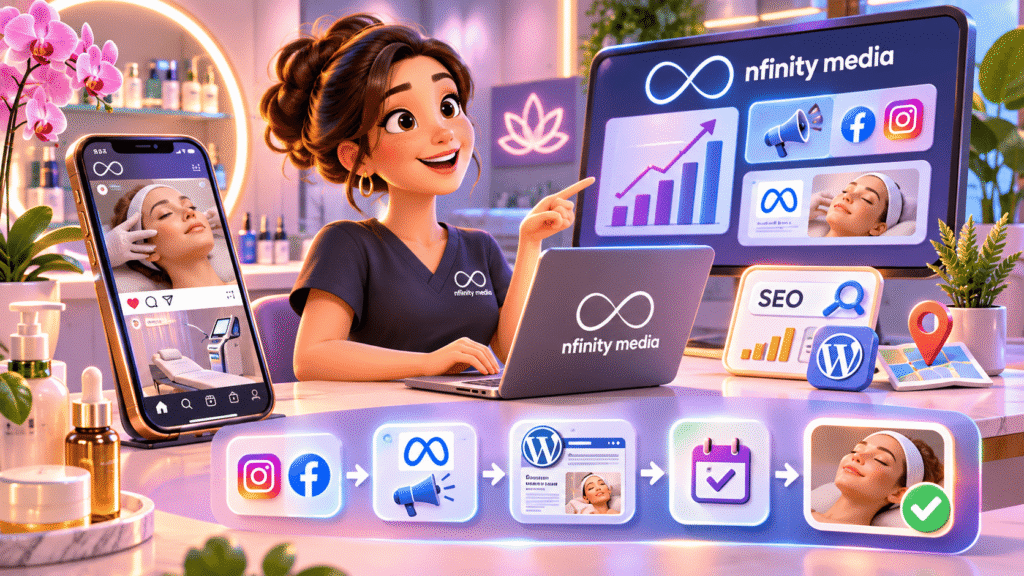
A social media agency may focus primarily on posting schedules.
A paid advertising agency may focus on campaigns and cost per lead.
A website agency may focus on design and development.
Nfinity Media can connect these disciplines into a more complete digital growth strategy.
Our approach considers:
Facebook and Instagram management: Consistent content planning, profile positioning, and useful audience communication.
Meta Ads campaign strategy: Treatment-specific advertising, creative testing, budget allocation, and performance evaluation.
WordPress development: Relevant landing pages, mobile usability, technical improvements, and booking pathways.
Conversion rate optimization: Reducing friction between advertising clicks and consultation requests.
Local SEO: Helping the clinic remain discoverable when prospective clients search Google for services and providers.
Measurement and follow-up: Connecting marketing activity to qualified inquiries and appointments while respecting applicable privacy requirements.
This integrated approach is particularly useful when a clinic already invests in several marketing channels but lacks coordination between them.
Instead of treating each platform as an isolated project, we evaluate how the entire system supports patient acquisition.
23. Frequently Asked Questions About Med Spa Facebook and Instagram Marketing
How often should a med spa post on Instagram?
A sustainable schedule matters more than an arbitrary posting target. Many clinics can begin with several quality posts or Reels per week and regular Stories, then adjust based on resources and performance.
Is Instagram better than Facebook for med spa marketing?
Instagram is well suited to visual content and practitioner-led education. Facebook can support local presence, community communication, and paid reach. The right balance depends on the clinic’s audience and objectives.
How much should a med spa spend on Meta Ads?
Budget depends on treatment economics, local competition, clinic capacity, and conversion performance. Start with a focused test budget that can be evaluated responsibly before scaling.
Why do Facebook Ads generate leads but not appointments?
Possible causes include weak qualification, unclear advertising messages, slow follow-up, poor landing pages, and scheduling friction. The complete lead-to-booking process should be reviewed.
Do Instagram followers help a med spa get more bookings?
Followers can provide an audience for ongoing communication, but follower count alone does not establish commercial value. Local relevance, engagement quality, and booking outcomes matter more.
Should med spas use Instagram Reels for marketing?
Reels can be useful for practitioner introductions, treatment education, and clinic experience content. They should be accurate, professionally reviewed where needed, and relevant to prospective clients.
Can Meta Ads and Google SEO work together?
Yes. Paid social can introduce the clinic, while search visibility helps prospective clients research treatments and providers. Consistent website content and branding support both channels.
Are before-and-after photos allowed in med spa Facebook Ads?
Certain cosmetic before-and-after advertisements may be permitted under current Meta policies, subject to restrictions. The treatment, creative, claims, audience, patient authorization, and applicable law must be reviewed.
Should med spas use Facebook Instant Forms or website landing pages?
Both can be tested. Instant Forms simplify inquiries, while landing pages provide more treatment context. Compare qualified consultations rather than form submissions alone.
What is included in med spa social media management?
Depending on the agreed scope, services may include profile optimization, content strategy, publishing, Reels planning, creative coordination, engagement management, and reporting. Paid advertising and production services may be scoped separately.
How long does it take to improve med spa social media performance?
Results vary. Content consistency and profile improvements can begin immediately, while meaningful patterns in engagement, lead quality, and appointments require sufficient activity and measurement.
Does Instagram activity directly improve Google rankings?
Instagram posting is not a direct substitute for Google SEO. However, social discovery can introduce the business to prospective clients who later search for the clinic. Website and local SEO must be developed independently.
What is the most important metric for med spa Facebook Ads?
There is no single metric for every campaign, but qualified consultation and client acquisition outcomes are generally more commercially useful than impressions or raw lead volume alone.
Can Nfinity Media support both Meta Ads and med spa website SEO?
Yes. Our service approach can connect Facebook and Instagram advertising with WordPress landing pages, technical SEO, local search strategy, and conversion optimization according to the clinic’s needs.
24. Build a Med Spa Marketing System That Produces More Than Social Media Activity
A successful med spa marketing strategy should not depend entirely on the next Instagram Reel, Facebook promotion, or advertising campaign.
It should create a connected experience in which prospective clients can discover the clinic, understand its services, evaluate its credibility, and take the next step toward a consultation.
Consistent social media management helps establish familiarity.
Facebook and Instagram Ads create paid opportunities for discovery and acquisition.
Search engine optimization supports treatment research and local visibility.
WordPress landing pages and booking workflows help convert interest into appointments.
And meaningful reporting shows which parts of the system are producing results.
Nfinity Media helps med spas connect these components through an integrated approach to social media management, Meta Ads, SEO, website performance, and conversion optimization.
Ready to Improve Your Med Spa’s Facebook, Instagram, and Appointment Strategy?
Let’s review your current social media presence, advertising campaigns, treatment priorities, website, and booking process.
The goal is to identify what already works, what should be preserved, and where a more coordinated strategy could create the greatest value.
Schedule a Med Spa Digital Growth Consultation with Nfinity Media.