A potential customer searches Google for a roofing contractor. Another discovers a backyard renovation project while scrolling through Instagram. A third visits a company’s website, compares its services, and returns several days later after seeing an advertisement on Facebook.
These customers may ultimately contact the same business, but their journeys begin in different places.
For local businesses, this creates an important marketing challenge: How do you connect organic search visibility with paid social advertising to attract qualified customers without treating every marketing channel as an isolated campaign?
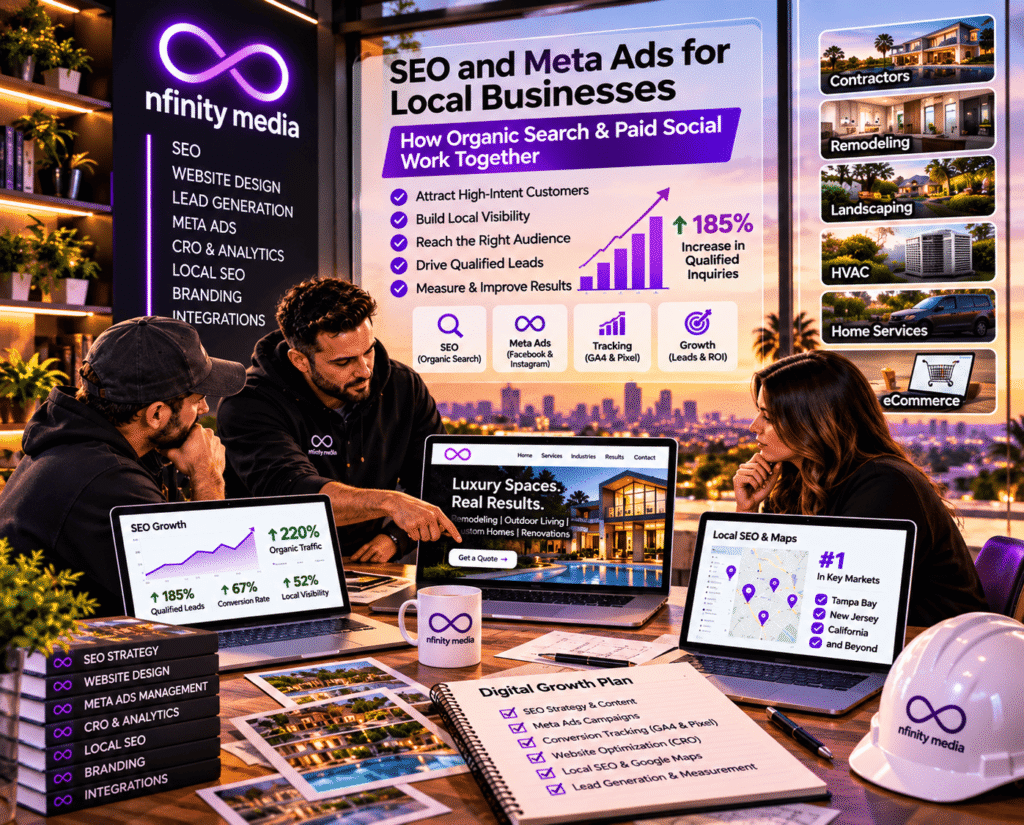
Search Engine Optimization (SEO) and Meta Ads serve different purposes. SEO helps businesses become discoverable when people actively search for products, services, and answers. Meta Ads allow businesses to reach selected audiences across Facebook and Instagram, introduce services, showcase projects, and encourage prospective customers to take action.
When coordinated effectively, these channels can support a more complete customer acquisition strategy.
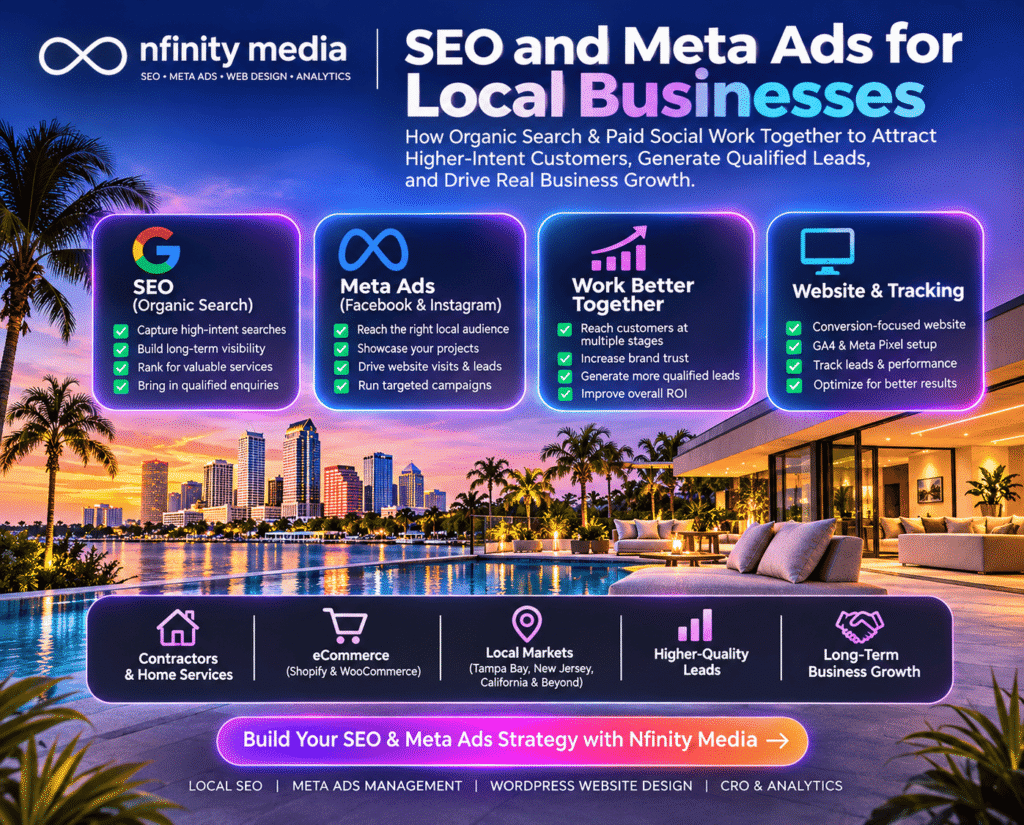
At Nfinity Media, we approach SEO, Meta Ads, website optimization, and conversion tracking as connected components of digital growth rather than unrelated marketing activities.
This guide explains how local businesses can combine organic search and paid social, when each channel makes sense, and how to measure the results that matter.
1. Understanding the Difference Between SEO and Meta Ads
Although SEO and Meta Ads can contribute to lead generation, they operate through different discovery mechanisms.
SEO: Reaching Customers Who Are Already Searching
Search Engine Optimization focuses on improving a website’s visibility in relevant organic search results.
For local service businesses, SEO commonly involves:
-
Technical website optimization and crawlability.
-
Google Business Profile optimization.
-
Service-specific landing pages.
-
Geographic and location-based content.
-
Keyword research and search intent analysis.
-
Internal linking and website architecture.
-
Helpful informational content.
-
Website performance and user experience.
For example, a homeowner searching for “roof replacement Los Angeles” is expressing a specific service need.
A roofing contractor with a relevant, helpful landing page has an opportunity to appear in organic search results and earn an inquiry.
Similarly, an HVAC company targeting “AC repair Tampa Bay” may benefit from a combination of Google Maps visibility, locally relevant service pages, and a website that makes requesting service straightforward.
SEO is particularly useful when customers already know what they need and actively search for a provider.
Meta Ads: Reaching Potential Customers Through Facebook and Instagram
Meta Ads operate primarily through paid audience delivery across platforms such as Facebook and Instagram.
Businesses can use these campaigns to introduce services, showcase completed work, communicate offers, and encourage inquiries.
Depending on the campaign objective, Meta Ads may support:
-
Brand awareness.
-
Lead generation.
-
Website visits.
-
Customer engagement.
-
Sales and conversions.
-
Remarketing to eligible audiences.
-
Promotion of specific services or offers.
For example, a landscaping contractor may showcase a completed outdoor kitchen installation to homeowners interested in improving their outdoor living spaces.
These customers may not have searched for a contractor that day, but the advertisement can introduce a relevant service and encourage further consideration.
The distinction is important: SEO primarily helps capture existing search demand, while Meta Ads can help reach and influence potential customers before or during their buying journey.
Neither channel automatically produces qualified leads. Results depend on targeting, competition, campaign execution, website experience, and the quality of the underlying offer.
2. Why SEO and Meta Ads Work Better as a Coordinated Strategy
A common digital marketing mistake is evaluating each channel without considering the wider customer journey.
An SEO specialist may focus exclusively on keyword rankings and organic traffic.
A paid social manager may focus on impressions, cost per click, or leads generated inside Meta’s advertising platform.
Meanwhile, the business owner wants to know something more practical:
Which marketing activities are helping us attract the right customers and generate profitable opportunities?
A coordinated approach connects these measurements.
SEO Supports High-Intent Discovery
Organic search can introduce customers to a business when they research a specific service, compare providers, or investigate a problem.
Useful service pages help visitors understand what the company offers and whether it meets their requirements.
Meta Ads Support Awareness and Consideration
Paid social campaigns can introduce services to relevant audiences, highlight completed projects, and encourage potential customers to learn more.
For visually oriented businesses such as landscaping, remodeling, and outdoor living, project photographs and videos can communicate capabilities that are difficult to demonstrate through text alone.
Website UX Connects Both Channels to Conversions
Regardless of whether a visitor arrives from Google or Instagram, the website needs to support the next step.
Clear service information, mobile usability, authentic project evidence, accessible contact options, and effective landing pages can help turn interest into inquiries.
Conversion Tracking Connects Activity to Results
Without accurate measurement, businesses may struggle to understand how organic search and paid social contribute to customer acquisition.
A coordinated tracking framework helps identify where leads originate, which campaigns generate meaningful actions, and where website improvements may be needed.
The goal is not simply to increase activity across two platforms. It is to make both channels contribute to measurable business objectives.
3. When Should a Local Business Prioritize SEO Over Meta Ads?
SEO may deserve greater initial emphasis when a business serves an established market with consistent, high-intent search demand.
Examples include:
-
Emergency plumbing repairs.
-
HVAC repair and installation.
-
Roof replacement.
-
Electrical panel upgrades.
-
Foundation repair.
-
Local professional services.
-
Home remodeling and construction.
Customers searching for these services often have a defined need.
A well-structured website can help the business compete for relevant searches while supporting long-term organic visibility.
Situations Where SEO May Be the Stronger Starting Point
SEO may be especially appropriate when:
-
Customers regularly search Google for the business’s services.
-
The website lacks dedicated pages for important offerings.
-
Existing pages receive impressions but have weak visibility or click-through rates.
-
Google Business Profile information needs improvement.
-
Technical issues limit indexing, usability, or performance.
-
The business wants to develop an organic acquisition channel over time.
However, SEO generally requires sustained effort, and improvements may take time to appear.
A new business that needs immediate inquiries may need to combine organic improvements with carefully managed paid campaigns.
4. When Should a Business Prioritize Meta Ads?
Meta Ads can be particularly useful when services are visually appealing, require customer education, or benefit from reaching people before they actively search.
Consider a contractor specializing in outdoor kitchens, custom patios, or luxury home renovations.
A homeowner may not be actively searching for a contractor, but an advertisement showcasing a completed project can introduce an idea and encourage future research.
Services That May Benefit From Paid Social
Depending on audience fit and campaign economics, opportunities may include:
-
Landscaping and outdoor living.
-
Home remodeling and renovation.
-
Custom home construction.
-
Interior design.
-
Pool installation and renovation.
-
Selected HVAC installation or upgrade offers.
-
eCommerce products.
-
Local businesses promoting seasonal services.
Meta Ads can also support remarketing where permitted and properly configured.
For example, an eligible visitor who explored a remodeling service page but did not submit an inquiry may later encounter a relevant advertisement.
Businesses must follow applicable privacy requirements, consent rules, and Meta’s advertising policies when using tracking and audience data.
Meta Ads should not be treated as a substitute for a useful website or a credible service offering. Paid traffic directed toward confusing or poorly designed landing pages can waste advertising budgets.
5. SEO and Meta Ads for Contractors: Different Trades, Different Customer Journeys
Contractor marketing is a useful example of why combining SEO and paid social requires more than a universal campaign template.
An emergency HVAC service company and a luxury outdoor living contractor may both benefit from digital advertising, but their customers behave differently.
HVAC Contractors: Capture Urgent Demand and Promote Planned Upgrades
HVAC businesses frequently serve customers with immediate repair needs.
Searches such as “AC repair near me” or “emergency HVAC repair” often indicate strong intent.
For these services, local SEO, Google Maps, and search-oriented advertising can be especially important.
Meta Ads may be more appropriate for planned purchases and services, such as system replacements, maintenance programs, or seasonal offers.
The marketing strategy should distinguish emergency demand from longer-consideration purchases.
Roofing Contractors: Combine Service Searches With Project Credibility
Roofing companies may target searches involving roof replacement, repairs, inspections, and roofing materials.
SEO can help customers discover relevant service pages.
Meta Ads may showcase completed roofing projects, explain service offerings, or promote legitimate seasonal campaigns.
Both channels benefit from clear licensing information, authentic project evidence, and accessible estimate requests.
Landscaping and Outdoor Living: Connect Search Demand With Visual Inspiration
Landscaping and outdoor living businesses often have strong visual assets.
Completed patios, pergolas, outdoor kitchens, landscape transformations, and hardscaping projects can support paid social creative.
Meanwhile, SEO can target customers already searching for specific services.
A coordinated strategy might use Meta Ads to introduce project ideas while organic landing pages provide detailed service information for customers conducting additional research.
General Contractors and Remodeling Companies: Support Longer Buying Journeys
Home renovation and construction projects often involve substantial research.
Prospective customers may compare contractors, review portfolios, investigate project timelines, and request multiple consultations.
SEO can support searches for renovation services, additions, design-build construction, and local general contractors.
Meta Ads can highlight project examples and communicate the contractor’s approach.
Both channels should direct prospective customers toward clear service explanations and appropriate consultation opportunities.
Electricians and EV Charger Installers: Match Advertising to Service Intent
Electrical contractors may serve urgent troubleshooting needs alongside planned improvements such as EV charger installations and panel upgrades.
SEO can address high-intent service searches and educational questions.
Paid social may be more useful for introducing planned installation services to relevant audiences.
The right channel mix depends on actual demand, lead quality, competition, and project economics.
6. Tampa Bay: Connecting Local SEO and Meta Ads Across Home Service Markets
Tampa Bay provides a useful example of how geographic relevance and service-specific marketing can work together.
Contractors serving Tampa, St. Petersburg, Clearwater, Brandon, Wesley Chapel, and surrounding communities may compete across several service categories.
However, the marketing needs of each business can vary considerably.
An HVAC contractor may prioritize air conditioning repair searches.
A general contractor may focus on renovation inquiries.
A landscaping company may want to attract higher-value outdoor improvement projects.
Local SEO Opportunities in Tampa Bay
A regional strategy may involve:
-
Google Business Profile improvements.
-
Service-specific website pages.
-
Accurate service-area information.
-
Technical SEO and mobile performance.
-
Relevant project content.
-
Internal linking between related services.
-
Conversion tracking for calls and inquiries.
Where Meta Ads Fit
Meta campaigns can complement these efforts through project showcases, planned service promotions, and relevant audience targeting.
For example, a Tampa Bay outdoor living contractor might use organic search to reach homeowners looking for patio construction while using Instagram creative to showcase completed pergola and outdoor kitchen projects.
The business should evaluate the performance of both channels based on qualified inquiries and project opportunities, not impressions alone.
Explore Nfinity Media’s Tampa Bay digital marketing and contractor SEO services to understand how local search, website optimization, and paid advertising can support different service businesses across the region.
7. New Jersey: SEO and Meta Ads for Competitive Regional Markets
New Jersey presents a different geographic challenge.
Businesses may serve densely populated communities, suburban markets, coastal areas, and multiple counties with distinct customer needs.
A contractor operating across Northern New Jersey may require a different content and geographic strategy from a company serving Atlantic County, Ocean County, or Southern New Jersey.
Why Regional SEO Structure Matters
A business targeting multiple communities should clearly communicate where it operates and which services it provides.
This may involve:
-
Dedicated pages for genuinely distinct services.
-
Accurate geographic coverage.
-
Helpful local project information.
-
Google Business Profile optimization.
-
Strong internal linking.
-
Mobile-friendly website experiences.
-
Clear lead-generation pathways.
Simply repeating the same service description across dozens of location pages is not a sustainable content strategy.
Using Meta Ads to Complement Organic Visibility
Meta Ads can support relevant regional campaigns, particularly for planned home improvement projects.
A remodeling company might showcase completed renovations.
An outdoor living contractor could feature patios, hardscaping, or backyard transformations.
A roofing company may promote a legitimate inspection or replacement consultation offer.
The advertising strategy should reflect the business’s actual services, geographic coverage, and customer acquisition goals.
Explore Nfinity Media’s New Jersey SEO and digital marketing services for approaches that connect local visibility, contractor website performance, and paid marketing opportunities.
8. California: Integrating SEO, Meta Ads and Conversion-Focused Websites
California offers a wide range of local business and contractor markets, including Los Angeles, Orange County, San Diego, Sacramento, and the San Francisco Bay Area.
The appropriate marketing strategy depends on the industry, target audience, and services offered.
For example, a luxury home builder may prioritize project credibility and consultation quality, while an HVAC contractor may emphasize immediate service availability and local search visibility.
Los Angeles: Search Visibility and Lead Generation
Los Angeles contractors may benefit from strong service-page architecture, local search optimization, and website experiences designed around different customer needs.
Meta Ads can complement these efforts through relevant project creative and paid campaigns.
Orange County: Premium Services and Project Presentation
Contractors serving Orange County may use SEO to reach customers researching remodeling, outdoor living, HVAC, electrical, and other services.
For businesses with strong project portfolios, paid social can provide an additional way to showcase capabilities.
San Diego: Outdoor Living and Construction Opportunities
San Diego landscaping, outdoor living, and construction businesses may benefit from connecting service-specific search visibility with project-focused visual content.
A strong website should help visitors move from inspiration to understanding the service and requesting a consultation.
The Role of WordPress Website Design
Whether visitors arrive through SEO or Meta Ads, website quality matters.
A conversion-focused WordPress website can support:
-
Fast, accessible mobile experiences.
-
Clear service navigation.
-
Project galleries and case studies.
-
Landing pages for distinct services.
-
Quote requests and consultation forms.
-
Analytics and conversion tracking.
-
Technical SEO preservation during redesigns.
Explore Nfinity Media’s WordPress Website Design & Redesign for California Contractors to learn how website development, technical SEO, and conversion optimization can work together.
9. Why Meta Pixel, GA4 and Conversion Tracking Matter
One of the most important challenges in combined SEO and Meta Ads campaigns is measurement.
A business may receive traffic from organic search, Facebook, Instagram, direct visits, referrals, and other sources.
Without an appropriate tracking setup, understanding which activities contribute to conversions becomes difficult.
Google Analytics 4
GA4 can help businesses evaluate website traffic, engagement, and configured conversion events.
For service businesses, meaningful events may include:
-
Contact form submissions.
-
Consultation requests.
-
Quote requests.
-
Phone-number clicks.
-
Appointment bookings.
For eCommerce businesses, tracking may include product views, add-to-cart actions, checkout events, purchases, and revenue.
Google Tag Manager
Google Tag Manager can simplify the management of website tracking tags and events.
However, the presence of GTM does not automatically mean conversion tracking is accurate.
Events should be configured, tested, and validated.
Meta Pixel and Conversions API
The Meta Pixel and Conversions API can help businesses measure eligible website and server-side events associated with Meta advertising.
When used together, appropriate event matching and deduplication are important to avoid inaccurate reporting.
Businesses should also account for privacy requirements, consent management, and platform policies. Explore Nfinity Media’s Meta Ads setup and tracking and meta ads management services.
CRM and Lead Quality Tracking
A form submission is not always a qualified lead.
For example, a general contractor may receive inquiries for projects outside its service area or below its minimum project size.
Connecting website leads with an appropriate CRM or lead management process can help businesses evaluate inquiry quality and actual business outcomes.
Accurate tracking is not simply about collecting more data. It is about making marketing decisions using reliable, meaningful information.
10. SEO vs. Meta Ads: Comparing Costs, Timelines and Business Value
SEO and Meta Ads have different cost structures and operational requirements.
| Factor | SEO | Meta Ads |
|---|---|---|
| Primary discovery | Organic search | Paid Facebook and Instagram placements |
| Typical customer intent | Often active research or service demand | Varies by audience and campaign |
| Visibility timeline | Usually develops over time | Campaign delivery can begin after approval |
| Ongoing investment | Content, technical work, local optimization | Media spend, creative, management and optimization |
| Traffic after stopping investment | Existing visibility may continue but can change | Paid delivery generally stops when campaigns stop |
| Primary measurement | Organic visibility, clicks, conversions, qualified leads | Campaign delivery, cost per result, conversions, lead quality |
| Main challenge | Competition and uncertain ranking timelines | Acquisition costs, creative performance and attribution |
The correct investment mix depends on business objectives.
A new contractor with limited search visibility may need to establish essential service pages and local business information before investing heavily in content expansion.
A business with established organic traffic may benefit from improving conversion rates or testing paid social campaigns for services with strong project economics.
There is no universal budget percentage that works for every business.
11. How to Allocate Marketing Budgets Between SEO and Meta Ads
Budget decisions should begin with business goals rather than arbitrary channel percentages.
Consider five questions.
What Services Generate the Most Valuable Customers?
Identify the services associated with profitable projects, repeat business, or strong customer lifetime value.
A contractor specializing in large renovation projects may evaluate lead acquisition differently from a business providing smaller maintenance services.
How Much Existing Organic Visibility Does the Website Have?
Review Google Search Console to identify pages already generating relevant impressions and clicks.
Improving an existing service page may offer a more practical opportunity than immediately creating numerous new pages.
Is There Strong Search Demand?
If customers frequently search for a specific service, SEO may deserve greater emphasis.
If a service requires visual demonstration or customer education, Meta Ads may provide a complementary acquisition opportunity.
Can the Website Convert Visitors Effectively?
Before increasing advertising investment, evaluate the website’s ability to generate inquiries.
Improving landing pages, forms, navigation, mobile usability, and trust elements can benefit both channels.
Can Leads Be Tracked and Qualified?
Businesses should establish appropriate measurement processes before making major budget decisions.
Otherwise, increased traffic and advertising activity may create the appearance of progress without demonstrating business value.
12. Common Mistakes When Combining SEO and Meta Ads
Mistake 1: Sending Every Visitor to the Homepage
A general homepage may not address the specific service or offer that attracted a visitor.
Dedicated, relevant landing pages can provide a clearer experience.
Mistake 2: Measuring Traffic Instead of Qualified Leads
More visitors do not necessarily mean more customers.
Businesses should evaluate lead relevance, conversion rates, and commercial outcomes.
Mistake 3: Publishing Repetitive Location Pages
Creating large numbers of nearly identical geographic pages can weaken content quality.
Location pages should provide genuine value and reflect real service coverage.
Mistake 4: Running Meta Ads Without Reliable Tracking
Incomplete or inaccurate event tracking can make campaign evaluation difficult.
Conversion events should be tested and monitored.
Mistake 5: Ignoring Mobile Website Performance
Slow-loading pages, difficult forms, and confusing navigation can create friction for visitors arriving from either channel.
Mistake 6: Assuming Every Service Needs the Same Channel Mix
Emergency repairs, planned renovations, eCommerce purchases, and professional consultations involve different buying journeys.
Campaign strategy should reflect these differences.
Mistake 7: Expecting Immediate SEO Rankings or Guaranteed Advertising Returns
Neither SEO nor Meta Ads guarantees a particular ranking, cost per lead, or revenue outcome.
Performance depends on execution, competition, market conditions, customer demand, and the business’s ability to convert inquiries.
13. A Practical SEO and Meta Ads Growth Framework
For businesses considering a coordinated strategy, the following process provides a structured starting point.
Step 1: Audit Existing Marketing Performance
Review organic search visibility, Google Business Profile information, website analytics, existing Meta campaigns, and conversion tracking.
Identify what is already working before recommending major changes.
Step 2: Prioritize High-Value Services
Determine which products or services deserve the greatest marketing attention.
Consider customer demand, project value, competition, and operational capacity.
Step 3: Improve Website Foundations
Address significant technical issues, weak service content, mobile usability, and conversion obstacles.
Preserve existing search equity during website changes.
Step 4: Strengthen Organic Search Visibility
Optimize important service pages, local business information, internal links, and helpful supporting content.
Step 5: Develop Relevant Meta Campaigns
Choose campaign objectives, creative assets, audiences, and landing pages based on actual business goals.
Avoid launching campaigns simply because competitors are advertising.
Step 6: Validate Conversion Tracking
Test GA4 events, Meta tracking, form submissions, and relevant CRM integrations.
Step 7: Review Performance and Refine
Evaluate organic search trends, paid campaign results, qualified leads, conversion rates, and customer acquisition costs where measurable.
Use the findings to adjust priorities rather than repeating the same activities indefinitely.
Frequently Asked Questions About SEO and Meta Ads
Is SEO better than Meta Ads for local businesses?
Neither channel is universally better. SEO is often valuable for reaching customers actively searching for services, while Meta Ads can help businesses reach relevant audiences through paid social placements. The appropriate choice depends on the business and its goals.
Can SEO and Facebook Ads work together?
Yes. SEO can support organic discovery while Facebook Ads introduce services, promote offers, and encourage customer consideration. Both channels can direct visitors toward relevant website experiences.
Should contractors invest in SEO and Instagram Ads?
Some contractors can benefit from both, particularly businesses offering visually oriented services such as landscaping, remodeling, and outdoor living. However, campaign economics and customer behavior should guide investment decisions.
How long does SEO take compared with Meta Ads?
Meta campaigns can begin delivering advertisements after setup and approval, although optimization and meaningful performance evaluation take time. SEO improvements may require weeks or months to influence visibility, with timelines varying by competition and website condition.
Do Meta Ads improve Google organic rankings?
Running Meta Ads does not directly purchase or guarantee higher organic Google rankings. The channels can complement each other through awareness, website discovery, and customer engagement, but organic rankings depend on Google’s search systems.
Can a business use Meta Ads without a website?
Some Meta lead generation campaigns can collect inquiries through on-platform forms or messaging. However, a useful website can support credibility, detailed service information, conversion tracking, and broader organic visibility.
What tracking tools should businesses use?
Common tools include Google Analytics 4, Google Tag Manager, Meta Pixel, Conversions API, Google Search Console, and appropriate CRM systems. The specific setup depends on the website, advertising channels, privacy requirements, and business objectives.
Should SEO and Meta Ads use the same landing pages?
Sometimes, but not always. An organic service page may serve broad informational and commercial search intent, while a paid campaign may benefit from a more focused landing page aligned with a specific advertisement or offer.
How can local businesses measure marketing ROI?
Businesses can evaluate qualified leads, conversion rates, customer acquisition costs, and attributable revenue where reliable data is available. Results should account for measurement limitations, sales cycles, and differences between marketing channels.
Build a More Connected Digital Marketing Strategy With Nfinity Media
SEO and Meta Ads should not compete for attention simply because they operate on different platforms.
For many local businesses, the greater opportunity is understanding how organic search, paid social, website design, and conversion tracking contribute to the same customer journey.
A contractor may discover opportunities through Google Maps and service-page rankings.
A remodeling company may benefit from project-focused Instagram campaigns.
An eCommerce business may need more accurate purchase tracking across Shopify, WooCommerce, GA4, and Meta advertising.
In each case, the objective remains consistent: connect marketing visibility with meaningful customer actions and measurable business outcomes.
At Nfinity Media, we help businesses evaluate and improve their digital presence through:
-
Search Engine Optimization and Local SEO.
-
Google Business Profile optimization.
-
Meta Ads strategy and management.
-
WordPress, Shopify, and WooCommerce website improvements.
-
Technical SEO and AI Search Optimization (AEO/GEO).
-
GA4, Google Tag Manager, Meta Pixel, and conversion tracking.
-
Website UX and Conversion Rate Optimization.
-
Service-specific and geographic content strategies.
Whether your business operates in Tampa Bay, New Jersey, California, New York, Illinois, or other U.S. markets, the right approach begins with understanding your existing visibility, identifying performance gaps, and prioritizing improvements that support your business goals.
Ready to Connect Your SEO, Meta Ads and Website Performance?
Schedule a Digital Growth Consultation with Nfinity Media to discuss your current organic search visibility, paid social campaigns, website conversion opportunities, and marketing measurement setup.
Build a digital marketing strategy where search visibility, paid advertising, and website performance work toward the same business objectives.