Los Angeles businesses compete for attention in one of the most diverse commercial environments in the United States. A homeowner comparing remodeling companies in Sherman Oaks, a prospective med spa client researching treatments in Beverly Hills, and a business owner looking for professional services in Downtown Los Angeles may all spend time on Facebook and Instagram. But they are not necessarily looking for the same information, responding to the same advertisements, or ready to take the same action.
That is why effective Los Angeles Meta Ads strategy requires more than choosing a daily budget, selecting an audience, and publishing a few attractive advertisements.
Facebook and Instagram advertising can introduce businesses to prospective customers, build familiarity, encourage inquiries, and reconnect with people who have already expressed interest. However, the results depend on several connected decisions: the service being promoted, the audience, the geographic market, the creative message, the conversion destination, and what happens after a lead arrives.
For companies operating across Los Angeles, Orange County, and Southern California, those decisions become even more important. The distance between neighborhoods, differences in customer expectations, service-area limitations, and the value of individual projects can change what a successful advertising campaign looks like.
At Nfinity Media, we approach Meta Ads as part of a broader customer acquisition system. That system connects Facebook and Instagram advertising with relevant website experiences, SEO-friendly WordPress development, conversion rate optimization (CRO), tracking, and lead qualification.
This guide explains how Los Angeles businesses can evaluate Meta Ads opportunities, build campaigns around real commercial objectives, and avoid measuring success exclusively through impressions, engagement, or inexpensive leads.
1. Why Los Angeles Businesses Need a Market-Specific Meta Ads Strategy
Los Angeles is not one uniform advertising market.
A business serving customers near Downtown Los Angeles may have different geographic priorities from a company operating in Santa Monica, Pasadena, Glendale, the San Fernando Valley, or the South Bay.
Even when two companies offer similar services, their advertising requirements can differ substantially.
Consider two hypothetical remodeling businesses. One specializes in large-scale residential renovations and accepts projects across several affluent neighborhoods. The other focuses on smaller kitchen and bathroom projects within a tightly defined service radius.
Both may advertise on Facebook and Instagram, but they should not necessarily use identical campaign objectives, geographic coverage, qualification questions, or budget allocation.
The first business may prioritize consultations with homeowners planning substantial investments. The second may need a steadier volume of inquiries within a manageable service territory.
A market-specific strategy begins by understanding the commercial realities behind the campaign.
Service areas should reflect operational capacity
For home service companies, advertising coverage should align with the locations where crews can realistically work.
A contractor might technically serve Los Angeles County but prefer projects in selected neighborhoods because of travel time, scheduling, job profitability, or existing customer relationships.
Advertising across a much larger territory than the company can effectively serve may increase inquiry volume without increasing worthwhile opportunities.
Before launching campaigns, businesses should clarify:
Which cities and neighborhoods generate profitable projects?
Which areas are difficult or expensive to serve?
Are certain services available only in specific locations?
Does the company want more local projects or geographic expansion?
How quickly can the business respond to inquiries?
What project sizes justify the customer acquisition cost?
These answers should influence the advertising strategy before creative production begins.
Customer value matters more than audience size
A larger audience does not automatically create a better campaign.
For a business selling high-value construction services, one qualified consultation may be more valuable than dozens of low-intent inquiries.
For a business promoting lower-priced, frequently purchased services, volume and acquisition efficiency may play a larger role.
The right strategy depends on the economics of the service.
Los Angeles Meta Ads campaigns should therefore be designed around customer value, realistic acquisition costs, and the actions that indicate genuine buying interest.
2. Facebook Ads vs. Instagram Ads: Understanding Their Roles in Customer Acquisition
Facebook and Instagram operate within Meta’s advertising ecosystem, but users may interact with content differently across placements and formats.
For Los Angeles businesses, the important question is not simply whether Facebook or Instagram is better.
It is how each platform and placement can contribute to the customer journey.
Facebook advertising for local businesses
Facebook advertising can support local service promotion, educational content, lead generation, and remarketing.
A roofing company might use an advertisement to explain common signs of roof deterioration. An outdoor living contractor might introduce homeowners to a patio renovation service. A professional services firm might promote a consultation around a clearly defined customer problem.
The creative should communicate relevance quickly.
Instead of a generic message such as “We provide quality services,” an advertisement might explain the service, the intended customer, the geographic availability, and the next step.
For example, a Los Angeles remodeling company could highlight a particular project category and direct interested homeowners to a page that explains the process, project scope, and consultation requirements.
Instagram advertising for visual services
Instagram can be particularly useful when the service benefits from visual explanation.
Examples include:
Luxury home construction and remodeling
Landscaping and outdoor living
Med spa and aesthetic services
Interior design
Pool construction and renovation
Hospitality and lifestyle businesses
Project photography, short videos, visual demonstrations, and appropriately documented customer experiences can help prospective customers understand the offering.
However, visually appealing content does not automatically generate qualified leads.
A beautiful advertisement may attract engagement from people who admire the work but have no intention of purchasing the service.
That is why the creative message should identify the commercial offer rather than relying entirely on aesthetics.
Use placements based on performance, not assumptions
A campaign may distribute advertisements across eligible Facebook and Instagram placements, including feeds, Stories, and Reels.
The best-performing combination depends on the objective, creative assets, audience behavior, and conversion data.
Businesses should avoid assuming that Instagram always produces younger customers, Facebook always produces older customers, or one platform is inherently more profitable.
Those assumptions are too broad to replace campaign testing.
A more useful approach is to evaluate which placements contribute to relevant engagement, inquiries, and downstream customer outcomes.
3. Los Angeles Audience Targeting: Geography, Intent, and Customer Relevance
Audience targeting is one of the most frequently misunderstood parts of Meta advertising.
Businesses often imagine that successful targeting requires discovering a perfect collection of interests or demographics.
In practice, Meta campaign delivery also depends on the selected objective, available audience signals, creative relevance, conversion feedback, and the platform’s current targeting capabilities.
Advertisers must also follow Meta’s applicable advertising policies, including restrictions on certain targeting options and special advertising categories.
Geographic targeting comes first for local services
For a Los Angeles business, geography can be one of the clearest indicators of commercial relevance.
A company should begin by defining where it wants customers, not simply where the largest number of people live.
A practical market plan might separate:
Core service territory: Areas where the company regularly completes work and wants additional projects.
Expansion territory: Areas the company can serve but where demand, profitability, or brand recognition needs further evaluation.
Excluded or lower-priority territory: Locations outside the company’s practical coverage.
This structure helps businesses evaluate whether advertising investment is aligned with operations.
It does not mean every neighborhood needs its own ad set. Excessive campaign fragmentation can make learning and performance evaluation more difficult, particularly when budgets and conversion volumes are limited.
Audience signals should support the offer
Depending on the campaign type and available Meta features, advertisers may use eligible audience inputs, customer lists, website engagement, or other permitted signals.
But the advertisement itself also plays an important role in attracting relevant people.
A message about luxury outdoor kitchens naturally communicates a different offer from a message about routine lawn maintenance.
A campaign for full-home remodeling attracts a different type of inquiry from an advertisement offering minor home repairs.
In this sense, the service positioning and creative can help qualify interest before someone clicks.
Retargeting should be purposeful
Retargeting can reconnect with eligible people who have previously interacted with a business.
Potential audiences may include website visitors, previous content engagers, or permitted first-party customer groups, subject to privacy requirements and available tracking.
The follow-up message should match what the audience already knows.
Someone who watched a project video may benefit from seeing a more detailed explanation of the service.
Someone who visited a consultation page may need reassurance about the process, project requirements, or next steps.
Repeating the same introductory advertisement indefinitely is not necessarily an effective retargeting strategy.
The objective is to provide useful information that moves an interested person toward an informed decision.
4. Orange County Meta Ads: Why the Strategy May Differ From Los Angeles
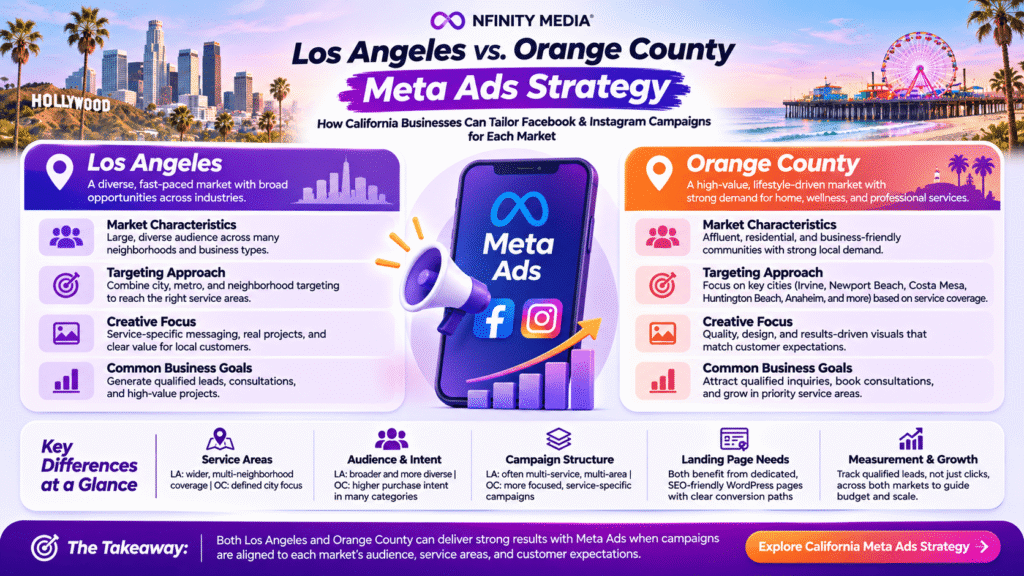
Orange County deserves separate attention within a Southern California Meta Ads strategy.
Businesses operating in Irvine, Newport Beach, Costa Mesa, Huntington Beach, Anaheim, Fullerton, Mission Viejo, or other Orange County communities may have different service territories, customer profiles, and commercial priorities from businesses focused on central Los Angeles.
A company serving both counties should not assume that the same campaign structure will be optimal across every location.
Define Orange County service coverage precisely
A home improvement company might want to prioritize coastal Orange County communities, while another may serve a broader combination of residential and commercial customers.
The relevant advertising territory should reflect where the business actually wants to operate.
This can affect:
Geographic campaign settings
Advertisement messaging
Landing-page service-area references
Consultation availability
Lead qualification
Budget allocation
A company should avoid advertising a location-specific offer if the website does not clearly explain whether the service is available there.
Match creative to the service, not a regional stereotype
Orange County advertising does not require every campaign to use luxury imagery or premium positioning.
Some businesses genuinely specialize in high-end construction, design, or aesthetic services. Others compete through convenience, specialized expertise, maintenance services, or reliable project delivery.
The creative should represent the actual business.
For a luxury design-build company, completed-project photography and a detailed consultation process may be appropriate.
For an HVAC company, the advertisement may be more effective when it clearly communicates the installation, replacement, or maintenance service being offered.
For a med spa, the creative should accurately describe the treatment and comply with relevant advertising rules.
The point is to match the offer with the customer rather than forcing every Orange County campaign into the same visual style.
When should Los Angeles and Orange County campaigns be separated?
Separate campaigns or reporting segments may be useful when the business has meaningfully different objectives, service availability, offers, budgets, or customer economics across the two markets.
However, splitting campaigns purely because two counties have different names is not automatically beneficial.
If a company serves both regions with the same service and offer, a more consolidated structure may sometimes provide sufficient flexibility.
The decision should be based on available data, budget, operational differences, and the need for meaningful control.
For businesses serving both Los Angeles and Orange County, the strongest strategy is usually the one that makes geographic performance measurable without creating unnecessary complexity.
5. Meta Ads for Los Angeles Contractors and Home Service Businesses
Contractors often face a specific advertising challenge: generating inquiries is not the same as generating viable projects.
A campaign can produce form submissions from people who are outside the service area, have unrealistic budgets, need a service the company does not offer, or are not ready to move forward.
This is why lead quality should influence campaign planning from the beginning.
General contractors and remodeling companies
Los Angeles general contractors may promote home renovations, additions, design-build services, or other construction projects.
Their advertising should help prospective customers understand the type of work the company accepts.
Useful creative and landing-page elements may include project categories, completed work, service territories, consultation expectations, and information about the project planning process.
Qualification questions can help distinguish major renovation opportunities from unrelated repair requests.
Roofing and HVAC companies
Roofing and HVAC businesses may have different advertising priorities depending on whether they want emergency inquiries, planned replacements, installation projects, or maintenance customers.
An advertisement for a major HVAC replacement should not necessarily use the same conversion experience as an advertisement promoting routine service.
The landing page should match the specific service being advertised.
For example, a replacement campaign may need to explain equipment options, service coverage, consultation steps, and what information the company requires to prepare an estimate.
Landscaping and outdoor living contractors
Landscaping, patio, pergola, outdoor kitchen, and hardscaping businesses often benefit from strong visual material.
But a campaign promoting large outdoor living projects should distinguish itself from routine landscaping maintenance.
The creative can communicate the intended project category, while the landing page can provide examples, service descriptions, and qualification pathways.
For companies operating across Los Angeles and Orange County, geographic clarity is especially important when project delivery involves crews, equipment, and scheduling.
Electricians and EV charger installers
Electrical contractors may promote installation, upgrades, specialized projects, or EV charging services.
Campaigns should distinguish between different customer needs and avoid combining unrelated services into one vague advertisement.
An EV charger installation campaign, for instance, can explain the type of installation offered, eligible service areas, and the next step for requesting an assessment.
Why contractor landing pages matter
A visitor interested in a specific service should not have to search through an entire website to find relevant information.
A dedicated page can provide a clearer connection between the advertisement and the inquiry.
This is particularly important for businesses that offer several different services.
The stronger the match between the ad, the service description, and the conversion action, the easier it becomes to evaluate whether the campaign is reaching the intended audience.
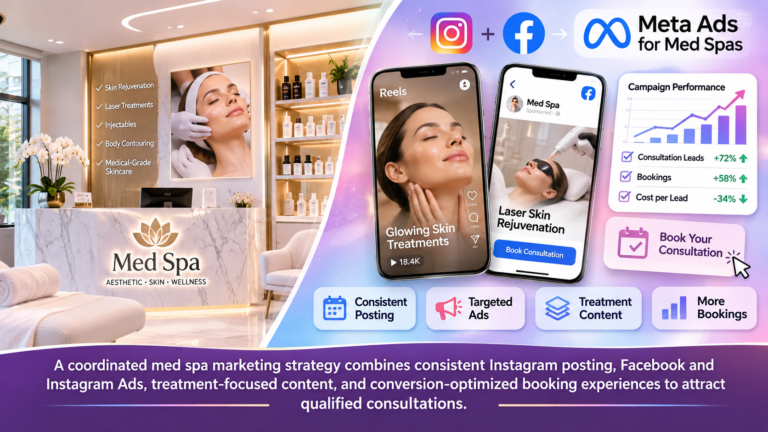
6. Meta Ads for Los Angeles and Orange County Med Spas
Med spas are another important application of Facebook and Instagram advertising in Southern California.
Treatments and aesthetic services often involve research, comparison, trust, and consultation before a prospective customer makes a decision.
The advertising strategy should reflect that journey.
Build campaigns around specific services
A generic advertisement promoting every available treatment may be less useful than a clear message about a particular service or consultation.
Different services can involve different customer questions, appointment requirements, and decision timelines.
The campaign should help prospective clients understand what is being offered and where they can learn more.
Use appropriate creative and claims
Aesthetic advertising requires particular care with platform policies, treatment claims, imagery, privacy, and applicable professional advertising rules.
Businesses should avoid misleading outcomes, unsupported guarantees, and creative that violates Meta’s policies concerning personal attributes or other restricted content.
Educational content, accurate service explanations, appropriate imagery, and clear consultation pathways can help establish relevance without relying on exaggerated promises.
Connect advertising with the appointment process
A med spa campaign may generate interest, but the booking process can determine whether that interest becomes an appointment.
The website should make it easy to understand the service, location, consultation options, and next step.
Where appropriate, a business may also use lead forms or booking tools to collect relevant information.
However, sensitive health information should not be unnecessarily collected or transmitted through advertising tracking systems.
Coordinate paid social with organic visibility
A Los Angeles or Orange County med spa may also benefit from strong local SEO, treatment pages, and an accessible website.
Meta Ads and SEO serve different acquisition functions.
SEO can help capture relevant searches from people actively researching services. Meta Ads can introduce services through paid placements and reconnect with eligible audiences.
Neither channel should be represented as directly improving the other’s rankings.
The advantage comes from providing a consistent, useful experience across both channels. Explore our social media and meta ads management in Los Angeles, CA.
7. Meta Instant Forms vs. WordPress Landing Pages: Choosing the Right Conversion Path
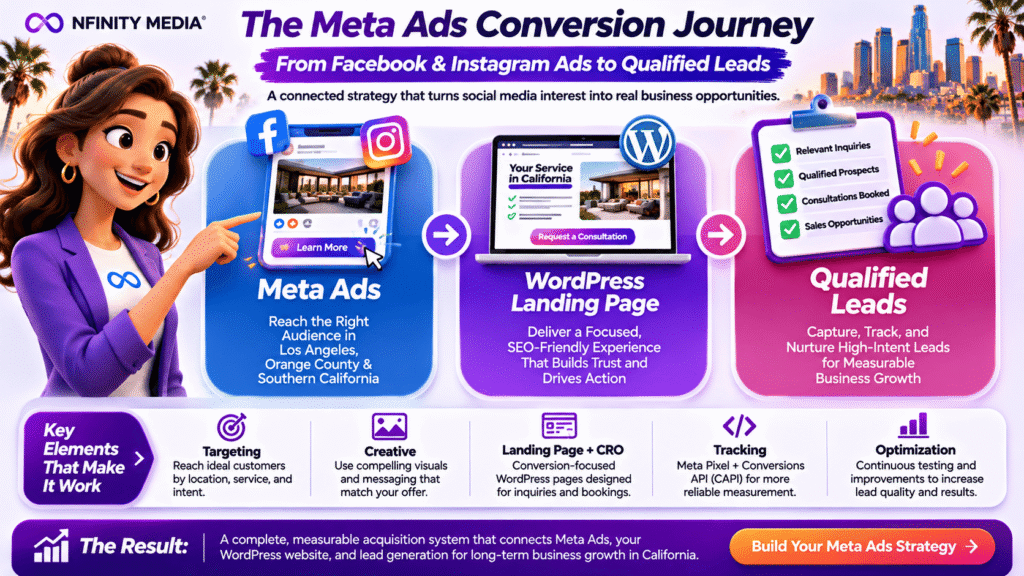
One of the most important decisions in a Meta Ads campaign is what happens after someone responds to an advertisement.
Two common options are Meta’s native lead forms and dedicated website landing pages.
Both can be useful, but they solve different problems.
When Meta Instant Forms make sense
Meta Instant Forms allow eligible users to submit information within the Meta environment.
This can reduce the number of steps required to complete an inquiry.
They may be useful for straightforward offers, initial consultation requests, or campaigns where a quick expression of interest is appropriate.
However, an easy form submission does not necessarily indicate strong purchase intent.
Businesses should evaluate whether the inquiries contain sufficient information and whether the sales team can contact and qualify those prospects.
When WordPress landing pages make sense
A dedicated WordPress landing page provides more room to explain a service.
It can include project examples, trust signals, service-area information, FAQs, qualification questions, and consultation details.
This can be valuable for higher-consideration services such as remodeling, luxury construction, outdoor living projects, or specialized professional services.
A well-designed page also gives the business greater control over the user experience and conversion pathway.
But more information is not always better.
A landing page overloaded with unnecessary content, distractions, or difficult forms may create friction.
The objective is to provide enough information for the visitor to make an informed next-step decision.
Compare qualified outcomes, not just form volume
Suppose a hypothetical campaign produces 80 native form submissions and another produces 30 website inquiries.
It would be premature to declare the first campaign more successful.
If only a small proportion of the first group is qualified, while the second group contains more suitable customers, the business outcome could be very different.
The comparison should consider:
Cost per inquiry
Percentage of qualified inquiries
Contact and response rates
Consultations booked
Sales opportunities
Customers acquired
Revenue or customer value where reliably measured
A lower cost per lead is useful only when the resulting leads are relevant to the business.
Testing both pathways
For some companies, testing both options may provide useful evidence.
A campaign could compare an appropriate native form experience with a dedicated landing page while keeping the offer and measurement framework sufficiently consistent.
Results should be interpreted carefully because audience delivery, conversion behavior, and attribution may differ.
The purpose is to identify which pathway creates the most useful business opportunities, not simply which one produces the largest number of submissions.
8. Why SEO-Friendly WordPress Landing Pages Matter for Meta Ads
A WordPress landing page built for paid advertising should be designed around the visitor’s intent.
That does not mean every advertising page should be indexed in Google.
It means the business should make deliberate decisions about website structure, content quality, technical performance, and organic search preservation.
Preserve existing organic search equity
Businesses with established websites may already rank for valuable service queries.
Changing page URLs, removing important content, altering internal links, or replacing service pages without a migration strategy can create unnecessary SEO risks.
When building Meta Ads landing pages, developers should evaluate whether the campaign can use an existing relevant page, a refined evergreen page, or a dedicated advertising variant.
If a new page is intended to rank organically, it needs its own meaningful search purpose.
If it is simply a campaign variation, indexing and canonical decisions should be reviewed rather than assumed.
Align the advertisement and landing-page message
A visitor clicking an advertisement for Los Angeles kitchen remodeling should arrive at a page that clearly discusses that service.
Sending the visitor to a generic homepage with dozens of unrelated options may make the next step less obvious.
The landing page should reinforce the offer presented in the advertisement.
This includes the headline, visual content, service description, geographic availability, and primary call to action.
Improve mobile usability
Many visitors will encounter advertisements on mobile devices.
Landing pages should therefore be evaluated on real mobile experiences, including:
Readable text and comfortable spacing
Clear primary calls to action
Accessible form fields
Fast-loading visual content
Logical content hierarchy
Minimal intrusive elements
Easy contact and booking options
A visually impressive desktop design is not enough if mobile visitors struggle to use it.
Consider Core Web Vitals and technical performance
Page performance can affect the visitor experience.
Large images, excessive scripts, poorly optimized widgets, and unnecessary third-party resources may slow down a landing page.
WordPress optimization may involve image compression, caching, careful plugin management, script optimization, and layout stability improvements.
These technical considerations matter for both usability and website quality.
They should be addressed alongside campaign development rather than treated as an unrelated maintenance task.
9. Conversion Rate Optimization for Los Angeles Facebook and Instagram Campaigns
Conversion rate optimization is the process of improving how effectively a website helps visitors complete meaningful actions.
For Meta Ads, CRO connects paid traffic with the business outcome the campaign is intended to support.
Start with the visitor’s question
A prospective customer arriving from an advertisement may want to know:
What does this company offer? Does it serve my location? Is it relevant to my project? Can I trust it? What happens if I contact them?
The landing page should answer those questions without forcing visitors through unnecessary steps.
Improve calls to action
Calls to action should describe a clear next step.
For a contractor, that might be requesting a project consultation.
For a med spa, it might be learning about treatment consultation availability.
For a professional services firm, it might be scheduling an introductory conversation.
The wording should match the actual process.
A button promising an immediate quote should not lead to a form that merely requests a callback without explaining the distinction.
Reduce unnecessary form friction
Long forms may discourage some visitors, but extremely short forms may produce insufficient information.
The appropriate form length depends on the service.
A high-value construction inquiry may benefit from asking about project type, location, approximate timeline, and other relevant requirements.
A simpler service request may need fewer questions.
The goal is to collect useful information without making the process unnecessarily difficult.
Use trust signals responsibly
Relevant trust signals may include completed-project examples, legitimate reviews, professional credentials where applicable, clear company information, and transparent service descriptions.
These elements should be accurate and verifiable.
Generic badges, invented testimonials, or unsupported performance claims do not create a reliable foundation for customer trust.
Evaluate the complete conversion journey
A landing page may produce inquiries, but a business still needs a process for responding to them.
A slow or inconsistent follow-up process can reduce the value of advertising investment.
For that reason, CRO should extend beyond the website to include appropriate lead routing, notification systems, scheduling, and sales feedback.
10. Meta Pixel, Conversions API, GA4, and Lead Measurement
Tracking is essential for understanding whether Meta Ads campaigns are contributing to business goals.
But advertising attribution is not perfectly complete, and different platforms may report different results.
A practical measurement strategy recognizes those limitations.
Meta Pixel
Meta Pixel is a browser-based measurement tool that can help record eligible website events.
Depending on the implementation, those events may include page views, lead submissions, or other meaningful actions.
The specific events should match the business objective.
Tracking every minor interaction as a primary conversion can make campaign performance difficult to interpret.
Conversions API
Meta’s Conversions API can support server-side event transmission through approved integrations.
Depending on the setup, it may complement browser-based measurement.
Businesses should consider event matching, deduplication, data quality, consent, and applicable privacy requirements.
CAPI is not a guarantee that every conversion will be recorded or attributed correctly.
Google Analytics 4 and Google Tag Manager
GA4 can help businesses understand website engagement and conversion activity.
Google Tag Manager can support organized deployment and management of compatible tracking configurations.
These tools provide additional perspectives on the visitor journey.
However, GA4 and Meta Ads Manager may attribute conversions differently because of their methodologies, reporting windows, and available data.
Those differences should be investigated rather than automatically treated as errors.
CRM and qualified lead feedback
For service businesses, the most valuable performance information may appear after the initial form submission.
A CRM or structured lead management process can help identify whether inquiries were contacted, qualified, booked, quoted, or converted into customers.
Where suitable integrations and permissions exist, this information can support better acquisition analysis.
For a Los Angeles contractor, a campaign producing ten qualified project opportunities may be more valuable than one producing a much larger number of irrelevant inquiries.
Measurement should reflect that distinction.
11. Understanding CPC, CPL, CPA, ROAS, and Customer Acquisition Economics
Meta Ads performance reports contain many metrics, but not all metrics carry equal business value.
Cost per click (CPC)
CPC measures advertising spend relative to clicks.
It can help evaluate traffic acquisition efficiency, but a low CPC does not establish that visitors are qualified.
Cost per lead (CPL)
CPL measures spend relative to recorded leads.
For example, if a hypothetical campaign spends $1,500 and produces 30 leads, the advertising-only CPL is $50.
That calculation does not establish the quality of those leads or include every business expense.
Cost per acquisition (CPA)
CPA generally measures the cost associated with a defined acquisition or conversion.
Businesses should specify what counts as an acquisition.
A booked consultation, qualified opportunity, and paying customer are different outcomes.
Return on ad spend (ROAS)
ROAS compares attributed revenue with advertising spend.
If a hypothetical campaign attributes $12,000 in revenue to $3,000 in ad spend, its reported ROAS is 4.0×.
That figure does not automatically represent profit.
It also depends on the reliability of revenue attribution.
Customer acquisition cost
A broader customer acquisition calculation may include advertising, management fees, creative production, software, and other relevant acquisition expenses.
For a service business, the appropriate acquisition cost depends on margins, customer lifetime value, capacity, and business objectives.
Why qualified CPL can be more useful than raw CPL
Imagine two hypothetical campaigns.
Campaign A produces 40 leads at $40 each, but only four are qualified.
Campaign B produces 20 leads at $65 each, but ten are qualified.
Campaign A appears cheaper based on raw CPL.
However, its advertising cost per qualified lead is $400, compared with $130 for Campaign B.
This simplified example illustrates why businesses should evaluate the quality of their inquiries before deciding where to allocate additional budget.
The best metric is the one that accurately reflects the business decision being made.
12. How Much Should Los Angeles Businesses Spend on Meta Ads?
There is no universal Meta Ads budget that works for every Los Angeles business.
The appropriate investment depends on the offer, target market, expected customer value, available creative, conversion pathway, and ability to handle inquiries.
A business promoting a specialized construction service may have different economics from a company offering routine maintenance.
Similarly, a business testing a new service may need a different campaign structure from one with established demand and reliable conversion history.
Separate advertising spend from management costs
Businesses should distinguish between the amount paid to Meta for advertising delivery and the cost of professional campaign management.
Other expenses may include creative production, landing-page development, tracking implementation, CRM tools, and ongoing website optimization.
Combining these costs without explanation can make campaign performance difficult to evaluate.
Build a budget around a testable objective
Instead of beginning with an arbitrary monthly figure, start with a business question.
For example:
Can this offer generate qualified consultations in a defined Los Angeles service territory at an acquisition cost the company can support?
The campaign should have enough budget and time to collect useful information, but the investment should remain appropriate to the business’s financial position and risk tolerance.
Avoid scaling based on early enthusiasm
A campaign that generates several inquiries shortly after launch may be encouraging.
But early results do not necessarily establish long-term performance.
Before increasing investment substantially, businesses should review lead quality, delivery consistency, conversion tracking, follow-up capacity, and customer outcomes.
Scaling should be an informed decision, not simply a reaction to attractive dashboard numbers.
13. Creative Testing for Facebook and Instagram Ads in Southern California

Creative testing helps advertisers learn which messages and formats communicate their offer effectively.
The purpose is not to produce endless variations without a clear hypothesis.
It is to identify what influences relevant customer response.
Test different value propositions
A contractor might compare messaging focused on design expertise, project planning, or a specific installation service.
A professional services firm might compare educational messaging with a direct consultation offer.
Each variation should represent a legitimate reason someone might choose the business.
Test formats appropriate to the service
Depending on the available assets and campaign objective, advertisers may evaluate static images, short videos, carousels, or other supported formats.
A landscaping company might use completed-project imagery.
An interior designer might use a visual explanation of the design process.
A contractor might use a short video demonstrating project stages.
The strongest format is not necessarily the most elaborate one.
It is the format that communicates the offer clearly to the intended audience.
Maintain message consistency
If an advertisement emphasizes a particular service, the landing page should reinforce that service.
If the advertisement promotes a consultation, the destination should explain how that consultation works.
Misalignment between creative and landing-page messaging can create confusion and reduce the usefulness of the campaign.
Document what each test is intended to learn
A structured testing process can record the hypothesis, creative variation, target outcome, measurement period, and observed results.
For example, a business might test whether project-specific creative generates more qualified inquiries than broad brand-awareness messaging.
The result should guide the next decision.
Creative testing becomes more valuable when each iteration produces a useful learning rather than another unstructured advertisement.
14. A Practical Los Angeles Meta Ads Campaign Planning Framework
A structured campaign process can help businesses avoid launching advertisements before the necessary foundations are in place.
Step 1: Define the business objective
Identify the service, target customer, desired conversion, and acceptable acquisition economics.
A campaign should have a clear purpose.
Step 2: Map the geographic market
Define the core Los Angeles service territory and determine whether Orange County or other Southern California markets should be included.
Document operational limitations and priority locations.
Step 3: Review the website experience
Evaluate the destination page for service relevance, mobile usability, trust signals, conversion pathways, and technical performance.
Identify issues that should be addressed before increasing traffic.
Step 4: Establish measurement
Configure appropriate tracking events and confirm that important conversion actions are being recorded as intended.
Review privacy, consent, and data-handling requirements.
Step 5: Develop campaign messaging
Create advertisements that explain the offer and the next step.
Align creative with the intended audience and service.
Step 6: Launch with a controlled structure
Use a campaign structure that supports meaningful evaluation without unnecessary fragmentation.
The objective is to gather useful performance information.
Step 7: Review lead quality
Evaluate inquiries beyond their initial submission.
Where possible, incorporate feedback about contact rates, consultation quality, and customer outcomes.
Step 8: Optimize and document decisions
Use available evidence to refine creative, audiences, budgets, landing pages, and conversion pathways.
Campaign management should be a continuing process of evaluation and improvement.
15. How Meta Ads and SEO Can Support Each Other Without Competing
Meta Ads and SEO are different acquisition channels.
Meta Ads purchases advertising distribution through Meta’s platforms.
SEO focuses on improving a website’s relevance, accessibility, and usefulness for organic search.
Running Facebook or Instagram advertisements does not directly cause a website to rank higher in Google.
However, the channels can share valuable website infrastructure.
Shared landing-page quality
Both organic visitors and paid-social visitors benefit from clear service information, accessible navigation, fast-loading pages, and trustworthy content.
A WordPress website developed with these principles can support multiple acquisition channels.
Shared conversion measurement
A business may use consistent definitions for qualified inquiries, consultation bookings, and customer acquisition across marketing channels.
This helps decision-makers compare outcomes more meaningfully.
Different audience entry points
A person searching Google for a specific contractor service may already be actively evaluating providers.
A person encountering an Instagram advertisement may be earlier in the decision process.
The website experience should account for these differences.
Internal linking and service architecture
A well-organized website can help visitors move between related service pages, educational resources, and consultation opportunities.
For example, a Los Angeles contractor SEO page may explain organic search strategy, while a Meta Ads service page explains paid-social acquisition.
Those pages can link to each other where the relationship is genuinely useful.
The objective is to create a coherent website rather than duplicate the same content across multiple URLs.
When an integrated strategy makes sense
Businesses with meaningful customer value, clear service positioning, and sufficient operational capacity may benefit from evaluating both channels.
But the right mix depends on budget, existing visibility, customer demand, and business goals.
A company does not need to invest in every channel simultaneously to have an effective marketing strategy.
16. Common Meta Ads Mistakes Los Angeles Businesses Should Avoid
Several recurring mistakes can limit the usefulness of paid-social campaigns.
Mistake 1: Targeting too broadly
Advertising across every possible location may generate inquiries from customers the business cannot serve effectively.
Geographic reach should reflect real business capacity.
Mistake 2: Optimizing only for cheap leads
A low CPL can look attractive even when the inquiries are irrelevant.
Qualified lead measurement provides a more meaningful perspective.
Mistake 3: Sending traffic to a generic homepage
A broad homepage may not clearly answer the questions raised by a specific advertisement.
Relevant landing pages can create a more direct path to conversion.
Mistake 4: Launching without reliable tracking
Without a reasonable measurement framework, campaign decisions may rely too heavily on incomplete indicators.
Tracking should be reviewed before major budget decisions.
Mistake 5: Ignoring the sales process
Advertising can generate interest, but businesses still need to respond to inquiries and manage opportunities.
Lead handling should be part of campaign planning.
Mistake 6: Changing campaigns too frequently
Constant adjustments can make it difficult to understand what caused performance changes.
Testing should follow a documented process.
Mistake 7: Assuming one successful creative will work indefinitely
Audience response, competitive conditions, and customer needs can change.
Creative performance should be reviewed over time.
Mistake 8: Treating Meta Ads and SEO as interchangeable
Paid social and organic search have different mechanics and customer entry points.
They can complement each other without being the same service.
Mistake 9: Expanding into Orange County without operational planning
A Los Angeles business may be able to reach Orange County audiences, but that does not mean every inquiry will be commercially worthwhile.
Service delivery and profitability should guide expansion.
Mistake 10: Making decisions from platform dashboards alone
Advertising reports are useful, but they may not capture every downstream business outcome.
Where possible, campaign evaluation should include qualified inquiries, booked appointments, and customer acquisition information.
17. When Should a Los Angeles Business Hire a Meta Ads Management Agency?
Some businesses can manage simple campaigns internally, particularly when they have the time, expertise, and systems needed to monitor results.
Professional support may become more useful when campaigns involve multiple services, geographic markets, creative variations, complex tracking, or significant advertising investment.
An agency or specialist should be able to explain how campaign decisions relate to business objectives.
Useful questions to ask include:
How will you define a qualified lead?
How will Los Angeles and Orange County targeting be evaluated?
What happens if our website needs improvement?
How will you measure conversions and customer acquisition?
Who owns the advertising account and campaign assets?
How are campaign changes documented?
What information do you need from our sales team?
How will management fees and advertising spend be reported?
The answers should be specific enough to help the business understand the proposed working relationship.
A strong agency relationship does not require promising a particular ROAS or a guaranteed number of customers.
It requires clear objectives, appropriate measurement, transparent communication, and a process for improving performance.
Why integrated website expertise can matter
A Meta Ads specialist may identify that a landing page is underperforming.
But improving the page can require WordPress development, technical troubleshooting, UX design, form integration, or analytics configuration.
When those capabilities are coordinated, businesses may be able to address problems across the acquisition journey rather than treating every issue as an advertising-platform problem.
That integrated approach is particularly relevant for companies with established websites and valuable organic search visibility.
18. Frequently Asked Questions About Los Angeles Meta Ads
Are Facebook Ads effective for Los Angeles businesses?
Facebook advertising can be useful for Los Angeles businesses when campaigns have a relevant offer, suitable geographic coverage, clear conversion goals, and a process for evaluating lead quality. Effectiveness varies by industry, budget, creative, customer value, and execution.
Is Instagram advertising better than Facebook advertising for Orange County businesses?
Neither platform is universally better. Instagram may be useful for visually driven services, while Facebook can also support local awareness and lead generation. Businesses should evaluate eligible placements and formats using actual campaign outcomes rather than broad assumptions.
Can Meta Ads generate leads for Los Angeles contractors?
Yes, Meta Ads can be used to promote contractor services and generate inquiries. However, businesses should distinguish qualified project opportunities from general interest, out-of-area submissions, and unsuitable requests.
Should I use Meta Instant Forms or a WordPress landing page?
Instant Forms may be appropriate for straightforward inquiries and lower-friction lead capture. WordPress landing pages can provide more information, qualification, trust signals, and booking options. The best choice depends on the offer and the quality of resulting leads.
Do Facebook and Instagram Ads improve Google SEO rankings?
No. Buying Meta advertising does not directly improve Google organic rankings. Paid social and SEO can share website improvements, conversion tracking, and content infrastructure, but they remain distinct acquisition channels.
Can I target Los Angeles and Orange County in the same campaign?
Potentially, depending on available targeting options and campaign requirements. Whether they should be combined depends on service coverage, budget, offers, conversion data, and the need for geographic control.
What should a Los Angeles Meta Ads report include?
A useful report may include spend, reach, clicks, CPC, conversions, CPL, qualified leads, acquisition costs, creative performance, and downstream customer outcomes where reliable information is available.
Is Meta Pixel enough for conversion tracking?
Meta Pixel can support browser-based measurement, but some businesses may also benefit from appropriate Conversions API integrations, GA4, and CRM reporting. The implementation should account for data quality, deduplication, consent, and privacy requirements.
How long does it take to evaluate a new Meta Ads campaign?
There is no universal timeline. The amount of useful data depends on campaign volume, conversion frequency, budget, audience, and the business’s sales cycle. Early signals can inform decisions, but stable conclusions generally require sufficient relevant observations.
Does a Los Angeles business need a separate Orange County landing page?
Not automatically. A separate page is useful when it serves distinct customer needs, services, or geographic intent. Creating nearly identical pages solely to change location names can produce unnecessary duplication.
What is more important: CPL or ROAS?
Both can be useful, but they answer different questions. CPL measures lead acquisition efficiency, while ROAS compares attributed revenue with advertising spend. Businesses should also consider lead quality, profitability, and customer acquisition costs.
Can Meta Ads support SEO-focused WordPress websites?
Yes. A WordPress website can support paid campaigns through relevant landing pages, conversion tracking, accessible design, and clear customer journeys. Technical and content changes should preserve valuable existing organic search assets.
19. Building a Sustainable Southern California Customer Acquisition Strategy
Los Angeles Meta Ads strategy should not be reduced to a collection of advertising tactics.
Audience selection, creative testing, geographic coverage, landing-page design, conversion measurement, and customer follow-up all contribute to the results a business can reasonably evaluate.
For companies serving Los Angeles, Orange County, and neighboring Southern California markets, the challenge is to connect these decisions with real operating conditions.
A contractor needs inquiries that fit its services, geography, and project requirements.
A med spa needs accurate advertising, an appropriate consultation experience, and responsible handling of customer information.
A professional services company needs relevant prospects who understand the offering and are prepared to take a meaningful next step.
Across these industries, the same principle applies:
The purpose of Meta Ads is not merely to purchase attention. It is to create a measurable path from relevant audience engagement to qualified business opportunities.
That path becomes stronger when the advertising message, website experience, tracking, and lead management process work together.
Explore California Meta Ads Management With Nfinity Media
Nfinity Media helps California businesses connect Facebook and Instagram advertising with WordPress landing-page development, SEO preservation, conversion rate optimization, and performance measurement.
Our approach considers the full acquisition journey, from campaign planning and audience relevance to website conversions and lead quality.
For businesses exploring professional support, learn more about our California Meta Ads Management services, including campaign strategy, creative testing, conversion tracking, and qualified lead generation.
Explore California Meta Ads Management:
https://nfinityitmedia.com/meta-ads-management-california/
Whether your business operates in Los Angeles, Orange County, San Diego, or across multiple California markets, the starting point is understanding your current acquisition process and identifying where more focused decisions could create value.
The goal is not to promise overnight results.
It is to build an advertising and website strategy that can be measured, evaluated, and improved as your business grows.