A medical spa website needs to do more than look luxurious. It must help prospective patients understand available aesthetic treatments, evaluate the practice’s credibility, explore relevant information, and confidently request a consultation or appointment.
For established med spas, the website may already attract visitors through Google searches for Botox, dermal fillers, laser treatments, skin rejuvenation, microneedling, and other aesthetic services. Some visitors arrive through treatment-specific searches, while others discover the practice through local search results, educational content, or referrals.
Those existing search pathways can represent valuable business assets.
Yet many medical spas continue operating WordPress websites that no longer reflect the quality of their facilities, patient experience, or service offerings. Outdated page layouts, slow-loading treatment galleries, confusing navigation, inconsistent booking buttons, and poorly organized service pages can create friction for prospective patients.
A WordPress website redesign for med spas offers an opportunity to improve these experiences without unnecessarily sacrificing the organic visibility the practice has already established.
The challenge is balancing three priorities: preserving SEO rankings, presenting treatments through a premium and trustworthy digital experience, and improving the journey from website visitor to consultation booking.
A successful redesign should address all three.
This guide explores how medical spas can modernize their WordPress websites while protecting valuable treatment URLs, strengthening technical SEO, improving mobile UX, and creating clearer appointment conversion pathways.
Why Medical Spas Need a Different Approach to Website Redesign
Medical spa website design differs from conventional local service business design.
A homeowner seeking emergency HVAC repair may prioritize immediate contact. A med spa visitor may spend considerably more time researching treatment options, evaluating practitioner qualifications, comparing before-and-after results, and deciding whether a particular procedure is appropriate.
The experience is often more personal and research-driven.
Prospective patients may want answers to questions such as:
Which aesthetic treatments does the practice offer?
Who performs or supervises the procedures?
What does the treatment involve?
What are the potential risks, limitations, and recovery considerations?
Does the practice provide appropriate consultations?
Where is the medical spa located?
How can an appointment be scheduled?
What should a new patient expect?
A premium design can help communicate professionalism, but visual presentation alone does not answer these questions.
The redesigned website must combine aesthetics with accurate information, credible provider details, accessible navigation, and appropriate booking options.
Common reasons med spas redesign their WordPress websites
A practice may consider redesigning when its existing website has:
An outdated visual identity that no longer reflects the business.
Treatment pages with inconsistent layouts or insufficient information.
Slow mobile performance caused by oversized imagery and video.
Confusing menus that make treatments difficult to locate.
Appointment buttons that lead to broken or cumbersome workflows.
Poor presentation of practitioner credentials and genuine patient reviews.
Duplicate or outdated service content.
Inconsistent information across location pages.
Unsupported WordPress themes or plugins.
Missing or unreliable conversion tracking.
These issues can affect both organic visibility and the patient experience.
However, replacing the entire website without reviewing its existing search performance may introduce unnecessary SEO risk.
The first step is understanding what should be preserved.
Preserve Existing Med Spa SEO Rankings Before Redesigning WordPress
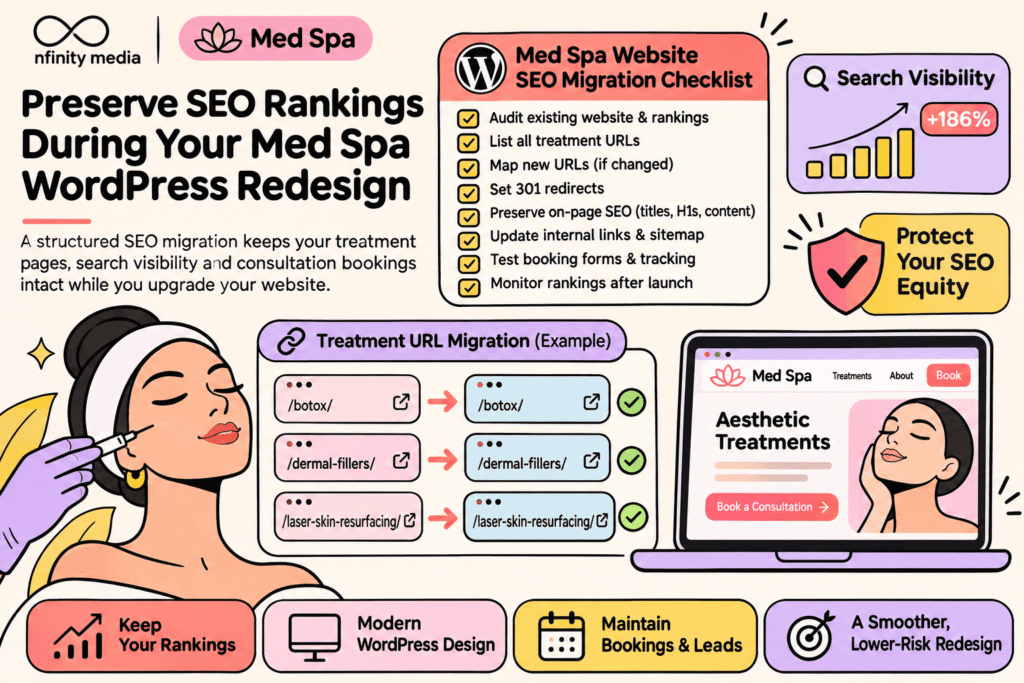
An established med spa website may already appear in search results for treatment and geographic queries.
Examples might include:
Botox consultations in a particular city.
Dermal filler services near a neighborhood.
Laser skin resurfacing.
Microneedling treatments.
Facial rejuvenation services.
Laser hair removal.
Chemical peels.
Medical spa consultations.
Individual practitioner or practice-name searches.
These queries do not all have the same intent.
Some users are comparing providers. Others are researching treatment suitability, expected experiences, or possible side effects. Some are ready to book an initial consultation.
The existing WordPress website may have dedicated pages addressing these different needs.
During a redesign, those pages should not be deleted, merged, or rewritten without reviewing their performance.
Audit existing treatment pages
Before development begins, use Google Search Console, GA4, and an appropriate website crawler to identify:
Treatment pages receiving organic impressions and clicks.
Search queries associated with those pages.
Existing indexed URLs.
Important backlinks.
Internal links between treatments and related information.
Booking pages and consultation conversion paths.
Practitioner biography pages.
Location-specific landing pages.
Technical errors and indexing issues.
Pages containing outdated or inaccurate treatment information.
This audit creates a baseline for evaluating the redesign.
A treatment page receiving qualified organic visitors may be more valuable than its visual appearance suggests.
Preserve successful treatment URLs
Consider an established medical spa with URLs such as:
/botox/
/dermal-fillers/
/laser-skin-resurfacing/
/microneedling/
If those pages already address relevant search intent, retaining their URLs may be preferable to changing them during redesign.
A new layout, better photography, clearer provider information, and improved booking calls to action can be introduced without changing the URL.
When changes are necessary, map the original page to its most relevant new destination and implement an appropriate permanent redirect.
Avoid sending unrelated treatment URLs to the homepage simply because the old content has been removed.
Preserve search intent and useful content
Keeping a URL does not automatically preserve its SEO relevance.
A treatment page should continue providing meaningful information about the treatment.
For example, a microneedling page may explain what the procedure involves, general suitability considerations, potential side effects, recovery expectations, and the consultation process.
The content should be reviewed for medical accuracy by appropriately qualified professionals.
Replacing detailed treatment information with a short promotional paragraph may reduce usefulness for visitors and change the page’s search relevance.
The goal is to improve clarity and presentation while maintaining accurate, substantive information.
WordPress Redesign for Medical Spas: Organize Treatment Pages Around Patient Needs
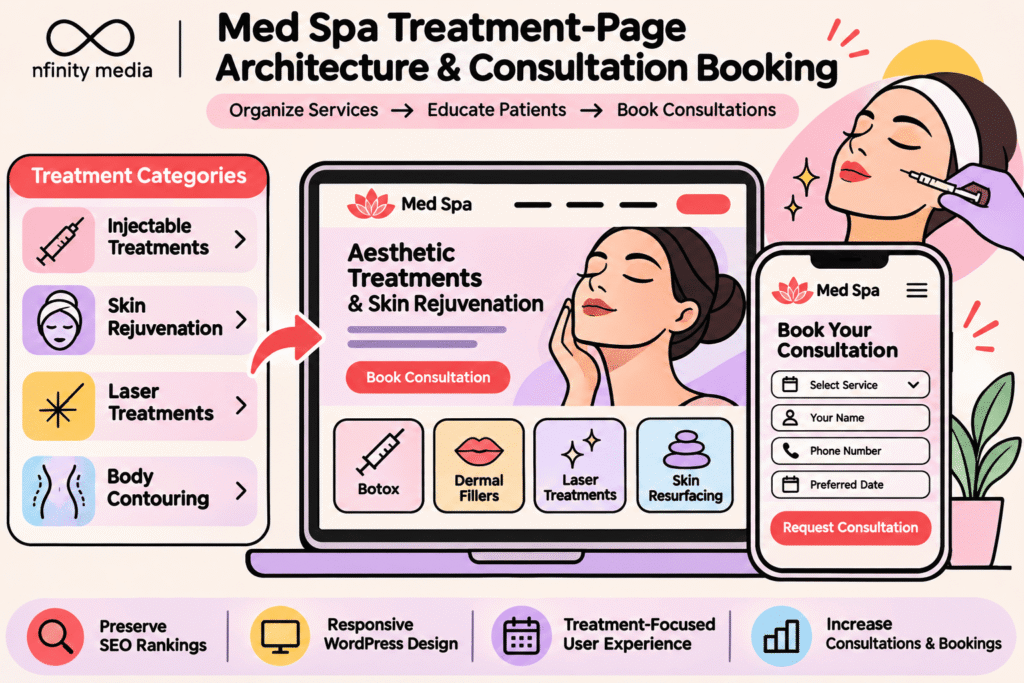
A medical spa’s service architecture is central to its website experience.
Many practices offer multiple treatment categories, sometimes with overlapping aesthetic goals.
A poorly structured website can make it difficult for prospective patients to understand the differences.
Create logical treatment categories
Depending on the practice’s actual offerings, a WordPress website may organize services into categories such as:
Injectable Treatments
Neuromodulator consultations
Dermal fillers
Other injectable aesthetic services
Skin Rejuvenation
Microneedling
Chemical peels
Laser skin resurfacing
Other skin treatments
Laser and Energy-Based Treatments
Laser hair removal
Skin-focused laser services
Other supported device-based treatments
Consultations and Patient Resources
New patient information
Provider biographies
Treatment FAQs
Consultation booking
Aftercare resources
These are examples rather than a recommendation to create every possible page.
The structure should reflect services actually offered, the qualifications of the providers, and meaningful differences in patient needs.
Avoid duplicating treatment content
A practice may use different brand names, equipment names, or marketing terms for related services.
Creating separate pages for every minor keyword variation can result in repetitive content.
A redesign provides an opportunity to review overlapping pages and determine whether consolidation would improve clarity.
However, pages with distinct treatments, technologies, or patient intent may warrant separate coverage.
Existing SEO performance should be considered before making structural changes.
Connect treatment pages with relevant resources
A well-organized treatment page can link to provider biographies, consultation information, related treatments, and medically reviewed FAQs.
These links help patients find additional information without repeatedly returning to the homepage.
They also support a coherent internal-link structure.
For example, a laser treatment page might link to a relevant provider profile and the practice’s consultation booking page.
The links should serve patient understanding rather than exist solely to repeat keywords.
Medical Spa Website SEO Migration: Protect URLs, Content, and Technical Settings
A WordPress redesign may involve changing themes, page builders, templates, booking integrations, or the site’s underlying architecture.
Even when the domain remains unchanged, these changes can affect SEO.
A structured migration process helps reduce avoidable disruptions.
Before redesign development
Document the existing website:
Crawl all important URLs.
Export organic search performance.
Identify treatment pages with meaningful visibility.
Record SEO titles, descriptions, canonicals, and indexing settings.
Review internal links and backlinks.
Identify practitioner and location pages.
Document structured data.
Review booking forms and conversion events.
Establish a staging environment.
Prepare a URL mapping plan.
During WordPress development
Preserve the purpose of important pages while improving the user experience.
Review heading structures, navigation, treatment content, image optimization, booking integrations, and mobile responsiveness.
A staging environment should be protected against public indexing, preferably through access controls.
Ensure that any staging-specific restrictions are removed or appropriately configured when the redesigned website launches.
Before launch
Verify that:
Important URLs return successful responses.
Changed URLs have relevant redirects.
Canonical tags point to intended destinations.
Indexable pages are not accidentally marked noindex.
XML sitemaps contain the intended URLs.
Navigation and internal links work.
Booking integrations function.
Analytics events are correctly configured.
Mobile layouts are usable.
Structured data reflects accurate information.
After launch
Monitor Search Console indexing reports, organic landing-page performance, crawl errors, and important treatment queries.
Test appointment workflows on the live website.
Search rankings may fluctuate after substantial changes, and no migration can guarantee identical results. Careful planning and monitoring reduce unnecessary risk.
For the broader redesign methodology, explore WordPress Website Redesign for Contractors Without Losing SEO Rankings, which explains the technical preservation principles that also apply to other service businesses.
Premium Med Spa Website Design: Build Trust Without Sacrificing Usability
Medical spas often compete on the quality of their environment, professionalism, and overall patient experience.
The website should reflect those qualities.
A premium WordPress design may use elegant typography, thoughtful spacing, high-quality photography, restrained animations, and a consistent visual identity.
But luxury presentation should not interfere with accessibility or practical navigation.
Use authentic imagery
Photography of the practice, treatment rooms, and authorized team members can communicate the environment more accurately than generic stock imagery.
Real images help prospective patients understand what to expect when visiting.
Photographs should be used with appropriate permissions and should not imply that a depicted person received a treatment unless that representation is accurate.
Make provider credentials easy to find
Prospective patients may want to understand who performs treatments and what qualifications or oversight arrangements apply.
Provider biographies should accurately describe relevant credentials, roles, experience, and professional responsibilities.
Avoid unsupported medical claims or exaggerated credentials.
A redesign can improve how this information is presented without turning provider pages into purely promotional content.
Maintain accessible design
A premium website should remain usable for visitors with different accessibility needs.
Consider readable font sizes, sufficient contrast, keyboard navigation, clear form labels, descriptive image alternatives, and appropriate interactive controls.
A visually minimalist design is not necessarily accessible unless these details are addressed.
Avoid excessive animations
Large video backgrounds, elaborate transitions, and animated galleries may create an upscale impression, but they can also delay loading and interfere with usability.
Use visual effects selectively.
The most valuable design is one that communicates the practice’s identity while helping prospective patients find accurate information and book consultations.
Before-and-After Galleries: Present Med Spa Results Responsibly
Before-and-after photography can be an important part of aesthetic treatment research.
However, these images require greater care than ordinary commercial project galleries.
Medical aesthetic results vary between individuals, and images should not imply guaranteed outcomes.
Use appropriate consent and permissions
Patient photographs should only be published with appropriate authorization and in compliance with applicable privacy and professional requirements.
The practice should have a clear process for obtaining and documenting consent.
Avoid misleading image presentation
Images should not be edited or presented in ways that materially misrepresent treatment outcomes.
Lighting, camera angles, timing, and other presentation factors can influence how results appear.
Where appropriate, provide accurate context and avoid implying that an individual result is typical or guaranteed.
Organize galleries around actual treatments
A medical spa may organize authorized photographs by treatment category.
This helps visitors find relevant examples without browsing an unrelated collection of images.
However, galleries should supplement—not replace—accurate explanations of benefits, limitations, risks, and consultation requirements.
Optimize gallery performance
Large image files can slow WordPress pages.
Use appropriately sized images, suitable compression, responsive delivery, and descriptive alternative text.
For images below the fold, appropriate lazy loading can reduce initial page weight.
Performance improvements should not compromise the accuracy or integrity of patient imagery.
Mobile Med Spa Website Design: Make Consultations Easier to Book
Many prospective patients discover medical spas through smartphones.
They may search for nearby providers, explore treatments on social media, compare reviews, and visit a practice’s website before making a decision.
The mobile experience should make those steps straightforward.
Simplify mobile navigation
Visitors should be able to find treatment categories, provider information, location details, and booking options without navigating through confusing menus.
A compact menu can work well when its labels are clear and its structure is logical.
Keep consultation buttons visible
A prominent consultation button can help interested visitors move to the next step.
Depending on the practice’s workflow, the call to action may say:
Schedule a Consultation
Request an Appointment
Explore Treatment Options
Contact Our Team
The wording should accurately describe what happens after the visitor selects it.
A request form should not be presented as an instantly confirmed appointment if the practice must first review availability.
Optimize mobile forms
Initial inquiry forms should avoid collecting unnecessary information.
Basic contact details, preferred service, and appointment preferences may be sufficient for some workflows.
Sensitive medical information should be collected only through appropriately secured and compliant systems.
A standard WordPress contact form should not be assumed suitable for protected health information.
Make location information accessible
Prospective patients may want directions, parking information, hours, and contact details.
A mobile-friendly location page can reduce friction before an appointment.
For practices operating multiple locations, each location should have accurate information and appropriate booking pathways.
Med Spa Appointment Booking Optimization: Reduce Friction Between Interest and Consultation
A medical spa website redesign should improve the path from treatment research to appointment requests.
That process often involves more consideration than a simple product purchase.
Visitors may need to understand the treatment, assess the provider’s credibility, and determine whether a consultation is appropriate.
Match calls to action with treatment intent
A visitor reading about injectable treatments may be ready to request a consultation.
Someone researching laser resurfacing may first want more information about the procedure and recovery.
A well-designed treatment page can provide both educational content and a clear next step.
Integrate booking systems carefully
Medical spas may use specialized scheduling or practice-management platforms.
A WordPress redesign should test how those systems function across devices.
Review:
Booking button destinations.
Embedded scheduling performance.
Mobile usability.
Appointment confirmation behavior.
Error handling.
Analytics events.
Appropriate privacy and security controls.
Avoid assuming that every third-party booking widget can be safely or legally used to collect sensitive patient information.
Clarify what happens after submission
A patient should understand whether an inquiry requests a callback, begins a consultation process, or confirms an appointment.
Clear expectations can reduce confusion and improve the overall experience.
Improve consultation quality, not just form volume
A higher number of submissions does not necessarily mean a better website.
Some inquiries may be irrelevant, incomplete, or unsuitable for the practice’s services.
Conversion optimization should focus on helping appropriately interested patients understand their options and contact the practice through the correct process.
Med Spa Website Conversion Optimization: Connect UX With Meaningful Outcomes
Med spa website conversion optimization involves improving the relationship between website content, patient expectations, and appropriate actions.
Useful conversion improvements may include clearer treatment explanations, visible provider credentials, easier navigation, accessible booking buttons, and mobile-friendly forms.
Strengthen treatment-page clarity
Treatment pages should explain what the practice offers without relying on vague promises.
Depending on the procedure, medically reviewed information may cover:
What the treatment involves.
General reasons patients seek it.
Potential benefits and limitations.
Important risks and side effects.
Recovery or aftercare considerations.
Consultation requirements.
Relevant provider information.
The purpose is to support informed decisions.
Use trust signals responsibly
Trust elements may include authentic patient reviews, verified credentials, professional affiliations, and accurate descriptions of the practice.
Avoid fabricated testimonials, unsupported superiority claims, or misleading guarantees.
Reviews and testimonials should comply with applicable advertising and professional requirements.
Test user journeys
A redesign can be evaluated by examining how visitors move through the website.
For example:
A visitor discovers a treatment page through organic search.
The visitor reviews the treatment information.
The visitor explores provider qualifications.
The visitor selects the consultation option.
The visitor completes the appropriate booking workflow.
If users consistently abandon a particular step, the practice can investigate usability issues.
Changes should be tested rather than assuming that a more attractive layout automatically produces more bookings.
Core Web Vitals and WordPress Speed for Medical Spa Websites
Medical spa websites often use high-resolution imagery, videos, animations, and third-party booking systems.
These features can create performance problems when implemented inefficiently.
Largest Contentful Paint
Largest Contentful Paint measures how quickly the main visible content loads.
A large homepage photograph or treatment hero image may influence this metric.
Image sizing, compression, hosting, caching, and loading priorities can improve performance.
Interaction to Next Paint
Interaction to Next Paint measures responsiveness.
Heavy JavaScript, complex galleries, and excessive third-party widgets can delay interactions with menus, buttons, and forms.
A WordPress redesign should evaluate whether scripts are necessary and how they affect usability.
Cumulative Layout Shift
Cumulative Layout Shift measures unexpected movement of page elements.
Booking buttons, image galleries, and embedded widgets should not shift unpredictably as the page loads.
Appropriate layout dimensions and stable components can help.
Balance premium presentation with performance
A medical spa does not need to eliminate photography or thoughtful visual design to create a fast website.
The goal is efficient implementation.
A well-optimized WordPress website can maintain a refined aesthetic while delivering accessible, responsive treatment pages.
Local SEO Preservation for Medical Spas in Competitive Markets
Medical spas frequently compete in geographically concentrated markets.
A practice may attract patients from its immediate neighborhood, nearby suburbs, or a broader metropolitan area.
Local search visibility can depend on accurate business information, relevant treatment pages, genuine reviews, and the relationship between the website and the practice’s real location.
A redesign should preserve useful geographic relevance.
Review existing local landing pages
Before changing location pages, identify which URLs attract organic visitors and consultation inquiries.
Review:
Actual practice locations.
Treatment availability.
Localized content accuracy.
Existing internal links.
Search performance.
Relevant provider information.
Contact and booking details.
Do not remove valuable local pages without reviewing their purpose and performance.
Avoid thin geographic duplication
Creating numerous near-identical city pages can produce weak content.
Location pages should provide genuine information about the practice’s presence, services, and patient experience.
A practice with one physical location should not imply that it operates offices in cities where it has no actual facility.
Coordinate with Google Business Profile
Ensure that the redesigned website presents accurate practice information.
If URLs change, review relevant website and appointment links in the Google Business Profile.
The objective is consistency and usefulness, not artificial geographic expansion.
WordPress Website Redesign for Tampa Bay Medical Spas
Tampa Bay includes established aesthetic practices and a range of neighborhoods and surrounding communities.
A med spa serving this market may offer injectable treatments, skin rejuvenation, laser services, or other procedures, depending on its qualifications and facilities.
A redesign can improve the presentation of treatment categories, provider biographies, consultation workflows, and location information.
For an existing practice, the priority should be preserving treatment pages that already attract relevant local searches.
A Tampa med spa website should not need to abandon established URLs merely to introduce a more refined visual design.
For related local organic visibility strategies, explore Nfinity Media’s Tampa Bay medical spa SEO services.
WordPress Website Redesign for New York Medical Spas
New York medical spa websites may need to serve patients comparing multiple treatment providers and locations.
Clear treatment explanations, accurate credentials, and accessible consultation options can help differentiate the patient experience.
For established practices, treatment pages and geographic URLs may already hold valuable search visibility.
A redesign should evaluate those assets before restructuring the website.
New York med spa websites may also benefit from organized provider profiles and clear distinctions between available procedures.
For related search strategy, see SEO for Med Spas in New York.
WordPress Website Redesign for Orange County Medical Spas
Orange County aesthetic practices may emphasize refined visual presentation, personalized consultations, and a broad range of cosmetic services.
A premium website should communicate the practice’s real identity rather than rely on generic luxury templates.
Useful improvements may include treatment galleries, provider information, responsive layouts, and streamlined consultation requests.
Existing service pages should be reviewed for SEO performance before content or URL changes.
The redesign should support both patient confidence and accurate local search relevance.
WordPress Website Redesign for Miami Medical Spas
Miami medical spas may attract prospective patients researching injectable services, skin treatments, and other aesthetic procedures.
The website should communicate treatment availability, provider qualifications, and consultation expectations clearly.
A redesign can improve mobile navigation, imagery, and booking pathways while preserving useful existing treatment pages.
For practices serving multilingual audiences, language-specific content should be implemented thoughtfully and accurately, with appropriate technical SEO when multiple language versions are published.
The website should reflect the practice’s real operations rather than assume every Miami med spa offers the same services.
Explore Med Spa SEO Strategies Across California and South Florida
A successful WordPress website redesign for med spas should do more than improve visual presentation. It should preserve valuable treatment-page rankings, strengthen local search visibility, improve mobile usability, and create clearer pathways from Google searches to consultation bookings.
At Nfinity Media, we connect medical spa SEO, WordPress website design, technical optimization, and conversion-focused patient experiences across competitive aesthetic markets.
Med Spa SEO in Orange County, California
Medical spas in Irvine, Newport Beach, Costa Mesa, and surrounding Orange County communities benefit from treatment-specific SEO, Google Maps optimization, premium website UX, and clear consultation pathways. Preserving established treatment pages during a WordPress redesign helps protect existing organic visibility while improving the patient experience.
Explore Med Spa SEO in Orange County
Med Spa SEO in Los Angeles, California
From Beverly Hills and West Hollywood to Santa Monica and greater Los Angeles, medical spas compete for visibility across aesthetic treatment searches. Our approach connects local SEO, treatment-page architecture, technical website performance, and conversion optimization to support qualified consultation inquiries.
Explore Med Spa SEO in Los Angeles
Med Spa SEO Across Southern California
Medical spas serving multiple Southern California communities need a coordinated approach to local search, treatment content, website architecture, and geographic relevance. WordPress redesign and SEO preservation can work together to strengthen the experience across treatment pages, practitioner profiles, and appointment pathways.
Explore Med Spa SEO in Southern California
Med Spa SEO in Miami and South Florida
Miami and South Florida medical spas operate in a competitive aesthetics market where treatment visibility, authentic patient trust, and mobile consultation experiences matter. A well-planned WordPress redesign can improve treatment navigation, booking usability, and website performance while preserving valuable local SEO assets.
Nfinity Media’s approach connects medical spa SEO, Google Maps visibility, treatment-page optimization, and conversion-focused website design for practices serving Miami, Brickell, Coral Gables, and surrounding South Florida communities.
Miami med spa SEO service-page link to be inserted once its exact URL is confirmed.
Connecting Local Med Spa SEO With WordPress Redesign
Whether a medical spa operates in Orange County, Los Angeles, Southern California, or Miami, the objective remains consistent: preserve existing search equity while improving the website experience that turns relevant treatment searches into consultation opportunities.
A coordinated approach to WordPress redesign, technical SEO, treatment content, and appointment optimization helps practices modernize their websites without unnecessarily abandoning the visibility they have already built.
Should a Med Spa Redesign or Completely Rebuild Its WordPress Website?
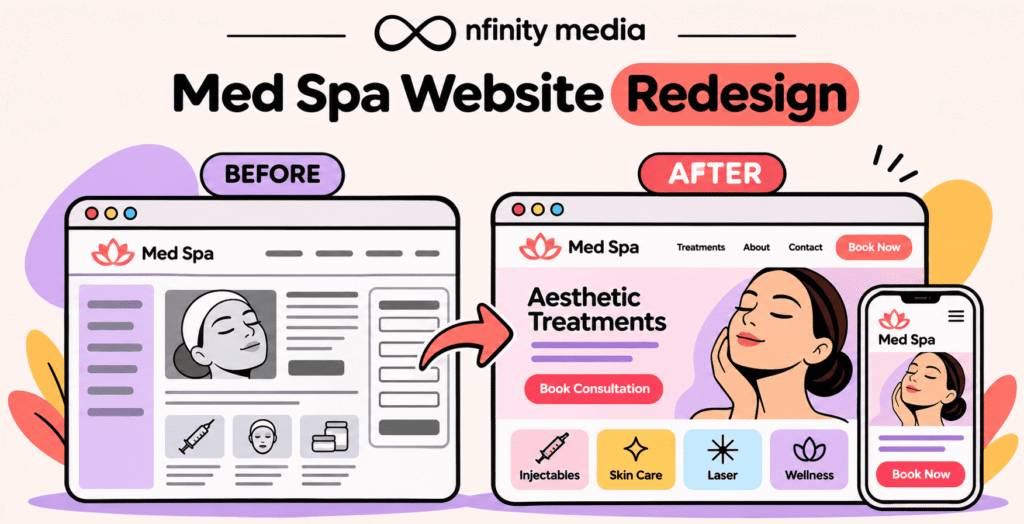
Not every medical spa requires a complete website rebuild.
A targeted redesign may be appropriate when the existing WordPress foundation remains maintainable and important treatment pages already perform well.
Consider a targeted redesign when:
Existing URLs have meaningful organic visibility.
Treatment content remains accurate and useful.
The theme and builder can support the desired design.
The main problems involve mobile UX, navigation, or visual presentation.
Booking integrations can be improved without replacing the entire platform.
Consider a larger rebuild when:
The website relies on unsupported technology.
Templates are inconsistent and difficult to maintain.
Booking functionality is unreliable.
The treatment architecture no longer reflects the practice.
Technical limitations prevent necessary improvements.
Major integrations or structural changes are required.
The decision should follow a technical and business assessment.
A complete rebuild is not automatically the best choice for a practice with valuable organic rankings.
Track Consultation Requests and Website Performance After Redesign
A redesigned med spa website should be evaluated through search performance, usability, and meaningful appointment outcomes.
Organic search measurement
Google Search Console can help monitor:
Treatment-related impressions.
Organic clicks.
Important landing pages.
Search queries.
Indexing changes.
Geographic visibility.
Compare results with the prelaunch baseline while accounting for seasonality and other marketing activity.
Booking and inquiry measurement
Depending on the practice’s systems, useful metrics may include:
Completed consultation request events.
Confirmed appointment bookings.
General contact submissions.
Verified phone inquiries.
Appropriate aggregate booking outcomes.
A booking-button click is not the same as a completed appointment.
Measurement should distinguish between interactions and confirmed outcomes.
Privacy-conscious tracking
Medical spa websites require particular care when using analytics, advertising pixels, and conversion tracking.
Do not send treatment selections, appointment details, patient identifiers, or other sensitive health information to advertising platforms without a lawful basis and appropriate safeguards.
The practice should review applicable privacy obligations, vendor agreements, consent requirements, and tracking configurations.
Where healthcare privacy rules apply, ordinary advertising or analytics tools may be unsuitable for certain pages or events.
A WordPress redesign should include a privacy and tracking review rather than simply copying all existing scripts to the new website.
Common Medical Spa WordPress Redesign Mistakes
Several mistakes can undermine an otherwise attractive redesign.
Deleting treatment pages with existing search visibility. Review organic performance before removing established content.
Changing URLs without a migration plan. Use relevant redirects and update internal links when changes are necessary.
Prioritizing appearance over treatment information. Prospective patients need accurate, understandable content.
Using generic luxury templates without authentic practice details. The website should reflect the actual providers, facilities, and services.
Publishing misleading before-and-after images. Patient imagery should be appropriately authorized and accurately presented.
Overloading pages with video and animation. Premium design should not compromise mobile performance.
Using unreliable booking integrations. Appointment workflows must be tested before launch.
Collecting sensitive patient information through unsuitable forms. Privacy and security requirements should shape implementation.
Making unsupported medical or outcome claims. Treatment content should be accurate and professionally reviewed.
Failing to monitor post-launch SEO. Search Console and technical checks help identify migration issues.
Avoiding these mistakes protects existing website value while improving the experience for prospective patients.
How Nfinity Media Approaches WordPress Website Redesign for Med Spas
At Nfinity Media, a medical spa WordPress redesign can bring together website UX, SEO preservation, technical performance, treatment-page organization, and conversion strategy.
The process starts with understanding the existing website rather than immediately replacing its design.
Important treatment URLs, search visibility, internal links, booking workflows, and technical limitations should be reviewed before development.
1. SEO preservation and technical planning
Identify valuable treatment pages, indexed URLs, metadata, internal links, and migration requirements.
Preserve established search intent while improving content organization and technical quality.
2. Premium WordPress UX
Develop responsive layouts, consistent typography, clear treatment navigation, and reusable design components.
The website should communicate the practice’s actual brand and professional identity.
3. Treatment-page and provider architecture
Organize treatment information, practitioner biographies, FAQs, and consultation pathways around patient needs.
Content involving medical procedures should be reviewed by appropriately qualified professionals.
4. Consultation conversion optimization
Improve booking-button placement, mobile forms, treatment-specific calls to action, and user journeys.
The objective is to help prospective patients take appropriate next steps.
5. Technical performance and responsible measurement
Review Core Web Vitals, WordPress configuration, analytics, booking events, and privacy considerations.
The redesigned website should be maintainable and measurable without compromising patient information.
A medical spa website can become more visually sophisticated without abandoning the organic search foundation it has already built.
The key is coordinating design, content, technical SEO, and conversion improvements from the beginning.
Frequently Asked Questions About WordPress Website Redesign for Med Spas
1. Can a med spa redesign its WordPress website without losing SEO rankings?
Yes. A med spa can redesign its WordPress website while taking steps to protect existing search visibility. Important measures include auditing treatment pages, retaining valuable URLs, preserving relevant content, implementing redirects when necessary, and monitoring performance after launch. Rankings cannot be guaranteed.
2. Should medical spas preserve existing treatment-page URLs?
Generally, established treatment URLs should be retained when the pages continue serving the same purpose. Unnecessary URL changes add migration complexity. If a page must move, a relevant permanent redirect and updated internal links are important.
3. What should a med spa website redesign include?
A comprehensive redesign may include premium WordPress layouts, treatment-page architecture, provider biographies, mobile UX, SEO migration planning, booking integrations, Core Web Vitals improvements, accessibility, and privacy-conscious conversion tracking.
4. How can a med spa website increase consultation bookings?
A website can reduce booking friction through clear treatment information, visible provider credentials, responsive design, straightforward consultation calls to action, and reliable scheduling workflows. Results depend on patient demand, traffic quality, and the practice’s operations.
5. Is Elementor suitable for medical spa websites?
Elementor can support responsive treatment pages, reusable layouts, galleries, and consultation calls to action. Its implementation should be evaluated for performance, accessibility, maintainability, and compatibility with booking systems.
6. Should Botox, fillers, and laser treatments have separate pages?
Separate pages may be appropriate when treatments serve distinct patient needs and can be explained accurately with substantive information. The architecture should reflect actual services rather than creating pages solely for minor keyword variations.
7. Can a med spa use Google Analytics and Meta Pixel on its website?
Analytics and advertising tools require careful privacy review. Certain tracking configurations may disclose sensitive health-related information, especially on treatment, intake, or booking pages. Practices should assess applicable laws, consent requirements, vendor arrangements, and data-sharing risks before implementation.
8. How long does a medical spa website redesign take to affect Google rankings?
There is no fixed timeline. Search engines need time to crawl and process changes, and results depend on the scale of the redesign, competition, and technical implementation. Monitoring should begin after launch and continue over subsequent weeks and months.
Final Thoughts: Preserve Med Spa SEO While Creating a Better Patient Experience
A medical spa website redesign should not require abandoning the search visibility, treatment content, and patient trust the practice has already developed.
A carefully planned WordPress redesign can preserve valuable URLs while improving treatment navigation, premium visual presentation, mobile performance, and consultation booking experiences.
The strongest approach begins with an audit of existing organic visibility and website functionality.
From there, design improvements can be built around accurate treatment information, authentic provider credentials, responsible patient imagery, and accessible consultation pathways.
Whether a medical spa operates in Tampa Bay, New York, Orange County, Miami, or another competitive market, the central principle remains the same:
Preserve the search equity your medical spa has already earned while building a more trustworthy, responsive, and conversion-focused WordPress website.
Nfinity Media helps service businesses connect WordPress redesign, technical SEO preservation, website UX, and lead-generation strategy.
If your medical spa website needs a redesign, schedule a digital growth consultation to discuss your existing website, treatment-page visibility, and opportunities for improvement.