A roofing contractor’s website can be one of the company’s most valuable sources of customer inquiries. Homeowners searching for roof repair, roof replacement, storm damage restoration, or a roofing inspection often begin by comparing companies through Google Search, Google Maps, and local service websites.
For an established roofing business, those searches may already lead to service pages that have accumulated years of search visibility, backlinks, local relevance, and customer trust.
But roofing websites do not always age gracefully.
An older WordPress website may have outdated layouts, slow-loading project galleries, confusing service navigation, poorly organized city pages, or estimate forms that are difficult to complete on a smartphone.
The website might still rank for valuable roofing keywords while failing to convert as many visitors as it could.
That creates an important opportunity: roofing contractor website redesign that improves the customer experience without unnecessarily sacrificing the search equity the business has already earned.
A successful roofing website redesign is not simply about installing a modern WordPress theme or replacing the homepage hero image. It involves protecting established organic visibility, improving the way roofing services are presented, making project evidence easier to evaluate, and creating stronger pathways from search traffic to qualified estimates.
For roofing companies operating in markets such as Chicago, Miami, Los Angeles, and other competitive metropolitan areas, the process also requires attention to local service pages, roofing-specific search intent, technical SEO, and conversion tracking.
This guide explains how roofing contractors can approach a WordPress redesign strategically, preserve important SEO assets, and improve the website’s ability to generate meaningful roofing inquiries.
Why Roofing Contractors Need More Than a Modern Website Design
Roofing is a highly visual, location-dependent, and trust-sensitive service.
Customers are not simply purchasing a product from an online catalog. They may be considering a substantial investment in their property, dealing with unexpected roof damage, or trying to identify a reliable contractor for work that affects the safety and durability of their home.
A roofing website therefore needs to communicate several things quickly:
Which roofing services the company provides.
Whether the contractor serves the customer’s location.
What types of roofing systems and projects it handles.
Whether the company has relevant experience and credible project evidence.
How customers can request an inspection, estimate, or consultation.
What happens after the initial inquiry.
An outdated website can make these answers unnecessarily difficult to find.
For example, a roofing contractor might have separate pages for roof replacement, roof repairs, flat roofing, storm damage, and commercial roofing, but present all of them beneath a confusing navigation menu.
Another company might have an extensive portfolio of completed projects but display photographs in slow-loading galleries with little explanation of the work performed.
A third contractor might have strong organic rankings but use an estimate form that requires too much information before a homeowner can submit an inquiry.
These problems affect usability and conversion opportunities even when the website is already receiving traffic.
Common signs a roofing website needs redesigning
A roofing company should consider a structured website review when it notices:
Outdated WordPress templates or inconsistent page layouts.
Service pages that are difficult to navigate on mobile devices.
Large, unoptimized roofing project photographs.
Weak calls to action on repair and replacement pages.
Generic content that does not distinguish different roofing services.
Confusing or outdated geographic coverage.
Missing or unreliable lead tracking.
Contact forms that fail or create unnecessary friction.
Poor presentation of verified reviews, credentials, or completed projects.
Technical issues caused by old themes, plugins, or page-builder configurations.
The solution is not always a complete rebuild.
Sometimes targeted improvements to an existing WordPress website can address these problems without changing established URLs or replacing the entire content structure.
The right approach begins with understanding what is already working.
Roofing Website SEO Preservation: Protect Rankings Before Redesigning
A roofing website redesign should start with an assessment of existing organic performance.
An established roofing contractor may already rank for combinations of services and locations such as:
Roof repair in a specific city.
Residential roof replacement.
Emergency roof leak repair.
Storm damage roof inspection.
Commercial roofing installation.
Flat roof repair.
Metal roofing contractors.
Asphalt shingle roof replacement.
Roof maintenance services.
These queries represent different customer needs, project values, and stages of the buying process.
Some customers need immediate assistance after discovering a leak. Others are comparing roofing materials or requesting multiple estimates for a planned replacement.
Removing or substantially changing the pages that serve these searches can affect how Google understands the website.
That is why roofing website SEO preservation must be integrated into the redesign rather than treated as an afterthought.
Identify high-value roofing landing pages
Before development begins, review Google Search Console and available analytics data to identify pages generating organic impressions, clicks, and customer inquiries.
Important pages may include:
The homepage.
Residential roofing services.
Roof repair.
Roof replacement.
Commercial roofing.
Storm damage services.
Individual roofing-system pages.
City and service-area landing pages.
Roofing project portfolios.
Helpful educational articles.
The audit should distinguish between pages that attract traffic and pages that contribute to qualified leads.
A roofing repair page may attract fewer visitors than a broad educational article but produce more immediate service inquiries.
Both can be valuable, but they serve different purposes.
Review rankings, backlinks, and internal links
Search visibility depends on more than the words appearing on a page.
Existing URLs may have backlinks from suppliers, industry associations, local organizations, or other relevant websites.
Internal links may connect a roofing service page with project examples, geographic pages, and supporting content.
A redesign should document these relationships.
When a high-value URL changes or disappears, the effects can extend beyond that single page.
Preserving useful links and relevant destinations helps maintain a coherent website structure.
Preserve successful roofing URLs whenever possible
Consider a roofing company with established WordPress URLs such as:
/roof-repair/
/roof-replacement/
/storm-damage-roofing/
/commercial-roofing/
If these URLs already serve the intended search queries, there may be little reason to change them.
The page layouts can be modernized, project images updated, calls to action improved, and content reorganized while retaining the existing addresses.
Changing a URL solely to insert another keyword or modernize its appearance adds unnecessary migration complexity.
When a URL change is justified, implement a relevant permanent redirect and update internal links.
For example, an old residential roof replacement page should normally redirect to its closest relevant replacement page, not to the homepage.
Preserve content relevance, not just URLs
Keeping an existing URL does not automatically preserve its rankings.
A page’s content, headings, internal links, structured information, and relationship to other website sections all contribute to how search engines interpret it.
A roof repair page should continue explaining roof repair after the redesign.
Replacing it with a short generic description of the roofing company could weaken its relevance for repair-related searches.
Content improvements should retain important service information while making the page easier for homeowners to understand.
The objective is to protect established value while improving quality—not to avoid every content change.
WordPress Redesign for Roofing Companies: Plan the SEO Migration
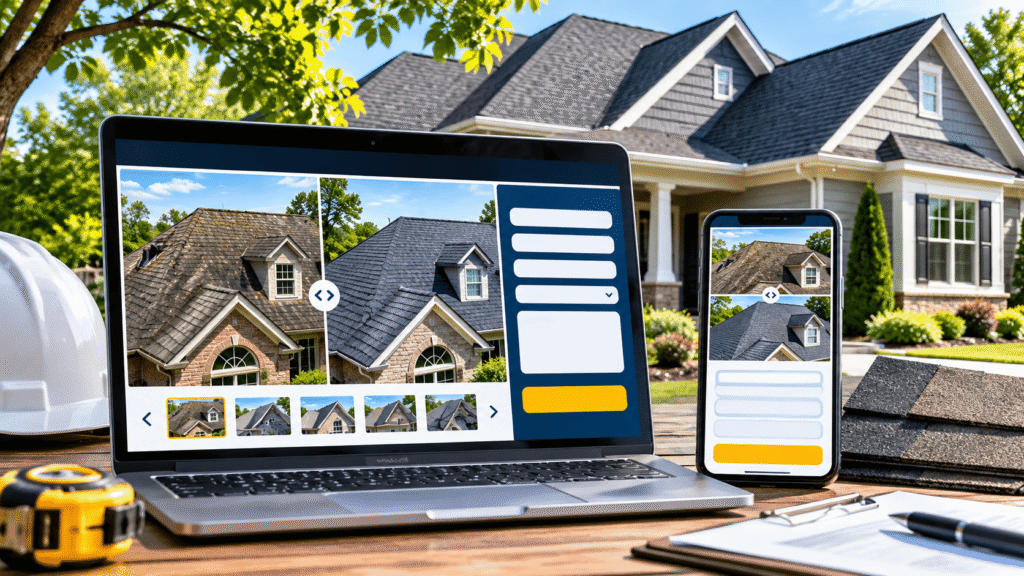
Even when a roofing company remains on WordPress, a redesign can involve technical changes that resemble a website migration.
A new theme, page builder, template system, or navigation structure may affect URLs, headings, metadata, image paths, internal links, or indexing settings.
A structured migration plan helps prevent avoidable disruptions.
Phase 1: Audit the existing roofing website
Before making changes, document:
Existing indexable URLs.
Organic landing-page performance.
Important roofing service pages.
Geographic landing pages.
Current SEO titles and meta descriptions.
Canonical URLs and indexing directives.
Backlinks and internal-link destinations.
Existing lead forms and phone tracking.
Structured data.
Technical performance and Core Web Vitals.
A website crawler can help identify broken links, redirects, duplicate titles, and technical issues that should be considered during development.
Phase 2: Create a protected staging environment
A WordPress staging environment allows the redesigned website to be developed and tested before replacing the live site.
The staging site should be protected from public indexing, ideally through access controls.
Developers can use it to review responsive layouts, test contact forms, validate navigation, and compare old and new pages.
Importantly, staging protections must not accidentally carry over to the live website.
Phase 3: Map roofing URLs and content
Create a mapping document showing the existing URL and intended destination for every important page.
Some URLs may remain unchanged.
Others may be consolidated or redirected if there is a legitimate content or architectural reason.
For instance, two overlapping roof maintenance pages might be combined into one stronger resource.
However, a roof replacement page and an emergency roof repair page should not be merged merely because both discuss roofing.
They may address substantially different search intent.
Phase 4: Validate technical SEO before launch
Review the redesigned website for:
Correct canonical tags.
Intended indexability.
Accurate XML sitemap URLs.
Working internal navigation.
Relevant heading structures.
Valid permanent redirects.
Appropriate structured data.
Optimized images.
Working forms and calls.
Mobile usability.
Analytics and conversion tracking.
Technical SEO validation should be completed before launch rather than relying on Google to discover problems afterward.
Phase 5: Monitor after launch
After publishing the redesigned website, review Search Console and analytics for changes in indexing, organic landing pages, and important roofing queries.
Test lead forms and call tracking again on the live site.
A redesign cannot guarantee stable rankings, because search results are affected by many factors. But a documented process reduces unnecessary technical risk and makes problems easier to diagnose.
Organize Roof Repair, Replacement, and Commercial Roofing Pages Around Customer Intent
One of the most important decisions in roofing contractor website design is how to organize services.
Roofing companies frequently offer multiple services that attract different types of customers.
A homeowner seeking emergency leak repair has different priorities from a property owner planning a full roof replacement.
A commercial property manager evaluating a flat roof restoration project may require more technical information and a different consultation process.
A well-structured WordPress website reflects these differences.
Roof repair pages
Roof repair content should help visitors understand whether the company addresses problems such as:
Active roof leaks.
Missing or damaged shingles.
Flashing problems.
Localized storm damage.
Roof ventilation issues.
Minor roof deterioration.
Emergency roof protection services, where offered.
The page should explain relevant services and provide a straightforward contact path.
It should not promise emergency availability unless the contractor actually provides it.
Roof replacement pages
Roof replacement typically involves a larger financial commitment and more research.
Customers may want information about:
Roofing materials.
Replacement versus repair.
Project assessment.
Installation processes.
Warranty information.
Financing options, if available.
Project timelines.
Completed replacement examples.
A redesigned roof replacement page can use clear content sections, project photography, and estimate calls to action to support these decisions.
Commercial roofing pages
Commercial roofing customers may be evaluating larger properties, different materials, maintenance contracts, or specialized installation requirements.
Relevant content might cover flat roofing, low-slope systems, roof coatings, inspections, and ongoing maintenance, depending on the contractor’s actual services.
Commercial pages should communicate capabilities accurately and make it easy for property managers or business owners to submit project information.
Roofing materials and systems
Some roofing companies benefit from separate content about asphalt shingles, metal roofing, tile roofing, or flat roof systems.
However, the website should not create thin pages for every keyword variation.
A separate page is most useful when it serves a distinct customer need and can provide meaningful information.
A redesign offers the opportunity to improve this architecture while protecting existing high-value pages.
Storm Damage and Emergency Roofing: Design for Urgent Search Intent
Storm-related roofing searches deserve special consideration because customers may be dealing with immediate property damage.
After severe weather, homeowners may search for roof leak assistance, storm damage inspections, or temporary protection.
The website should make relevant services easy to identify without relying on exaggerated urgency or unsupported promises.
Make emergency contact options accessible
For roofing contractors that genuinely provide emergency services, the mobile experience should prioritize fast access to contact information.
Useful elements may include:
A visible phone number.
Click-to-call buttons.
Clear emergency service descriptions.
Accurate service-area coverage.
Simple inquiry forms.
Information about next steps.
A customer should not need to navigate through a long homepage before finding the relevant service.
Distinguish inspection, repair, and replacement
Not every storm-damaged roof requires full replacement.
Website content should avoid implying that every problem needs the most expensive solution.
A credible roofing website can explain the company’s inspection process, available repair services, and circumstances in which replacement may be considered.
This helps customers understand the available options without making unsupported diagnoses.
Present insurance-related information carefully
Some roofing contractors assist customers with documentation or provide estimates that may be relevant to insurance claims.
If the company offers this assistance, the website can explain its actual role.
However, content should not promise claim approval, guaranteed coverage, or insurance outcomes.
A redesign should improve clarity and trust rather than introduce aggressive claims that may mislead homeowners.
Roofing Project Galleries: Turn Completed Work Into Website Trust Signals

Roofing is a visual industry.
Before-and-after photographs, completed installations, and real project examples can help prospective customers evaluate workmanship and experience.
Yet many roofing websites treat their project galleries as collections of large images without meaningful context.
A WordPress redesign can transform those galleries into more useful resources.
Organize roofing projects by service type
A project portfolio may include categories such as:
Residential roof replacement.
Roof repairs.
Metal roofing.
Tile roofing.
Commercial roofing.
Flat roof systems.
Storm damage restoration.
The categories should reflect completed work and actual services.
Visitors should be able to explore projects relevant to their needs.
Add useful project descriptions
A roofing project page becomes more informative when it explains the work rather than relying entirely on photographs.
Depending on available information, a project description may include:
The type of roofing service.
The roofing system or materials used.
General project location.
The property’s relevant characteristics.
The scope of work.
Challenges addressed.
Completed project photographs.
Avoid publishing private customer information or unsupported project claims.
Optimize roofing images for WordPress performance
High-resolution project photography can create large page files.
Image optimization should include appropriate dimensions, modern formats where suitable, compression, descriptive filenames, and meaningful alternative text.
For example, an image of a completed standing-seam metal roof can use alt text describing the actual installation rather than repeating generic roofing keywords.
Lazy loading can help with images below the fold, while prominent above-the-fold imagery should be handled carefully to avoid delaying the main content.
Connect portfolios to service pages
A completed roof replacement project can link to the company’s roof replacement service page.
A commercial roofing case study can direct interested property managers to relevant service information.
These contextual connections support usability and reinforce relationships between services and completed work.
They also give prospective customers a natural path from evaluating project evidence to requesting an estimate.
Mobile Roofing Website Design: Improve Calls and Estimate Requests
Many roofing customers research contractors on smartphones.
A mobile-friendly website should make it easy to identify the relevant service, review trust signals, and contact the company.
Use clear mobile navigation
Roof repair, replacement, commercial roofing, and service-area information should be accessible without excessive menu complexity.
Navigation labels should describe services plainly.
Visitors should not have to guess whether a generic menu item contains the roofing service they need.
Prioritize readable content
Large blocks of text, tiny fonts, and crowded layouts can make roofing information difficult to evaluate.
A redesigned website should use clear headings, appropriate spacing, readable typography, and responsive images.
This matters particularly on service pages where customers are comparing multiple contractors.
Improve click-to-call functionality
A clearly visible phone number can reduce friction for customers who prefer to speak with someone.
Mobile call buttons should use functioning telephone links and be tested on real devices.
A sticky contact bar may be useful, but it should not obscure important content or interfere with navigation.
Simplify roofing estimate forms
An estimate request form might ask for:
Name.
Phone number.
Email address.
Property ZIP code or location.
Roofing service needed.
Brief project description.
Preferred contact method.
More detailed qualification may be appropriate for large commercial projects.
The form should collect enough information to support follow-up without making initial contact unnecessarily difficult.
Roofing Website Lead Generation: Design Around Qualified Project Inquiries
A redesigned roofing website should do more than attract attention.
It should help the right customers contact the business about relevant roofing work.
Roofing website lead generation depends on aligning search intent, page content, trust signals, and conversion opportunities.
Match calls to action with roofing services
Different roofing pages should use calls to action appropriate to their purpose.
For roof repair:
Request a Roof Repair Inspection
For roof replacement:
Schedule a Roof Replacement Estimate
For commercial roofing:
Discuss Your Commercial Roofing Project
For a roofing project portfolio:
Request an Estimate for a Similar Project
These are examples. Actual wording should match the contractor’s services and operational capabilities.
A single generic button repeated everywhere may be less helpful than a clear next step tailored to the service.
Place calls to action where customers need them
An estimate button in the homepage header is useful, but it should not be the only conversion opportunity.
Relevant calls to action can appear after service explanations, project examples, and trust-building sections.
The goal is to provide convenient next steps without overwhelming the page with repeated promotional blocks.
Show authentic roofing business credentials
Depending on what the contractor can substantiate, useful trust signals may include:
Relevant licensing information.
Insurance information.
Manufacturer certifications.
Verified customer reviews.
Completed roofing projects.
Years of experience.
Service-area coverage.
Warranty details.
Financing availability.
Claims should be accurate and current.
A redesign should make genuine evidence easier to find rather than replacing it with fabricated testimonials or unsupported ranking claims.
Consider the value of different roofing leads
Not every inquiry represents the same type of project.
A minor repair, full residential replacement, and commercial roofing contract may have very different project scopes.
A website should make it easy for the business to understand what customers need.
This can improve lead routing and help the company evaluate whether its website is attracting relevant opportunities.
Core Web Vitals and WordPress Performance for Roofing Websites
Roofing websites often rely heavily on visual content.
Large project photographs, image sliders, background videos, maps, and third-party widgets can increase loading time.
A redesign provides an opportunity to improve performance without sacrificing useful project presentation.
Largest Contentful Paint
Largest Contentful Paint measures how quickly the main visible content loads.
On a roofing website, the main content may be a large hero image showing a completed roof installation.
Optimizing image dimensions, file formats, caching, hosting, and loading priorities can improve the experience.
Interaction to Next Paint
Interaction to Next Paint measures how responsive the website is to user interactions.
Excessive JavaScript, complicated sliders, and poorly optimized widgets can make menus and forms sluggish.
WordPress redesign should evaluate unnecessary scripts and improve interaction responsiveness.
Cumulative Layout Shift
Cumulative Layout Shift measures unexpected movement of visible content.
Roofing websites should reserve appropriate space for images, embedded reviews, and dynamic elements.
A visitor should not accidentally activate the wrong button because content moves while loading.
Balance design and speed
A roofing company does not need to remove every project gallery or interactive feature to improve performance.
The objective is to implement useful features efficiently.
A fast website with no meaningful project evidence may be less persuasive than a well-optimized website that presents authentic work clearly.
Performance should support the overall customer experience.
Local SEO Preservation for Roofing Contractors Serving Multiple Cities
Roofing companies frequently operate across metropolitan areas, suburbs, and surrounding communities.
Their websites may include pages for individual cities or service areas.
These pages can be valuable when they provide accurate, relevant information and already attract organic visibility.
A redesign should evaluate them carefully.
Audit existing service-area URLs
Review which geographic pages receive impressions, clicks, backlinks, and customer inquiries.
A page serving a relevant local roofing search should not be removed simply because the redesigned navigation looks cleaner without it.
Important information to preserve may include:
Actual service-area coverage.
Relevant roofing services.
Local project examples.
Geographic context.
Existing internal links.
Contact information.
Established URLs.
Avoid duplicate city-page templates
A redesigned website should not generate dozens of near-identical pages with only city names changed.
Geographic content should reflect actual service coverage and provide meaningful information for customers.
Local project examples, regional roofing considerations, and service availability can help differentiate pages when supported by real business information.
Maintain consistency with Google Business Profile
Website information should remain consistent with the roofing company’s real business details and Google Business Profile.
If the redesign changes important landing-page URLs, review website links used in relevant profiles and business listings.
The objective is accurate representation and a clear user experience—not manipulating business information to target additional keywords.
Roofing Website Redesign for Chicago and Illinois Contractors
Chicago and Illinois roofing contractors may serve customers dealing with seasonal weather exposure, roof repairs, replacement projects, and commercial roofing needs.
For an established roofing company, its website may already have service pages targeting Chicago and surrounding communities.
A redesign should preserve valuable local URLs and improve how those services are presented.
Prioritize service architecture
A roofing website serving Illinois markets may need clear sections for residential roofing, repairs, replacements, storm-related services, and commercial roofing.
The exact structure depends on the contractor’s capabilities.
Protect existing geographic visibility
If service-area pages already perform for relevant Illinois searches, review their rankings and organic traffic before changing them.
Retain useful localized information and relevant internal links.
Improve mobile roofing inquiries
Homeowners looking for roof repairs or replacement estimates should be able to reach the appropriate service page quickly.
A WordPress redesign can improve forms, contact buttons, and project presentation while retaining the site’s established SEO foundation.
For related local search strategy, explore Roofing Contractor SEO in Illinois, Chicago & Naperville.
Roofing Website Redesign for Miami and South Florida Contractors
Roofing companies operating in Miami and South Florida may need to communicate services related to roof repair, replacement, maintenance, and storm-related damage.
Customers may also research roofing materials and installation requirements relevant to their properties.
A website redesign should reflect the contractor’s actual capabilities and avoid generic claims about services it does not provide.
Present roofing systems clearly
Depending on the company, relevant service content may discuss tile roofing, metal roofing, flat roofing, shingle systems, or commercial applications.
Separate pages should be created only when they provide meaningful value and match actual services.
Improve trust and project presentation
Authentic roofing photographs, verified credentials, and clear explanations of completed work can help customers evaluate the business.
The redesigned website should make this information accessible without slowing down mobile pages.
Preserve Miami-area SEO assets
Established pages targeting Miami and surrounding service areas should be evaluated before changing URLs or content.
A redesign can improve usability while protecting valuable local relevance.
For broader contractor visibility and lead-generation strategy, see SEO for Contractors in Miami and South Florida.
Roofing Website Redesign for Los Angeles and Southern California Contractors
Los Angeles roofing companies may serve a mix of residential properties, commercial buildings, and different roofing systems.
A redesigned website should communicate the company’s actual service capabilities and geographic coverage clearly.
Organize roofing services for relevant customers
Depending on the business, the website may feature residential roof repair, replacement, flat roofing, tile roofing, commercial projects, or other services.
The architecture should reflect customer needs rather than simply repeating keyword variations.
Improve estimate pathways
Homeowners comparing roofing contractors may review project examples, credentials, and service details before requesting a quote.
Clear calls to action and mobile-friendly forms can help move visitors from research to inquiry.
Preserve existing local rankings
A Los Angeles roofing website with established service pages should retain valuable content and URLs whenever practical.
New designs, improved project galleries, and stronger mobile UX can be introduced without automatically replacing the existing SEO structure.
For a related commercial SEO resource, explore Nfinity Media’s Los Angeles roofing contractor SEO services.
Should Roofing Contractors Redesign or Completely Rebuild Their WordPress Website?
A roofing company does not always need to rebuild its website from scratch.
The right decision depends on the condition of the existing WordPress installation, its content architecture, technical limitations, and business goals.
When a targeted redesign may be sufficient
A targeted redesign may be appropriate when:
Important roofing pages already rank well.
Existing URLs and service content remain relevant.
The theme and page builder are maintainable.
The main problems involve visual presentation or mobile UX.
Forms and navigation need improvement.
Page speed can be improved without replacing the entire platform.
This approach may reduce migration complexity.
When a more extensive rebuild may be justified
A larger rebuild may be appropriate when:
The website uses unsupported technology.
Templates are inconsistent or difficult to maintain.
Plugin conflicts create ongoing problems.
Service architecture no longer reflects the business.
Existing functionality is unreliable.
Major integrations or structural changes are required.
The decision should be based on a technical audit and business requirements.
A complete rebuild is not inherently better than a carefully planned redesign.
For roofing contractors with established organic visibility, unnecessary changes can introduce avoidable risks.
How to Measure Roofing Website Redesign Performance
The success of a roofing website redesign should be evaluated through more than appearance.
A modern homepage may create a stronger first impression, but commercial performance depends on whether the website attracts relevant visitors and helps them contact the business.
Monitor organic search performance
Use Google Search Console to compare:
Organic impressions.
Organic clicks.
Important roofing queries.
Landing-page performance.
Indexing status.
Search visibility for service and location pages.
Account for seasonal changes and differences in search demand when interpreting results.
Monitor qualified lead generation
Depending on the company’s tracking systems, relevant metrics may include:
Completed estimate requests.
Verified phone inquiries.
Roofing inspection bookings.
Commercial project inquiries.
Qualified leads recorded in the CRM.
Appointments that progress to actual projects.
A click on a phone number is not necessarily a completed call, and a submitted form is not automatically a qualified lead.
Measurement should distinguish between website interactions and meaningful business outcomes.
Monitor technical quality
Review Core Web Vitals, crawl errors, redirects, broken links, and form functionality.
A redesign should not introduce new technical problems while improving visual presentation.
Compare performance over an appropriate period
SEO changes may take time to be reflected in search results.
Comparisons should consider the timing of the redesign, seasonality, competitive changes, and any simultaneous marketing activity.
Avoid attributing every change in leads or rankings solely to the website redesign.
Common Roofing Website Redesign Mistakes to Avoid
Even an attractive WordPress redesign can create problems when important details are overlooked.
Deleting valuable roof repair or replacement pages. Existing pages may already attract qualified customers through Google.
Changing URLs without proper redirects. Unnecessary URL changes can disrupt established search pathways.
Replacing useful content with generic marketing copy. Roofing customers need specific service information.
Publishing unoptimized project galleries. Large photographs can make mobile pages unnecessarily slow.
Using the same call to action for every roofing service. Emergency repairs, replacement estimates, and commercial inquiries may require different approaches.
Removing service-area pages without reviewing performance. Local visibility should be assessed before consolidation.
Using fabricated reviews or unsupported credentials. Authentic evidence is more valuable than misleading claims.
Ignoring conversion tracking during migration. Broken analytics or forms can undermine lead reporting.
Launching without mobile testing. Roofing customers should be able to navigate, call, and request estimates from smartphones.
Failing to monitor SEO after launch. Post-launch checks help identify technical issues before they become persistent problems.
Avoiding these mistakes makes the redesign process more predictable and protects the website’s existing commercial value.
How Nfinity Media Approaches WordPress Redesign for Roofing Companies
At Nfinity Media, roofing contractor website redesign is approached as a coordinated project involving WordPress development, SEO preservation, UX, technical performance, and lead generation.
The process begins by evaluating what the existing roofing website already does well.
Important service pages, search visibility, geographic coverage, project content, and conversion pathways should be understood before structural changes are made.
From there, the redesign can address five connected priorities.
1. Roofing SEO preservation
Review existing URLs, high-value service pages, internal links, metadata, indexing, and redirect requirements.
The objective is to preserve useful search equity while allowing meaningful content and design improvements.
2. WordPress design and user experience
Create responsive layouts, clearer navigation, readable service content, and maintainable templates.
Roof repair, replacement, commercial roofing, and project galleries should be organized around customer needs.
3. Project portfolio presentation
Improve how completed roofing work is displayed through relevant photographs, descriptive project content, and optimized image performance.
Authentic project evidence should support customer confidence.
4. Conversion rate optimization
Improve estimate forms, mobile contact options, service-specific calls to action, and trust-building elements.
The goal is to reduce friction between relevant website traffic and qualified roofing inquiries.
5. Technical performance and measurement
Review Core Web Vitals, WordPress configuration, analytics, conversion tracking, and post-launch performance.
The redesigned website should be easier to use, measure, and maintain.
These priorities work best together.
A roofing website does not need to abandon its established SEO foundation to become more modern, and an attractive design should not come at the expense of clear service information or functioning lead-generation tools.
For the broader commercial approach, explore WordPress Website Redesign for Contractors Without Losing SEO Rankings.
Frequently Asked Questions About Roofing Contractor Website Redesign
1. Can roofing contractors redesign their websites without losing Google rankings?
Yes. Roofing contractors can redesign their websites while taking steps to preserve existing SEO visibility. Important precautions include auditing current rankings, retaining valuable URLs, preserving relevant content, implementing necessary redirects, and monitoring performance after launch. Rankings cannot be guaranteed, but careful planning reduces avoidable risks.
2. Should a roofing company keep its existing WordPress URLs?
In many cases, yes. Established URLs should generally be retained when their pages continue serving the same purpose. Changing URLs without a clear reason adds migration complexity. If a URL must change, use a relevant permanent redirect and update internal links.
3. What should a roofing contractor website redesign include?
A comprehensive redesign may include mobile-friendly WordPress layouts, roofing service architecture, project galleries, local SEO preservation, technical migration planning, Core Web Vitals optimization, trust signals, estimate forms, and conversion tracking.
4. How important are roofing project galleries for website conversions?
Project galleries can help prospective customers evaluate the contractor’s work. Real photographs, meaningful descriptions, and relevant service links can make the portfolio more useful. Galleries should also be optimized to avoid slowing down the website.
5. Should roof repair and roof replacement have separate website pages?
Separate pages are often appropriate because roof repair and replacement serve different customer needs and search intent. Each page should provide meaningful information about the actual service rather than duplicating generic roofing content.
6. Can Elementor be used for a roofing contractor website redesign?
Yes. Elementor can support responsive roofing service pages, galleries, forms, and reusable layouts. However, the implementation should be evaluated for performance, accessibility, maintainability, and unnecessary scripts or widgets.
7. How can roofing companies improve lead generation after a redesign?
Roofing companies can improve conversion pathways through clearer service navigation, mobile-friendly estimate forms, visible contact information, authentic project examples, relevant calls to action, and reliable lead tracking. Actual results depend on traffic quality, customer demand, and business operations.
8. How long does it take Google to process a roofing website redesign?
There is no fixed timeline. Google must crawl and process relevant changes, and the impact depends on the scale of the redesign, website condition, competition, and technical implementation. Monitoring should begin immediately after launch and continue over subsequent weeks and months.
Final Thoughts: Protect Roofing SEO While Building a Better Lead-Generation Website
For an established roofing contractor, a website redesign should not mean discarding the search visibility, content, project evidence, and customer trust the business has already built.
A carefully planned WordPress redesign can retain valuable roofing service pages while improving mobile performance, navigation, project presentation, and conversion opportunities.
The process should begin with understanding existing rankings, URLs, internal links, and customer inquiries.
From there, the website can be improved around the actual needs of roofing customers: urgent repairs, planned replacements, commercial projects, and trustworthy estimates. Explore our Roofing SEO Service page.
Whether a roofing company operates in Chicago, Miami, Los Angeles, or another competitive market, the principle remains consistent:
Preserve the search equity your roofing business has already earned while creating a faster, clearer, and more conversion-focused WordPress website.
Nfinity Media helps contractors connect WordPress redesign, technical SEO preservation, website UX, and lead-generation strategy.
If your roofing website needs improvement, explore our WordPress contractor redesign services or schedule a digital growth consultation to discuss your existing website, SEO priorities, and redesign goals.