Cleaning companies don’t all compete for the same customers. A residential maid service might need consistent weekly cleaning bookings, while a commercial janitorial company may be looking for office contracts, property management relationships, or recurring facility maintenance agreements.
Yet many cleaning businesses approach social media marketing in exactly the same way: posting occasional before-and-after photos, promoting a discount, or running Facebook Ads without a clear strategy for turning inquiries into paying customers.
Effective social media marketing for cleaning companies connects Facebook and Instagram content, Meta advertising, local search visibility, and a reliable booking or estimate-request process.
The goal isn’t simply to generate more likes, followers, or inexpensive leads. It’s to attract customers who need the cleaning services a business actually provides—and make it easy for them to book.
At Nfinity Media, we approach cleaning company marketing as a connected acquisition system involving social media, paid advertising, WordPress landing pages, SEO, conversion optimization, and lead tracking.
This guide explains how that system can support residential cleaning companies, maid services, deep-cleaning specialists, move-out cleaners, commercial janitorial providers, and post-construction cleaning businesses.
1. Why Cleaning Companies Need More Than Occasional Facebook and Instagram Posts
Cleaning is a highly local service, but buying behavior varies by customer type.
Homeowners may search for a cleaner because they’re moving, hosting guests, managing a busy household, or preparing a property for sale. Property managers may need dependable turnover cleaning. Commercial facilities may be comparing vendors for ongoing janitorial contracts.
Social media can introduce a cleaning business to these customers before they actively request an estimate.
However, social media visibility and actual customer acquisition are different outcomes.
A cleaning company might receive thousands of Instagram views without generating a single booking if its content doesn’t clearly communicate:
Which cleaning services it provides.
Whether it serves residential or commercial properties.
Which cities and neighborhoods it covers.
What makes its team trustworthy and dependable.
How prospective customers can request pricing or schedule service.
A strong marketing strategy answers these questions consistently.
Organic social media versus paid Meta advertising
Organic Facebook and Instagram marketing helps build familiarity, credibility, and recognition.
Paid Meta Ads can expand reach beyond existing followers and introduce specific services to potential customers within a defined service area.
Both have a role, but they should not be treated as interchangeable.
A residential cleaning company might use Instagram Reels to demonstrate a deep-cleaning transformation, then run a Facebook campaign promoting recurring home-cleaning consultations.
A commercial janitorial provider might use organic content to demonstrate professional processes and use advertising to reach local decision-makers. However, commercial campaigns generally require additional qualification because not every inquiry represents a viable contract opportunity.
The strongest approach connects content, advertising, landing pages, and follow-up rather than treating each channel as a separate activity.
2. Facebook Ads for Residential Cleaning and Maid Services
Residential cleaning is one of the most natural applications of local Facebook and Instagram advertising.
Potential customers can understand the service quickly, the results are visually demonstrable, and the offer can be tied to an immediate household need.
But the campaign structure should reflect the type of customer a cleaning business wants.
Recurring maid service campaigns
Recurring cleaning customers can be particularly valuable because a single successful acquisition may lead to weekly, biweekly, or monthly appointments.
Rather than advertising only a one-time discounted clean, campaigns can emphasize:
Weekly and biweekly home-cleaning availability.
Consistent scheduling and dependable service.
Clear service-area coverage.
Professional cleaning teams.
Simple online estimate requests.
Convenient recurring appointment options.
The business should measure how many advertising leads become recurring customers—not simply how many people submit a form.
Deep-cleaning campaigns
Deep-cleaning services often appeal to homeowners preparing for a particular event or addressing a more intensive cleaning need.
Creative can demonstrate kitchens, bathrooms, appliances, flooring, and detailed cleaning work.
Ad messaging should explain what is included, what may cost extra, and whether the service is intended as a one-time appointment or the beginning of ongoing maintenance.
Move-out and move-in cleaning
Facebook Ads for move-out cleaning companies deserve a separate campaign angle because the customer’s urgency and buying criteria differ from routine maid service.
Potential customers may be coordinating lease deadlines, property inspections, home sales, or relocation schedules.
Useful campaign messages include:
Move-out and move-in cleaning appointments.
Apartment and rental property cleaning.
Cleaning before a property handover.
Availability within specific service areas.
Estimate requests based on property size and condition.
A move-out cleaning landing page should ask about the property location, approximate size, desired service date, and cleaning requirements.
These details help distinguish a qualified booking inquiry from someone casually comparing prices.
3. Instagram Marketing for Cleaning Services: Content That Builds Trust
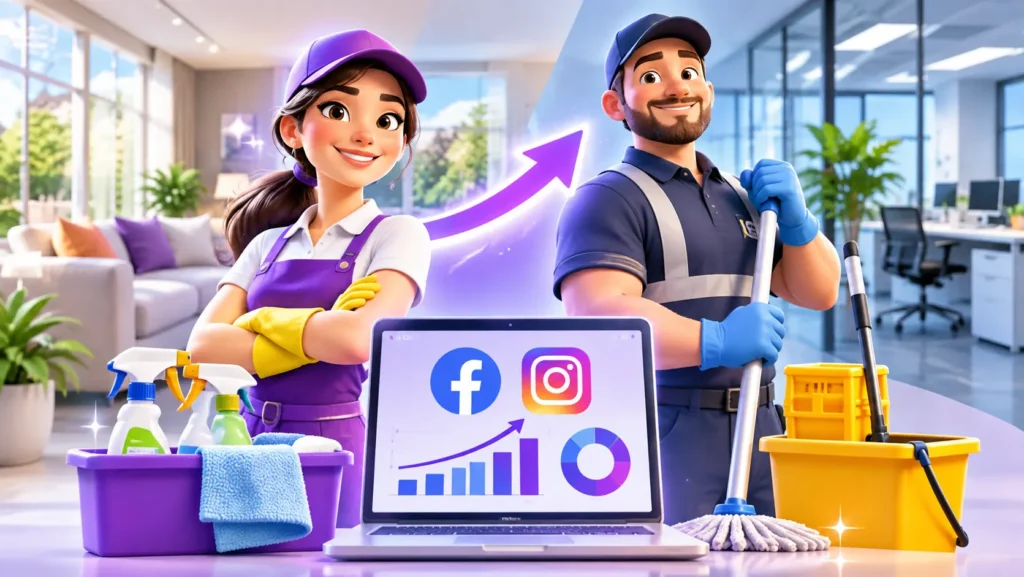
Instagram marketing for cleaning companies works best when the content makes the service tangible.
Cleaning is visually demonstrable, which gives businesses several useful content formats.
Before-and-after transformations
Before-and-after photos and short videos can demonstrate the quality and scope of work.
Examples include kitchen cleaning, bathroom detailing, floor care, office common areas, and post-renovation cleanup.
Use authentic project footage and obtain appropriate permission before publishing images from private homes or commercial facilities.
Cleaning process Reels
Short videos can show the team preparing equipment, following cleaning checklists, completing detailed work, and maintaining quality standards.
These videos help customers understand what they’re purchasing.
Educational content
Educational posts can address practical questions:
What’s included in standard house cleaning?
When should a homeowner schedule deep cleaning?
How is move-out cleaning different from regular cleaning?
How often should offices schedule professional cleaning?
What should property managers prepare before a turnover clean?
This content can also support website FAQs and service-page development.
Customer testimonials and team introductions
Cleaning businesses often enter private homes, offices, and other sensitive spaces.
Trust matters.
With permission, customer testimonials, team introductions, and behind-the-scenes content can help reduce uncertainty before someone books.
A realistic posting schedule
A smaller cleaning business doesn’t need to publish daily to maintain a useful presence.
A practical starting schedule could include two or three weekly posts, a short project Reel, and regular Stories showing current work or appointment availability.
Consistency and relevance are more useful than posting large amounts of repetitive content.
4. Commercial Cleaning and Janitorial Service Meta Ads Require a Different Strategy
Commercial cleaning marketing should not simply copy residential maid-service campaigns.
The buyer is different, the decision process is often longer, and the value of a successful contract may be substantially higher.
Commercial cleaning businesses may serve:
Professional offices and business parks.
Retail locations and showrooms.
Apartment and condominium common areas.
Property management portfolios.
Medical and dental offices.
Warehouses and industrial facilities.
Schools and other institutional facilities, where appropriate.
A commercial buyer usually needs more than an attractive before-and-after photograph.
They may evaluate scheduling, staffing, insurance, quality-control procedures, building access, service consistency, and the ability to manage a particular facility type.
Facebook Ads for commercial cleaning companies
Meta campaigns can promote office-cleaning estimates, facility walkthroughs, and janitorial service consultations.
However, Meta’s audience-targeting options should not be assumed to identify every facility manager or business decision-maker accurately.
Commercial campaigns should use relevant creative, geographic coverage, qualifying questions, and appropriate conversion tracking to improve lead quality.
Commercial cleaning lead qualification
Instead of asking only for a name and phone number, a commercial cleaning inquiry form can request:
Business or facility type.
Approximate building size.
Property location.
Desired cleaning frequency.
Whether an existing cleaning provider is being replaced.
Preferred walkthrough or consultation date.
These details help the cleaning company prioritize realistic opportunities.
The objective is not the lowest possible cost per lead. It’s the cost of acquiring a qualified commercial cleaning opportunity that can become a profitable contract.
5. Post-Construction Cleaning: A Specialized Lead Generation Opportunity
Post-construction cleaning is an interesting sub-niche because it connects cleaning services with contractors, remodelers, builders, and property managers.
Unlike routine residential cleaning, these projects often involve defined completion dates, construction dust, debris, and preparation for occupancy or handover.
Potential customers include general contractors, renovation companies, commercial property managers, and developers.
What should post-construction cleaning campaigns emphasize?
Marketing should communicate:
Rough, final, and touch-up cleaning where offered.
Residential and commercial project capabilities.
Construction-site readiness and safety procedures.
Service-area availability.
Scheduling around project completion.
The ability to request project-specific estimates.
The landing page should be clear about which types of cleaning are offered and whether the company handles specialized or hazardous materials. Businesses should not imply certifications or capabilities they don’t hold.
Combining Meta Ads with contractor relationships
For post-construction cleaning companies, paid social media can support brand awareness and inquiry generation, but direct relationships with contractors and property managers may also be essential.
This makes a hybrid strategy useful: Meta Ads, professional website content, local SEO, project examples, and relationship-based business development.
6. Why Cleaning Company Facebook Ads Generate Leads but Not Bookings
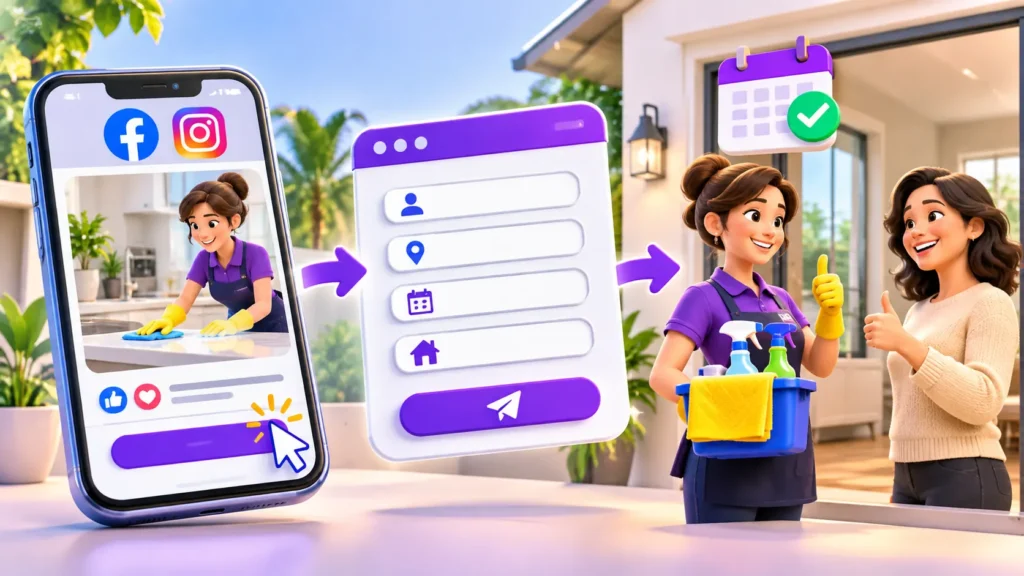
A cleaning company may run a campaign, receive form submissions, and still struggle to fill its schedule.
The problem is often somewhere between the advertisement and the completed booking.
The advertisement attracts the wrong customer
Broad messaging such as “Affordable Cleaning Services” can generate price-sensitive inquiries without distinguishing between residential cleaning, deep cleaning, and commercial work.
More specific service offers usually make it easier to identify relevant customers.
The form doesn’t qualify the inquiry
A form requesting only a phone number may produce volume but leave the cleaning company with little information about the job.
For residential services, asking about cleaning type, property size, location, and preferred date can improve qualification.
For commercial work, facility type and desired cleaning frequency may be more important.
The business responds too slowly
Cleaning inquiries are often time-sensitive.
A customer requesting move-out cleaning may contact several providers on the same day.
A clear follow-up process, appointment confirmation, and accessible scheduling options can reduce the chance of losing a qualified inquiry.
The website doesn’t match the advertisement
If someone clicks an advertisement for move-out cleaning but lands on a generic homepage, they may have difficulty finding the relevant service.
The landing page should reinforce the offer and explain what happens next.
Nobody tracks completed jobs
Meta may report a lead when someone submits a form, but that does not automatically establish that the lead booked, paid, or became a recurring customer.
Connecting advertising data with actual booking and customer records provides a more useful picture of campaign performance.
7. WordPress Landing Pages That Turn Cleaning Leads Into Customers
A well-designed WordPress website can connect social media traffic with actual service inquiries.
Rather than sending every campaign to the homepage, cleaning companies can develop dedicated pages for important services.
For example:
Residential house cleaning.
Recurring maid services.
Deep cleaning.
Move-in and move-out cleaning.
Office and commercial cleaning.
Post-construction cleaning.
Each page should explain the service, show relevant proof, identify the service area, and provide a clear next step.
Essential landing-page elements
A cleaning service landing page can include a concise headline, authentic project images, service inclusions, customer reviews, service-area details, FAQs, and a prominent estimate-request form.
For recurring residential cleaning, the CTA might be Request a Weekly or Biweekly Cleaning Estimate.
For commercial janitorial work, a more suitable CTA could be Schedule a Commercial Cleaning Walkthrough.
These different calls to action reflect different buyer expectations.
Nfinity Media’s approach to Google Ads landing page optimization can also be applied to paid social campaigns: preserve message consistency, reduce friction, and make conversions measurable.
8. Meta Pixel, Conversions API, GA4 and Cleaning Lead Tracking
Running Facebook and Instagram Ads without meaningful conversion tracking can make campaign decisions unnecessarily difficult.
A cleaning company should understand what happens after someone interacts with an advertisement.
Relevant tracking may include:
Landing-page visits.
Estimate-request submissions.
Booking-button interactions.
Qualified lead status.
Confirmed appointments.
Completed jobs and recurring customer acquisition.
Meta Pixel and Conversions API can support campaign measurement when implemented appropriately.
Google Analytics 4 and Google Tag Manager can help measure website activity and conversion events.
A CRM or booking platform can record lead status and appointment outcomes.
Businesses should configure these tools with appropriate consent, privacy protections, and accurate event definitions. Customer contact information and other personal data should not be shared indiscriminately.
The most useful performance metrics
Residential cleaning businesses should examine cost per qualified inquiry, cost per completed booking, recurring-customer acquisition, and customer retention.
Commercial cleaning businesses should examine qualified walkthrough requests, proposal opportunities, contract close rates, and customer acquisition costs.
A campaign with fewer leads can outperform a high-volume campaign if it produces better customers.
9. How Much Should Cleaning Companies Spend on Facebook and Instagram Ads?
There is no universal Meta Ads budget that works for every cleaning company.
Budget decisions should consider local competition, service-area size, average job value, contribution margin, customer retention, and the company’s capacity to fulfill new bookings.
For planning purposes, a small residential cleaning business might test an illustrative advertising budget of $600–$1,500 per month, while an established multi-service company might evaluate $1,500–$3,000 or more.
These are planning examples, not verified industry benchmarks or guaranteed spending requirements. Agency management fees, creative production, and landing-page development would be additional expenses.
Commercial cleaning businesses should be especially careful about optimizing for lead quantity alone.
A small number of qualified recurring contracts may be more valuable than many low-quality inquiries.
A simple cleaning company acquisition calculation
Suppose a residential cleaning company spends $1,000 on advertising and generates 40 inquiries.
That represents a $25 advertising cost per inquiry.
If 10 inquiries become paying customers, the advertising cost per acquired customer is $100.
Whether that is profitable depends on the gross profit from each booking, repeat business, operational costs, and any agency fees.
This illustrates why cleaning companies should evaluate customer acquisition economics instead of treating cost per lead as the final measure of success.
10. Local SEO and Google Search Strengthen Cleaning Company Social Media Campaigns
Social media can create interest, but customers often use Google to compare businesses before making contact.
A homeowner might discover a cleaning company through Instagram, then search its business name, reviews, and service area.
A property manager might see a Facebook advertisement and later research the company through Google.
This makes local SEO an important supporting channel.
Google Business Profile
Cleaning companies should maintain accurate business information, service areas, categories, hours, and customer-facing details.
Genuine reviews and consistent business information can help prospective customers evaluate a company.
Service-specific SEO pages
A cleaning company serving multiple customer needs should distinguish between house cleaning, deep cleaning, move-out cleaning, and commercial janitorial services.
These services have different search intent.
A useful website structure makes those differences clear without generating dozens of nearly identical location pages.
Location relevance
Cleaning companies should identify the cities and communities they genuinely serve.
A local SEO strategy can combine service pages, geographic relevance, customer reviews, internal linking, and technically sound WordPress implementation.
Learn more about local SEO for service businesses.
Search visibility and Meta Ads work together
Meta Ads can introduce a service to people who weren’t actively searching for it.
Google Search can capture people with an immediate need.
The combination is useful when campaigns, landing pages, and follow-up processes support the same business goals.
11. Social Media Strategies for Different Cleaning Business Models
A cleaning company’s advertising strategy should reflect its services rather than relying on a generic campaign template.
| Cleaning business | Social media focus | Primary conversion |
|---|---|---|
| Residential house cleaning | Trust, convenience, recurring availability | Booked home cleaning |
| Maid services | Reliability, team introductions, repeat schedules | Weekly or biweekly customer |
| Deep cleaning | Detailed transformations and service scope | Deep-cleaning estimate |
| Move-out cleaning | Timing, property handover, availability | Date-specific booking |
| Commercial janitorial | Professional capabilities and consistency | Facility walkthrough |
| Office cleaning | Workplace presentation and ongoing maintenance | Office-cleaning proposal |
| Post-construction cleaning | Project completion and contractor coordination | Project-specific estimate |
The distinction matters because each audience has different buying motivations.
A campaign built around an inexpensive first clean may attract residential customers, but it may not appeal to a commercial property manager seeking a long-term janitorial provider.
Likewise, a commercial cleaning advertisement focused on building walkthroughs is unlikely to be the most efficient approach for a homeowner who needs an apartment cleaned before moving.
12. A Practical 30-Day Marketing Plan for Cleaning Companies
Week 1: Audit the current customer journey
Review existing social media profiles, website pages, Google Business Profile, lead forms, and booking processes.
Identify which cleaning services produce the strongest margins and which customer types the company wants to attract.
Check whether existing advertising leads can be connected to actual appointments and revenue.
Week 2: Build relevant content and landing pages
Prepare authentic before-and-after photos, cleaning-process videos, testimonials, and service explanations.
Develop or improve the landing pages for priority services.
Make sure forms request enough information to qualify customers without creating unnecessary friction.
Week 3: Launch focused Meta Ads tests
Test one or two priority offers rather than advertising every cleaning service simultaneously.
A residential cleaning company might test recurring house cleaning against deep cleaning.
A commercial provider might test office-cleaning walkthroughs against broader janitorial inquiries.
Use appropriate geographic settings, accurate tracking, and relevant creative.
Week 4: Review lead quality and booking results
Compare campaign inquiries with actual appointments, estimates, completed jobs, and recurring customers.
Identify where leads are lost.
Improve creative, landing-page messaging, qualification questions, and follow-up before increasing spending.
A 30-day test can reveal operational problems and early campaign signals, but it may not be long enough to establish reliable profitability for every service, particularly commercial contracts with longer sales cycles.
13. Frequently Asked Questions
Are Facebook Ads effective for cleaning companies?
Facebook Ads can generate inquiries for residential and commercial cleaning services when campaigns use relevant offers, appropriate geographic targeting, clear landing pages, and dependable follow-up. Results vary by market, service type, competition, and execution.
Is Instagram marketing useful for maid services?
Yes. Instagram can showcase authentic cleaning transformations, team professionalism, customer testimonials, and recurring service availability. It can help build trust before someone requests a cleaning appointment.
Can Meta Ads generate commercial cleaning contracts?
Meta Ads can support commercial cleaning lead generation, including walkthrough requests and janitorial service inquiries. However, commercial contracts often require more qualification and a longer sales process than residential cleaning bookings.
What is the difference between residential and commercial cleaning advertising?
Residential campaigns typically focus on household needs, convenience, appointment availability, and recurring service. Commercial campaigns focus on facility requirements, reliability, service capabilities, and qualified contract opportunities.
Should cleaning companies advertise move-out cleaning separately?
Often, yes. Move-out cleaning customers may have fixed deadlines, property handover requirements, and different service expectations. A dedicated campaign and landing page can address those needs more clearly.
How can post-construction cleaning companies find more customers?
They can combine service-specific SEO, professional project examples, contractor relationships, targeted advertising, and estimate-request landing pages. Campaigns should clearly describe project types and service capabilities.
How much should a cleaning company spend on Meta Ads?
The appropriate budget depends on customer value, margins, local competition, capacity, and campaign objectives. Start with an amount the business can sustain while measuring qualified inquiries and actual bookings.
Does a cleaning company need a WordPress landing page for Facebook Ads?
A dedicated landing page isn’t mandatory, but it can help communicate the service, qualify inquiries, and measure conversions. It is particularly useful when a business advertises several cleaning services with different customer needs.
Should cleaning companies invest in SEO or Meta Ads first?
That depends on current visibility, available budget, immediate lead requirements, and business goals. Local SEO helps capture active search demand, while Meta Ads can introduce services to relevant audiences. Many businesses benefit from coordinating both channels.
14. Build a More Connected Cleaning Company Marketing Strategy
Cleaning companies don’t need more disconnected marketing activity.
They need a system that connects the right customers with the right cleaning services—and turns those opportunities into scheduled jobs or qualified commercial contracts.
For residential cleaning businesses, that may mean recurring maid-service campaigns, authentic Instagram content, local SEO, and a convenient booking process.
For commercial janitorial providers, it may mean facility-specific messaging, qualified walkthrough requests, professional website content, and structured follow-up.
For move-out and post-construction cleaning specialists, it may mean service-specific advertising that reaches customers with clear project requirements and timelines.
Nfinity Media brings together Meta Ads management, social media strategy, WordPress website optimization, local SEO, and conversion tracking to help service businesses create more measurable customer-acquisition systems.
Explore our Meta Ads management services or Facebook and Instagram advertising services to learn how these channels can work together.
Ready to Improve Your Cleaning Company’s Lead Generation?
Whether you operate a residential maid service, commercial janitorial company, or specialized cleaning business, the first step is understanding where your current marketing loses qualified customers.
Schedule a digital growth consultation with Nfinity Media to review your website, social media presence, advertising opportunities, and booking conversion process.