A swimming pool builder’s website needs to accomplish something that many conventional service websites do not: help prospective customers imagine a major transformation of their property.
Homeowners researching custom swimming pools, luxury outdoor environments, pool renovations, or complete backyard construction projects often spend considerable time evaluating design styles, reviewing completed installations, comparing contractors, and considering the investment involved.
A website that simply lists pool construction services may not provide enough information to support those decisions.
At the same time, an established pool builder may already have valuable Google rankings for custom pool construction, swimming pool installation, pool remodeling, pool renovation, and location-specific searches.
Those rankings, project pages, backlinks, and existing customer inquiries represent assets that should be considered before changing the website.
A WordPress website redesign for pool builders should therefore accomplish more than a visual refresh.
It should preserve useful SEO visibility, showcase completed projects more effectively, improve mobile performance, and create clear pathways from project inspiration to qualified consultations.
For pool construction companies operating in competitive markets such as Miami, San Diego, Southern California, New York, and New Jersey, this balance is especially important.
A modern website should reflect the quality of the company’s work without unnecessarily abandoning the search equity it has already developed.
This guide explains how pool builders can approach WordPress redesign, protect important organic landing pages, improve project portfolio UX, and strengthen the website’s role in generating valuable construction inquiries.
Why Pool Builder Websites Require a Different Redesign Strategy
Pool construction is a visual, high-consideration service.
Customers are often researching a substantial investment involving design, engineering, materials, permitting, scheduling, and coordination with other outdoor improvements.
A homeowner considering a custom pool may also be evaluating spas, decking, patios, lighting, water features, or an integrated outdoor living environment.
The website must help customers understand the contractor’s capabilities and the types of projects it completes.
Unlike a business selling a standardized product, a custom pool builder may need to demonstrate how its work changes across property sizes, architectural styles, budgets, and project requirements.
What prospective pool construction customers want to see
A useful pool builder website should make it easy to explore:
Custom swimming pool designs and construction capabilities.
Completed residential or commercial pool projects.
Pool renovation and remodeling services.
Relevant outdoor living integrations.
Materials, finishes, and design options.
The company’s construction and consultation process.
Actual geographic service coverage.
Experience, credentials, and authentic customer feedback.
Clear next steps for requesting a design consultation or estimate.
A redesigned website should organize these elements around the customer journey.
A prospective customer may discover the business through Google, review several project galleries, explore the construction process, and then submit an inquiry.
Each step should be straightforward.
Signs a pool builder website needs redesigning
Common problems include outdated portfolio layouts, large unoptimized photographs, confusing service navigation, slow mobile performance, and generic contact forms.
Other issues may include:
Important pool construction services buried beneath broad homepage content.
Project galleries without useful descriptions.
Inconsistent city or service-area pages.
Poor differentiation between new pool construction and pool remodeling.
Broken estimate forms or scheduling links.
Outdated WordPress plugins and page-builder configurations.
Missing conversion tracking.
Weak presentation of completed luxury projects.
Limited mobile accessibility.
Valuable organic traffic that does not produce enough relevant inquiries.
These problems should be evaluated together rather than assuming a new theme will solve everything.
A successful pool builder website redesign combines technical planning, search visibility, design presentation, and conversion strategy.
Preserve Pool Builder SEO Rankings Before Redesigning WordPress
An established pool construction website may have accumulated organic visibility across multiple services and geographic markets.
Potential searches include:
Custom swimming pool builders.
Inground pool construction.
Luxury pool builders.
Swimming pool installation.
Pool renovation contractors.
Pool remodeling services.
Pool and spa construction.
Pool builders in a specific city.
Backyard pool design and construction.
Pool construction consultations.
These searches reflect different customer needs.
Someone researching luxury pool designs may be at an earlier stage than a homeowner requesting estimates for an approved construction project.
Both may become valuable customers, but the website should provide appropriate information for each stage.
A redesign should preserve relevant content and search pathways whenever practical.
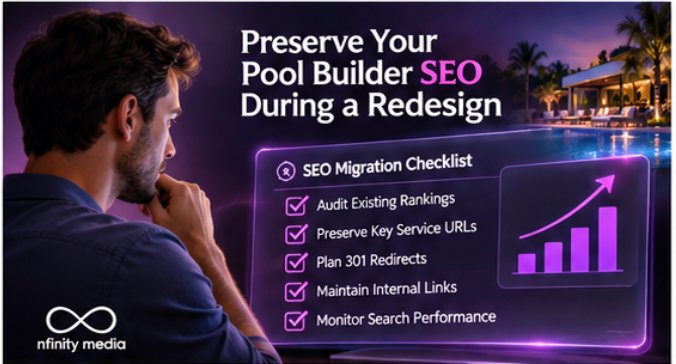
Start with an existing website SEO audit
Before development begins, review Google Search Console, analytics, and website crawl data.
Identify:
Pages receiving meaningful organic clicks and impressions.
Search queries associated with pool construction and renovation.
Existing indexed URLs.
Project portfolio pages attracting search traffic.
Backlinks pointing to individual projects or service pages.
Internal links between services, galleries, and geographic pages.
Existing consultation and estimate conversions.
Technical errors and redirect chains.
Core Web Vitals and mobile performance.
Content that is outdated, duplicated, or no longer relevant.
This establishes a baseline for redesign decisions.
A project gallery that appears visually outdated may still attract organic visitors or backlinks.
Its content should be evaluated before deletion.
Preserve established pool construction URLs
Consider an existing WordPress website with URLs such as:
/custom-pool-construction/
/pool-renovation/
/luxury-swimming-pools/
/pool-and-spa-construction/
/completed-projects/
If these pages already address meaningful search intent, changing their URLs may be unnecessary.
The design can be modernized while preserving the existing addresses.
When a URL change is justified, create a mapping from the old page to the most relevant new destination and implement a permanent redirect.
Avoid redirecting unrelated project pages or services to the homepage.
Protect content relevance
Keeping a URL alone does not guarantee that its search performance will remain stable.
A pool renovation page should continue addressing renovation services after redesign.
Replacing useful content with a few generic promotional statements can change how visitors and search engines understand the page.
The goal is to improve clarity, accuracy, and presentation while preserving the page’s intended purpose.
Review backlinks to project portfolios
Pool builder websites may receive backlinks to individual project pages from suppliers, designers, publications, or other websites.
These links can be valuable.
If a redesign consolidates or removes a portfolio URL, review whether the original project content can be preserved or moved to a relevant destination.
This is particularly important when a completed project has attracted attention beyond the company’s own website.
WordPress Redesign for Pool Contractors: Plan the SEO Migration
A pool builder can remain on WordPress while still making substantial technical changes.
Switching themes, rebuilding Elementor layouts, changing project-gallery systems, or reorganizing service pages can affect metadata, URLs, images, structured data, and internal linking.
A documented migration process helps reduce avoidable problems.
Phase 1: Document the existing website
Before development, export important URLs, metadata, internal links, and search performance.
Review current consultation forms, call tracking, project galleries, and location pages.
Identify any existing content that should remain accessible after launch.
Phase 2: Build in a protected staging environment
A staging environment allows the new website to be developed without disrupting the live site.
Use appropriate access restrictions to prevent unintended public indexing.
Review responsive layouts, service navigation, gallery functionality, and conversion pathways before launch.
Phase 3: Map services and project URLs
Create a URL mapping document showing which pages will remain unchanged and which require redirects.
Avoid consolidating pages with substantially different intent simply to reduce the page count.
For example, custom pool construction and pool renovation may deserve separate pages because they represent different customer needs.
Phase 4: Validate technical SEO
Before launch, check:
Canonical URLs.
Indexing directives.
XML sitemaps.
Heading structures.
Internal links.
Redirects.
Image accessibility.
Structured data.
Mobile performance.
Consultation forms.
Analytics and conversion events.
Phase 5: Monitor the redesigned website
After launch, use Google Search Console to review indexing, important queries, and organic landing-page performance.
Test consultation forms and call tracking on the live website.
No redesign can guarantee identical rankings, but careful planning helps protect existing assets and makes problems easier to identify.
For a broader explanation of migration planning, see WordPress Website Redesign for Contractors Without Losing SEO Rankings.
Pool Construction Website Design: Organize Services Around Project Intent
Pool builders often provide a range of services that should be represented clearly on the website.
A homeowner planning a new custom pool has different needs from someone renovating an existing swimming pool.
A customer considering a pool-and-spa combination may want to explore integrated design options.
A strong WordPress architecture reflects these differences.
Custom pool construction
A custom pool construction page may cover:
Design consultations.
Pool shapes and configurations.
Relevant construction approaches.
Materials and finishes.
Integrated spas or water features.
The general construction process.
Completed custom pool projects.
Consultation and estimate options.
The content should reflect the contractor’s actual capabilities.
Pool renovation and remodeling
Pool renovation pages should address the types of improvements the company provides.
These may include resurfacing, tile updates, coping replacement, equipment improvements, or substantial redesigns.
Renovation customers often want to understand how an existing pool can be improved without starting an entirely new construction project.
Project photographs and accurate descriptions can be particularly useful.
Luxury swimming pool design
Luxury pool construction may involve architectural integration, custom finishes, water features, infinity-edge designs, or connections with larger outdoor living environments.
Not every pool builder offers these services.
Where they are available, a dedicated page can explain the company’s approach and showcase relevant completed projects.
Pool and spa construction
A combined pool-and-spa service may warrant its own content when it represents a meaningful part of the business.
The page can explain design integration, project planning, and relevant examples.
Avoid creating separate pages for every minor wording variation.
The website architecture should follow actual services and customer intent.
Luxury Pool Project Galleries: Turn Visual Inspiration Into Qualified Inquiries
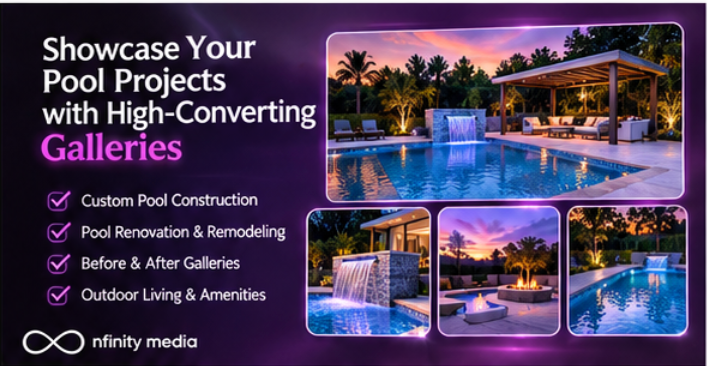
Project galleries are among the most important elements of a pool builder website.
Customers want to see the quality, variety, and style of completed work.
A WordPress redesign can turn a collection of photographs into a structured portfolio that supports both customer research and organic search.
Organize projects by meaningful categories
Depending on the company’s portfolio, categories may include:
Custom inground pools.
Luxury residential pools.
Pool renovations.
Pool and spa combinations.
Modern geometric pools.
Freeform pool designs.
Pools integrated with outdoor living areas.
Categories should reflect real projects rather than exist solely to target keywords.
Give individual projects useful context
A project page can be more valuable when it explains what was built.
Relevant details may include:
General project location.
Type of pool construction.
Design objectives.
Materials and finishes.
Water features or integrated spas.
Outdoor living elements.
Challenges addressed.
Completed project photography.
Do not publish private customer details without permission.
Project descriptions should accurately represent the completed work.
Improve before-and-after presentation
Before-and-after images can be particularly useful for pool renovation projects.
They help visitors understand the transformation.
However, images should be authentic and presented accurately.
Avoid editing photographs in ways that materially misrepresent project results.
Optimize image performance
High-resolution pool photographs can be large.
A WordPress redesign should consider image compression, responsive sizes, modern file formats, and appropriate loading priorities.
Use descriptive filenames and meaningful alt text.
For example, an image might be described as:
Custom rectangular swimming pool with integrated spa, stone decking, and landscaped backyard.
This provides useful context without repetitive keyword stuffing.
Connect project galleries to relevant services
A completed pool renovation project can link to the pool renovation service page.
A luxury pool portfolio can link to custom pool construction.
These contextual links help visitors move from inspiration to practical service information.
They also strengthen the website’s internal structure.
Mobile Pool Builder Website Design: Make Project Exploration Easy
Many homeowners research pool designs on smartphones and tablets.
A mobile-friendly website should allow visitors to explore projects, understand services, and request consultations without unnecessary friction.
Make galleries easy to browse
Project images should resize appropriately across devices.
Avoid galleries that require difficult gestures or display tiny thumbnails.
Visitors should be able to inspect completed work without waiting for excessively large images to load.
Use clear service navigation
Custom construction, renovation, spas, and relevant outdoor services should be easy to locate.
Navigation should reflect the company’s actual offerings.
A complicated menu with dozens of overlapping service names can make the website harder to use.
Provide visible consultation options
A homeowner exploring completed projects may want to request a consultation after viewing several examples.
Relevant calls to action should be available throughout the experience.
Examples include:
Discuss Your Custom Pool Project.
Request a Pool Construction Consultation.
Explore Pool Renovation Options.
Schedule a Design Consultation.
The wording should accurately describe the next step.
Keep forms practical
An initial pool construction inquiry may ask for:
Name.
Contact information.
Project location.
Type of project.
General project description.
Preferred consultation method.
Some contractors may also request a budget range or approximate project timeline.
These fields can help qualify inquiries, but excessive form requirements may discourage prospective customers.
The appropriate balance depends on the contractor’s sales process.
Pool Contractor Website Lead Generation: Attract Better Project Inquiries
A pool builder website should not be evaluated solely by traffic volume.
A company specializing in high-value custom construction may prefer a smaller number of relevant project inquiries over a large number of visitors seeking unrelated services.
Pool contractor website lead generation should focus on matching the company’s capabilities with prospective customers who need those services.
Separate new construction and renovation inquiries
A homeowner planning a new pool may require a design consultation, while a customer requesting renovation may need an assessment of an existing structure.
Separate service pages and relevant form options can help direct inquiries appropriately.
Explain the consultation process
High-value construction projects often involve several stages.
A website can explain the general process, such as:
Initial inquiry.
Project discussion.
Property and feasibility review.
Design development.
Estimate or proposal.
Construction planning.
The exact process should reflect how the contractor operates.
Providing clear expectations can help visitors understand what happens after submitting a request.
Use authentic trust signals
Relevant trust elements may include:
Completed pool projects.
Verified customer reviews.
Appropriate licensing information.
Relevant professional credentials.
Years of experience.
Construction-process explanations.
Accurate service-area coverage.
Real photographs of the company’s work.
Avoid unsupported claims or fabricated project results.
Track qualified inquiries
Website measurement should distinguish between basic interactions and meaningful business opportunities.
Useful metrics may include completed consultation forms, verified phone inquiries, design appointments, and qualified projects recorded in the CRM.
A form submission is not automatically a qualified lead.
Where practical, the business should evaluate whether inquiries match its service area, project capabilities, and intended customer profile.
Core Web Vitals and WordPress Speed for Pool Builder Websites
Pool builder websites frequently rely on large photographs, videos, image sliders, and interactive galleries.
These features can create performance challenges.
A redesign should improve loading speed while preserving the visual presentation that makes the company’s work compelling.
Largest Contentful Paint
Largest Contentful Paint measures how quickly the main visible content loads.
On a pool builder homepage, the largest element may be a high-resolution photograph of a completed swimming pool.
Appropriate image sizing, compression, caching, hosting, and loading priorities can improve performance.
Interaction to Next Paint
Interaction to Next Paint measures responsiveness to user interactions.
Heavy scripts and complicated galleries can delay navigation and form interactions.
A WordPress redesign should evaluate whether each script contributes useful functionality.
Cumulative Layout Shift
Cumulative Layout Shift measures unexpected movement of visible content.
Image galleries, embedded videos, and interactive elements should have appropriate layout dimensions.
This helps prevent buttons and content from shifting as the page loads.
Balance visual quality with performance
A pool builder should not need to remove every large project photograph to improve speed.
The objective is efficient implementation.
Responsive image delivery, thoughtful gallery design, and appropriate loading behavior can help preserve visual impact while improving usability.
Preserve Local SEO When Redesigning Pool Builder Service-Area Pages
Pool construction companies often serve multiple cities, suburbs, and surrounding communities.
Their websites may include geographic landing pages that already attract relevant organic traffic.
A redesign should evaluate these pages before changing or removing them.
Review existing geographic performance
Use Search Console to identify location pages receiving impressions and clicks.
Review whether those pages provide accurate information about the company’s actual service coverage.
A page with meaningful local visibility may deserve preservation even if its design needs improvement.
Avoid duplicating city content
Creating numerous near-identical pages with only location names changed can produce weak content.
Useful service-area pages should provide relevant information about the business’s actual operations.
Where available, local project examples and genuine geographic context can improve usefulness.
Preserve internal links
Service pages, portfolio projects, and geographic pages may link to one another.
These relationships can help customers explore relevant information.
A redesign should retain useful connections rather than replacing them with an isolated set of new templates.
Maintain accurate business information
Contact details, service coverage, and relevant Google Business Profile links should remain consistent with the company’s actual operations.
If important URLs change, review the destinations used in trusted business listings.
Pool Builder Website Redesign for Miami and South Florida
Miami and South Florida provide a useful example of how pool construction websites can combine visual presentation with geographic SEO.
Pool builders may offer custom construction, renovation, spas, and related outdoor improvements.
The redesigned website should reflect the actual service mix rather than assume every company offers the same projects.
Showcase relevant pool construction work
Authentic photographs of completed Miami-area projects can help prospective customers understand the contractor’s design capabilities.
Where supported by actual work, project descriptions may discuss pool styles, materials, integrated spas, or surrounding outdoor features.
Preserve local service pages
Existing Miami and South Florida landing pages should be evaluated before changing URLs.
A redesign can improve mobile UX, galleries, and consultation forms while retaining useful geographic content.
Improve project inquiry quality
A company specializing in custom pool construction may benefit from forms that distinguish new builds from renovations.
Clear service information and consultation expectations can help prospective customers determine whether the contractor is a suitable fit.
For related organic visibility strategies, explore SEO for Contractors in Miami and South Florida.
Pool Builder Website Redesign for San Diego and Southern California
San Diego and Southern California pool builders may work on projects involving custom pools, integrated spas, outdoor living spaces, and landscape design.
A WordPress redesign can improve how these projects are presented.
Connect pools with outdoor living projects
Where the contractor provides integrated services, the website may showcase pools alongside patios, decking, pergolas, or outdoor kitchens.
However, those services should not be presented as available unless the business actually offers them.
Improve premium portfolio UX
Large completed-project galleries should be organized so visitors can explore different styles and construction capabilities.
Responsive images, descriptive project pages, and clear consultation options can support the research process.
Preserve service and geographic relevance
Established San Diego or Southern California pages should be reviewed for organic performance before changes are made.
A redesigned site can improve visual presentation without unnecessarily replacing valuable URLs.
Pool Builder Website Redesign for New York and New Jersey
Pool construction companies in New York and New Jersey may serve customers with different property sizes, seasonal considerations, and project requirements.
The website should communicate relevant services and geographic coverage accurately.
Organize construction and renovation services
A pool builder may provide new construction, renovations, spas, or other services.
Separate pages can help when the offerings address distinct customer needs.
Use completed projects to build confidence
Project examples can help homeowners evaluate design styles, materials, and construction experience.
Descriptions should reflect real work rather than generic promotional claims.
Preserve local SEO assets
Existing New York and New Jersey service-area pages may already attract relevant organic visitors.
Review those URLs and their internal links before redesigning the website.
The goal is to improve the customer experience while protecting useful search visibility.
Should Pool Builders Redesign or Completely Rebuild Their WordPress Websites?
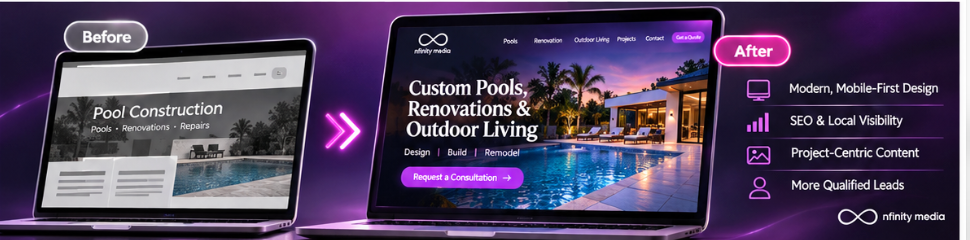
Not every pool builder needs a complete website rebuild.
The decision depends on the condition of the existing WordPress installation, the flexibility of its templates, the quality of its content, and the company’s business requirements.
A targeted redesign may be sufficient when:
Existing service pages already rank well.
URLs and content remain relevant.
The current theme or page builder is maintainable.
The main issues involve visual presentation or mobile usability.
Project galleries need improvement.
Consultation forms and navigation can be updated without replacing the entire platform.
A larger rebuild may be appropriate when:
The website relies on unsupported technology.
Templates are inconsistent and difficult to maintain.
Technical problems interfere with ordinary updates.
The service architecture no longer reflects the business.
Gallery functionality is unreliable.
Major integrations or structural changes are required.
A complete rebuild is not automatically better.
For pool builders with established organic visibility, unnecessary redevelopment can introduce avoidable migration risks.
The right approach follows an audit of technical condition, search performance, and business needs.
How to Measure Pool Builder Website Redesign Performance
The success of a pool builder website redesign should be evaluated through organic visibility, website usability, and qualified project inquiries.
Organic search performance
Use Google Search Console to monitor:
Important pool construction queries.
Organic clicks and impressions.
Service-page performance.
Project portfolio visibility.
Indexing status.
Geographic landing pages.
Compare results with the prelaunch baseline while accounting for seasonal changes.
Consultation and lead performance
Depending on the contractor’s systems, relevant metrics may include:
Completed consultation forms.
Verified phone inquiries.
Design appointment bookings.
Qualified renovation requests.
Qualified new construction inquiries.
Opportunities recorded in the CRM.
A website redesign should support meaningful business outcomes rather than focus only on form volume.
Technical performance
Monitor Core Web Vitals, crawl errors, broken links, redirects, and form functionality.
The redesigned website should not introduce technical problems while improving visual presentation.
Longer-term evaluation
Pool construction projects may involve extended research and decision-making.
Not every visitor will request a consultation during the first session.
Review performance over an appropriate period and avoid attributing every change solely to the redesign.
Common Pool Builder WordPress Redesign Mistakes
Several avoidable mistakes can undermine a pool builder website redesign.
Deleting established service pages without an SEO audit. Existing pages may already attract valuable organic visitors.
Changing URLs unnecessarily. URL changes add migration complexity and may affect existing links.
Using oversized, unoptimized project images. Large galleries can slow down mobile experiences.
Publishing project photographs without useful context. Descriptive project pages can be more informative than image-only galleries.
Combining new pool construction and renovation into generic content. These services may serve different customer needs.
Removing useful geographic pages. Evaluate local search performance before consolidation.
Using generic consultation forms for every project type. New construction and renovation inquiries may benefit from different qualification questions.
Relying on unsupported project claims. Authentic portfolios and accurate credentials support credibility.
Failing to test conversion tracking. Broken forms or missing events can undermine lead reporting.
Ignoring post-launch SEO monitoring. Search Console and technical reviews help identify migration issues.
A successful redesign should address these risks before the new website goes live.
How Nfinity Media Approaches WordPress Website Redesign for Pool Builders
At Nfinity Media, WordPress redesign for pool builders can bring together technical SEO preservation, project-focused website UX, responsive design, and qualified lead-generation strategy.
The process begins by understanding the existing website.
Important service pages, organic search performance, project portfolios, internal links, and consultation pathways should be evaluated before major structural changes.
1. SEO preservation and migration planning
Identify established pool construction URLs, renovation pages, geographic content, metadata, internal links, and redirect requirements.
Preserve useful search intent while improving website structure.
2. Premium WordPress design
Develop responsive layouts that communicate the quality of the contractor’s actual work.
Project galleries, service navigation, and consultation pathways should be accessible across devices.
3. Portfolio and image optimization
Organize completed projects into useful categories, improve descriptive content, and optimize image performance.
The goal is to showcase real construction capabilities without unnecessarily slowing down the website.
4. Conversion rate optimization
Improve calls to action, consultation forms, service-specific inquiry pathways, and trust signals.
Help prospective customers understand whether the contractor is a suitable fit for their project.
5. Technical performance and measurement
Review Core Web Vitals, WordPress configuration, analytics, form tracking, and post-launch performance.
The redesigned website should be easier to maintain and evaluate.
These elements work together.
A visually impressive pool construction website should also be technically reliable, search-friendly, and designed around meaningful customer inquiries.
For the broader commercial service, explore WordPress Website Redesign for Contractors Without Losing SEO Rankings.
Frequently Asked Questions About WordPress Website Redesign for Pool Builders
1. Can pool builders redesign their WordPress websites without losing SEO rankings?
Yes. Pool builders can redesign their WordPress websites while taking steps to preserve existing organic visibility. Important measures include auditing current pages, retaining valuable URLs, preserving relevant content, implementing redirects when necessary, and monitoring Search Console after launch. Rankings cannot be guaranteed.
2. Should a pool builder preserve existing construction and renovation URLs?
Generally, established URLs should be retained when the pages continue serving the same purpose. Changing them unnecessarily adds migration complexity. When changes are justified, use relevant permanent redirects and update internal links.
3. What should a pool builder website redesign include?
A comprehensive redesign may include responsive WordPress layouts, custom pool construction pages, renovation content, project galleries, local SEO preservation, technical migration planning, Core Web Vitals optimization, consultation forms, and conversion tracking.
4. How important are project galleries for pool builder websites?
Project galleries are especially useful because prospective customers often evaluate design quality and construction capabilities visually. Authentic photographs, meaningful project descriptions, and relevant service links can help visitors understand completed work.
5. Should pool construction and pool renovation have separate pages?
Separate pages are often appropriate because new construction and renovation address different customer needs. Each page should provide substantive information about the service rather than duplicate generic content.
6. Can Elementor be used for a pool builder WordPress website?
Yes. Elementor can support responsive layouts, project galleries, reusable service templates, and consultation forms. Its implementation should be evaluated for performance, maintainability, accessibility, and unnecessary scripts.
7. How can pool builders improve qualified lead generation after redesigning?
Pool builders can improve inquiry pathways through clear service navigation, authentic project portfolios, mobile-friendly consultation forms, relevant calls to action, and reliable lead tracking. Results depend on traffic quality, project demand, and the company’s operations.
8. How long does a pool builder website redesign take to affect Google rankings?
There is no fixed timeline. Google needs time to crawl and process changes, and results depend on the scale of the redesign, competition, and technical implementation. Monitoring should begin after launch and continue over subsequent weeks and months.
Final Thoughts: Preserve Pool Builder SEO While Creating a Better Project Experience
A pool builder website redesign should not require abandoning the organic visibility, project content, and customer trust the business has already developed.
A carefully planned WordPress redesign can preserve valuable service URLs while improving project galleries, mobile performance, consultation pathways, and overall website usability.
The process should begin with an audit of existing search visibility, service architecture, and technical condition.
From there, improvements can focus on authentic completed projects, accurate construction information, responsive design, and qualified inquiry generation.
Whether a pool builder operates in Miami, San Diego, Southern California, New York, New Jersey, or another competitive market, the central principle remains consistent:
Preserve the search equity your pool construction business has already earned while building a more compelling, responsive, and conversion-focused WordPress website.
Nfinity Media helps contractors connect WordPress redesign, technical SEO preservation, website UX, and lead-generation strategy.
If your pool construction website needs improvement, explore our WordPress contractor redesign services or schedule a digital growth consultation to discuss your existing website, project portfolio, and redesign priorities.