Building a swimming pool is one of the larger investments a homeowner can make in their outdoor living space. Unlike an impulse purchase, a custom pool project can involve months of research, design consultations, financing discussions, contractor comparisons, permits and construction planning.
That creates a unique marketing challenge for swimming pool builders.
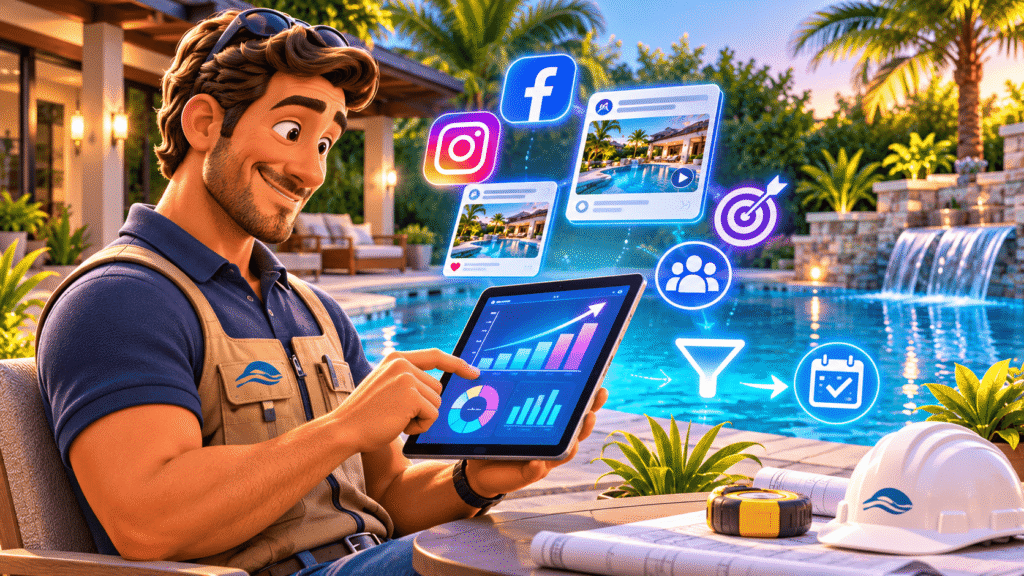
Homeowners may spend weeks looking at pool designs on Instagram before they search Google for a contractor. Others discover a beautiful backyard transformation through Facebook, save the post, discuss the project with their family and contact a builder several months later.
This is why social media advertising for pool builders requires more than attractive photos and occasional boosted posts.
A successful strategy connects visual inspiration with geographic targeting, project qualification, landing page optimization, conversion tracking and a realistic advertising budget.
For pool construction companies, the goal is not simply to generate more likes, followers or inexpensive leads. It is to reach homeowners who have the right property, budget, location and project expectations — and help them take the next step toward a consultation.
In this guide, we explore how pool builders can approach Facebook and Instagram advertising, structure Meta Ads campaigns, determine monthly budgets, improve lead quality and build a sustainable social media marketing system.
1. Why Social Media Advertising Works Differently for Pool Builders
Swimming pool construction is a visual, high-consideration service.
A homeowner may not be actively searching for a pool contractor today, but an impressive outdoor living transformation can introduce the possibility of building a pool.
That makes platforms such as Facebook and Instagram valuable for reaching prospective customers before they enter an active contractor-selection process.
However, there is an important distinction between creating demand and capturing existing demand.
Google Search often reaches homeowners who are already looking for a pool builder, pool installation company or custom swimming pool contractor.
Meta Ads can reach homeowners earlier, while they are exploring backyard renovations, luxury outdoor living ideas and potential improvements to their properties.
Both approaches can contribute to the same customer journey.
Social media influences the research process
A homeowner considering a pool may interact with several types of content:
Before-and-after backyard transformations.
Custom pool designs with spas, waterfalls and integrated landscaping.
Videos explaining the pool construction process.
Project walkthroughs showing materials, finishes and outdoor kitchens.
Customer testimonials and completed project showcases.
Educational content about timelines, budgeting and design options.
These interactions can help establish familiarity with a pool construction company.
But visual engagement alone does not guarantee purchase intent.
A person who likes a luxury pool photograph may not own a suitable property or have the budget to build one.
That is why pool builder advertising must balance inspiration with qualification.
2. Facebook Ads vs. Instagram Ads for Pool Construction Companies
Facebook and Instagram operate within Meta’s advertising ecosystem, allowing advertisers to manage campaigns through Meta Ads Manager.
Although the platforms share advertising infrastructure, homeowners may engage with pool construction content differently across placements.
Facebook Ads for pool builders
Facebook can be useful for promoting educational content, customer testimonials, project showcases and consultation offers.
Potential creative approaches include:
Completed pool construction projects
Show the finished pool alongside the original backyard conditions, explaining the transformation and major design decisions.
Customer experience stories
Feature homeowners discussing why they selected the builder, how the design process worked and what they appreciated about the completed project.
Pool construction education
Explain project timelines, common planning questions, financing considerations and what homeowners should understand before requesting an estimate.
Local project campaigns
Showcase completed work in the actual geographic markets served by the company.
A pool builder operating in suburban Chicago, for example, should avoid creating the impression that it serves every location in Illinois if its construction operations are concentrated in a smaller area.
Instagram Ads for pool builders
Instagram is particularly suited to visually compelling pool projects.
Reels, Stories, carousel ads and high-quality photography can demonstrate craftsmanship and help homeowners imagine what is possible.
Effective Instagram creative may include:
Short walkthroughs of completed custom pools.
Before-and-after construction sequences.
Modern pool designs with integrated spas.
Luxury outdoor living transformations.
Pool lighting and nighttime photography.
Material selections and design details.
Instagram advertising should not rely exclusively on visual appeal.
Captions, on-screen text and calls to action should explain the service area, type of construction and next step.
A beautiful pool video can attract attention. A clear message helps determine whether that attention becomes a qualified inquiry.
3. How Much Should Pool Builders Spend on Facebook and Instagram Ads?
One of the most common questions pool construction companies ask is:
What is a realistic Facebook advertising budget for a pool builder?
There is no universal amount.
The appropriate budget depends on the company’s market, average project value, service area, competition, creative resources, existing brand awareness and ability to manage incoming leads.
A custom pool builder selling high-value projects in Southern California may require a different advertising strategy from a regional pool contractor operating in a less competitive market.
The following ranges are illustrative planning scenarios, not verified industry benchmarks or guaranteed spending requirements.
| Monthly Meta Ad Spend | Potential Approach | Main Consideration |
|---|---|---|
| $750–$1,500 | Limited geographic testing with a small creative set | Restricted testing volume and slower learning |
| $1,500–$3,000 | Local lead generation and creative experimentation | Requires disciplined targeting and follow-up |
| $3,000–$5,000 | Multiple creative concepts, retargeting and structured optimization | Better opportunity to compare campaigns |
| $5,000–$10,000 | Broader market coverage or multiple project categories | Requires stronger tracking and lead qualification |
| $10,000+ | Multi-market or established high-volume acquisition programs | Greater need for CRM integration and operational oversight |
These figures represent advertising media spend only. Agency management, creative production, landing page development and other services may be additional expenses.
Why a small budget can still be useful
A pool builder does not necessarily need to begin with a large advertising investment.
A controlled test can help answer practical questions:
Which project photographs attract relevant inquiries?
Do homeowners respond better to complete backyard transformations or individual pool features?
Are consultation-focused landing pages producing better-qualified prospects than instant forms?
Which service areas generate inquiries that the company can actually fulfill?
A smaller budget can provide directional evidence, although limited conversion volume may make results less reliable.
Why spending more does not automatically produce better leads
Increasing the advertising budget cannot compensate for weak creative, unclear positioning or poor follow-up.
If the campaign attracts homeowners looking for inexpensive above-ground pools while the company specializes in premium custom gunite construction, more spending may simply increase the number of unsuitable inquiries.
Budget decisions should follow business economics, not platform recommendations alone.
4. Understanding Cost Per Lead vs. Cost Per Qualified Pool Consultation
One of the biggest mistakes in pool builder Meta Ads management is optimizing exclusively for cost per lead.
A low-cost lead is not necessarily valuable.
Suppose two campaigns produce the following hypothetical results:
| Metric | Campaign A | Campaign B |
|---|---|---|
| Advertising spend | $2,000 | $2,000 |
| Total leads | 50 | 20 |
| Cost per lead | $40 | $100 |
| Qualified consultations | 3 | 8 |
| Cost per qualified consultation | $667 | $250 |
Campaign A appears more efficient when evaluated only by lead volume.
However, Campaign B produces more qualified consultations at a lower cost per qualified opportunity.
This illustrates why pool builders should measure more than form submissions.
What makes a pool construction lead qualified?
Qualification depends on the company’s business model, but useful considerations include:
Whether the property is within the construction service area.
Whether the homeowner owns or controls the property.
Whether the project involves new construction, renovation or another supported service.
Whether the homeowner’s budget aligns with typical project requirements.
Whether the expected timeline is realistic.
Whether the homeowner is ready to schedule a design consultation.
The goal is not to create unnecessary friction.
It is to help prospective customers understand whether the company is a suitable fit before consuming significant sales resources.
5. Building the Right Meta Ads Campaign Structure for Pool Builders
A structured campaign strategy should reflect how homeowners move from inspiration to consideration and eventually to consultation.
Not every pool builder needs numerous campaigns or complicated advertising funnels.
In fact, excessive segmentation can fragment a limited budget.
A practical framework includes three complementary functions.
Campaign function 1: Introduce the company through completed projects
Use compelling photographs and videos to showcase the quality and style of the company’s work.
Creative examples include:
Luxury pool transformation
A completed backyard featuring a custom pool, spa, lighting and integrated outdoor living area.
Modern pool design
A geometric swimming pool with clean architectural lines, premium decking and carefully selected finishes.
Family-oriented backyard
A pool designed around entertainment, seating areas and practical outdoor living.
The campaign should communicate what the company actually builds.
A builder specializing in luxury custom pools should not advertise generic pool services that attract unrelated project requests.
Campaign function 2: Encourage consultations
These campaigns focus on a clear next step.
Examples include:
“Explore a Custom Pool Design for Your Backyard.”
“Planning a New Swimming Pool? Discuss Your Project.”
“Schedule a Consultation for Your Custom Pool Construction.”
The destination should help homeowners understand the process and determine whether they are ready to proceed.
Campaign function 3: Re-engage interested audiences
Where appropriate and permitted by privacy and advertising rules, retargeting can reconnect with people who have already interacted with the company.
Potential audiences may include previous website visitors or people who engaged with eligible social media content.
Retargeting creative should provide additional value rather than repeatedly showing the same advertisement.
Useful messages include:
What happens during a pool design consultation.
How a custom pool project progresses from concept to construction.
Examples of completed projects in the company’s service area.
Answers to common planning and budgeting questions.
Audience sizes, consent requirements and Meta’s available targeting features should determine whether retargeting is practical.

6. Facebook Lead Forms vs. Dedicated Pool Builder Landing Pages
Meta Ads can direct users to an instant lead form or a website landing page.
Neither approach is universally better.
The right choice depends on campaign goals, qualification requirements, website quality and sales operations.
Facebook and Instagram instant forms
Instant forms allow users to submit their information without leaving the platform.
Potential advantages include a relatively simple submission experience and fewer steps between the advertisement and the inquiry.
However, ease of submission can sometimes create more low-intent responses.
Pool builders may need additional questions to understand whether the inquiry represents a realistic construction opportunity.
Examples include:
What type of project are you considering?
New custom pool, pool renovation, pool and spa combination, or another supported project.
Where is the property located?
City or ZIP code within the company’s construction area.
What is your anticipated project timeline?
Planning now, within several months, or researching for a future project.
What investment range are you considering?
Only use budget ranges that accurately reflect the company’s typical projects.
Dedicated landing pages
A purpose-built landing page can provide more context before a homeowner submits an inquiry.
For pool builders, an effective page may include:
A clear headline explaining the construction service.
Relevant completed project photography.
The geographic service area.
Pool types and available design features.
A concise explanation of the consultation process.
Authentic testimonials and project examples.
A visible consultation form or booking option.
Mobile-friendly navigation and fast loading performance.
Landing pages can also support conversion tracking and structured qualification.
For companies investing in paid acquisition, landing page optimization should be considered part of the broader conversion system, even when the traffic originates from Meta rather than Google Ads.
7. Why WordPress Website UX Matters for Pool Builder Advertising
A paid social campaign may generate attention, but the website often determines what happens next.
Homeowners who discover a pool builder through Instagram may visit the website before requesting a consultation.
They may want to verify that the business is established, review completed projects, understand the services offered and determine whether the company works in their area.
This is where website design and conversion optimization become important.
Create a clear path from inspiration to action
A homeowner who clicks an advertisement featuring a modern custom pool should arrive at a page that continues the same story.
Sending that visitor to an unrelated homepage or a generic list of services introduces friction.
A stronger journey might be:
Instagram pool transformation → custom pool landing page → completed projects → consultation request.
The message, imagery and service offering should remain consistent throughout.
Make project portfolios useful
A gallery of beautiful photographs is valuable, but contextual project information can strengthen it.
Where available, include:
General project location.
Pool type and major design features.
Scope of construction.
Outdoor living elements included.
Challenges addressed during the project.
Actual completed-project photographs.
This helps homeowners understand the builder’s capabilities rather than simply admire the imagery.
Optimize mobile performance
A large share of social media interactions occur on mobile devices.
Pool builder landing pages should therefore prioritize readable typography, compressed images, accessible navigation, clear calls to action and forms that work comfortably on smaller screens.
For WordPress-based pool companies, Core Web Vitals, image loading and page structure should be evaluated alongside visual design.
A visually impressive page that loads slowly or makes consultation requests difficult can weaken the return on advertising.
8. Instagram Content Strategy: What Pool Builders Should Actually Publish
Paid advertising works best when the company’s social media presence supports the same positioning.
A pool builder does not need to publish constantly.
It needs a useful content library that demonstrates craftsmanship, credibility and the types of projects the company wants to sell.
Before-and-after transformations
Show how the property changed from its original condition to the completed outdoor environment.
Include enough context to explain the transformation.
Construction progress videos
Short videos showing excavation, structural work, plumbing, finishes and completed results can help homeowners understand the complexity of pool construction.
Avoid presenting construction steps as universal because methods vary by project, site conditions and local requirements.
Design decision content
Explain why certain features were selected.
For example, a builder might discuss how a spa was integrated into a pool layout or why a particular decking material suited the property.
Educational posts
Answer questions that prospective customers regularly ask.
Examples include:
“How Long Does a Custom Pool Project Take?”
“What Should Homeowners Prepare Before a Pool Design Consultation?”
“What Affects the Cost of a Custom Swimming Pool?”
“How Do Pool Builders Plan Around Limited Backyard Space?”
Customer stories
With permission, share genuine experiences from completed projects.
Testimonials should be authentic, properly attributed where appropriate and compliant with advertising requirements.
Location-relevant projects
Pool construction is geographically constrained.
A builder serving Orange County, California, may benefit from showcasing real projects in its operating area, while a company serving the Chicago suburbs should focus on the markets it can reasonably support.
The goal is to connect local credibility with relevant service demand.
9. Geographic Targeting for Pool Builder Meta Ads
Pool builders generally operate within defined construction territories.
Travel distance, permitting, labor availability, project economics and service commitments all influence where the company can accept work.
Advertising geography should reflect these operational realities.
Start with the actual service area
A company based in Naperville may serve selected western Chicago suburbs, but that does not necessarily mean it should advertise across all of Illinois.
Likewise, a Miami-area pool contractor may serve Miami-Dade and selected Broward communities without covering every part of South Florida.
Targeting should follow confirmed operational coverage.
Separate markets when the business case supports it
Some companies may benefit from distinct campaigns for different service areas.
However, creating separate ad sets for every city can be counterproductive when budgets and audience sizes are limited.
Geographic segmentation should be based on meaningful differences in project economics, creative relevance or sales capacity.
Use location-specific proof
Local relevance can be demonstrated through genuine project examples.
A completed pool project in a specific city can support advertising to homeowners in that market.
Avoid implying that a project was completed in a location where it was not.
Accurate geographic proof is more useful than generic location-name repetition.
10. How Meta Ads and Google SEO Work Together for Pool Builders
Social media advertising and organic search are often treated as separate marketing channels.
For pool builders, they can support different stages of the same purchasing journey.
A homeowner might first discover a company through an Instagram Reel.
Later, they search Google for the company name, read reviews, browse completed projects and compare several pool builders.
Eventually, they return to request a consultation.
That journey may involve multiple channels before conversion.
Meta Ads create awareness and consideration
Facebook and Instagram can introduce the company’s craftsmanship, project style and service offering to prospective customers.
SEO supports active research
Search-optimized pages can help the company appear when homeowners investigate specific services.
Relevant topics include:
Custom swimming pool construction.
Luxury pool builders.
Gunite and concrete pools, where offered.
Pool and spa design.
Pool renovation, where offered.
Local pool construction services.
Google Business Profile supports local verification
Homeowners may use Google Maps to review the company’s business information, service area, photographs and customer feedback.
For local contractors, local SEO can support the research and verification process that follows initial advertising exposure.
Website CRO connects the channels
A well-designed website should accommodate visitors arriving from paid social, organic search, direct traffic and branded searches.
The strongest strategy is not necessarily the one that credits every inquiry to a single platform.
It is the one that helps qualified homeowners discover, evaluate and contact the company.
11. Meta Pixel, Conversions API and CRM Tracking for Pool Companies
Advertising performance should be evaluated using reliable business data.
Meta Ads Manager can report platform activity, but a pool builder also needs to understand which inquiries become consultations, proposals and signed projects.
Meta Pixel
The Meta Pixel can help measure eligible website events and support advertising optimization, subject to applicable consent and privacy requirements.
Common events may include landing page visits, lead form submissions or consultation requests.
Conversions API
Conversions API can support server-side event transmission where appropriately implemented.
It is not a substitute for privacy compliance, consent management or accurate event configuration.
Pixel and Conversions API events should be deduplicated when both report the same conversion.
GA4 and Google Tag Manager
Google Analytics 4 and Google Tag Manager can help organize website event measurement and analyze traffic behavior.
Tracking should focus on meaningful actions rather than creating excessive events with little business value.
CRM integration
The customer relationship management system is especially important for high-value pool construction.
Useful pipeline stages may include:
Lead submitted
Qualified
Consultation
Proposal
Contract signed

Connecting advertising data with sales outcomes can help identify campaigns that generate actual opportunities rather than simply low-cost submissions.
For pool builders, a campaign that produces fewer leads but more signed construction projects may be substantially more valuable.
12. Calculating a Sustainable Pool Builder Advertising Budget
Pool Builder Meta Ads Budget Calculator
Explore how Facebook and Instagram advertising
budgets, lead costs and consultation conversion
rates could influence your pool construction
lead generation results.
$15,000
$500
80%
50%
Planning disclaimer:
This calculator uses hypothetical assumptions
for educational purposes. Results are mathematical
projections, not Meta Ads performance forecasts,
actual pool construction lead costs, or guaranteed
contracts. Fractional contracts represent an
expected average, not partial projects.
Advertising management fees and production costs
are excluded.
A practical advertising budget should begin with business economics.
Consider a hypothetical pool builder with the following assumptions:
Adjust the assumptions to explore possible outcomes. Results are mathematical projections, not Meta Ads performance forecasts or guarantees. Fractional contracts represent an expected average, not actual partial projects.
These calculations are useful for scenario planning, but real-world results will vary.
A company should also evaluate gross profit per project, sales capacity, seasonality, project cancellations, management fees and the time required to close a construction contract.
Advertising is sustainable only when the economics work for the business.
13. Common Facebook and Instagram Advertising Mistakes Pool Builders Should Avoid
Several recurring mistakes can undermine otherwise promising campaigns.
Boosting posts without a defined conversion objective
Boosted posts may increase exposure, but they are not automatically equivalent to a structured lead-generation campaign.
Pool builders should choose campaign objectives based on the business outcome they want.
Targeting too broadly
Advertising outside the company’s realistic construction territory can generate inquiries that the business cannot fulfill.
Using generic stock imagery
Generic pool photographs may attract attention but do little to establish the company’s actual craftsmanship.
Authentic completed projects are generally more persuasive when available.
Promoting services the company does not specialize in
A luxury pool builder should avoid vague advertising that attracts unrelated maintenance, cleaning or low-budget installation inquiries.
Ignoring lead response time
A qualified homeowner may contact multiple builders.
Delayed follow-up can reduce the opportunity to secure a consultation.
Measuring only lead volume
Cost per qualified consultation, proposal opportunities and signed contracts are more meaningful than raw form submissions alone.
Changing campaigns too frequently
Constantly editing budgets, audiences and creative can make performance difficult to interpret.
Testing should follow a defined plan and allow enough evidence to support decisions.
Treating Instagram engagement as revenue
Followers, video views and likes can contribute to awareness, but they do not directly establish profitable customer acquisition.
14. A Practical 90-Day Meta Ads Strategy for Pool Builders
A 90-day roadmap can help pool construction companies approach advertising systematically.
The timeline should be adjusted to available budgets, existing marketing assets and campaign performance.
Days 1–30: Research, tracking and campaign preparation
Begin by reviewing the company’s current marketing position.
Key activities include:
Define the actual construction service area.
Identify priority project types and ideal customer profiles.
Review previous leads and closed-project characteristics.
Audit Facebook and Instagram business assets.
Evaluate existing website and landing page performance.
Confirm Meta Pixel, Conversions API and CRM requirements.
Select authentic project photography and video assets.
Prepare initial campaign creative and consultation messaging.
The goal is to launch with a clear understanding of what constitutes a qualified opportunity.
Days 31–60: Campaign testing and lead-quality evaluation
Launch a manageable number of campaign variations.
Test differences that may materially influence performance, such as project imagery, creative formats, messaging and lead capture methods.
Review:
Lead volume and cost.
Geographic relevance.
Project-type fit.
Qualified consultation rate.
Sales-team feedback.
Landing page conversion performance.
Early CRM pipeline movement.
Avoid declaring success based on a few inexpensive leads.
Days 61–90: Refine and scale selectively
Use the available evidence to improve campaign allocation.
Potential actions include:
Reduce spending on poor-fit lead sources.
Expand effective creative concepts.
Improve landing page qualification.
Refine geographic coverage.
Test additional project-specific messaging.
Improve CRM follow-up workflows.
Reassess the budget against consultation and proposal outcomes.
Because pool construction has a longer sales cycle, signed-project data may remain incomplete after 90 days.
The first three months should establish a measurable acquisition process, not an assumption of immediate predictable revenue.
15. Should Pool Builders Hire a Meta Ads Management Agency?
Some pool construction companies can manage basic advertising internally.
Others benefit from specialist support, particularly when campaigns require ongoing creative development, conversion tracking, WordPress landing pages and CRM integration.
The decision depends on internal capabilities and the cost of managing the system effectively.
A Meta Ads management partner should understand more than how to launch Facebook campaigns.
For pool builders, useful capabilities include:
Campaign strategy: Aligning advertisements with the company’s construction services, service areas and project economics.
Creative direction: Using authentic pool photography and videos to communicate craftsmanship and differentiation.
Landing page optimization: Improving the experience between the advertisement and consultation request.
Tracking and reporting: Connecting platform data with qualified leads and sales outcomes.
SEO coordination: Ensuring paid campaigns complement existing organic search visibility rather than operate as an isolated marketing channel.
Lead-quality analysis: Reviewing whether inquiries match the builder’s actual project requirements.
Nfinity Media approaches Meta Ads management as part of a connected acquisition system involving advertising, website experience, conversion optimization and measurement.
For pool builders, this means focusing on qualified construction opportunities rather than treating every social media lead as equally valuable.
16. Frequently Asked Questions About Social Media Advertising for Pool Builders
Are Facebook Ads effective for pool builders?
Facebook Ads can help pool builders introduce their services to homeowners, showcase completed projects and generate consultation inquiries. Results depend on creative quality, service-area targeting, budgets, qualification and follow-up.
Is Instagram better than Facebook for swimming pool advertising?
Instagram is well suited to visual project showcases, while Facebook can support project stories, educational content and consultation campaigns. Both platforms can be tested through Meta Ads Manager, and performance should be evaluated using qualified leads rather than engagement alone.
What is a good monthly Facebook Ads budget for a pool builder?
There is no universal budget. Some companies begin with controlled tests around $1,500–$3,000 per month, while larger or more competitive programs may spend substantially more. These are illustrative planning ranges, not industry averages. Budget decisions should reflect project economics and the company’s ability to handle inquiries.
Should pool builders use Facebook lead forms or website landing pages?
Both can work. Instant forms simplify submissions, while dedicated landing pages provide more space for project details, qualification and trust-building. Testing should compare qualified consultations, not just submission costs.
What type of pool construction ads perform best?
Completed project showcases, authentic before-and-after transformations, construction walkthroughs, customer stories and consultation-focused messages are useful creative formats to test. No single format is guaranteed to outperform the others.
Can Meta Ads generate leads for luxury pool builders?
Yes, Meta Ads can be used to market premium custom pool construction. However, the creative, messaging, qualification process and landing page should reflect the company’s actual project scope and typical investment level.
How long does it take to see results from pool builder Facebook Ads?
Initial inquiries may appear soon after launch, but meaningful performance evaluation often requires additional time. Pool construction sales cycles can extend over months, so qualified consultations, proposals and signed contracts should be monitored over an appropriate period.
Should pool builders combine social media ads with SEO?
Yes, when the budget and business strategy support both. Social media can introduce the company during the inspiration stage, while SEO helps homeowners find and evaluate contractors during active research. Website conversion optimization connects the two.
Conclusion: Build a Pool Builder Social Media Strategy Around Qualified Projects
Social media advertising for pool builders is most valuable when it supports the way homeowners actually plan major backyard investments.
Facebook and Instagram can introduce prospective customers to a company’s craftsmanship, inspire interest in custom pool construction and create opportunities for design consultations.
But advertising alone does not create a complete customer acquisition system.
The strongest approach connects authentic project creative, realistic Meta Ads budgets, accurate geographic targeting, useful landing pages, conversion tracking and consistent lead follow-up.
For established pool builders, the objective should be clear: turn social media interest into qualified consultations and profitable construction opportunities.
That requires measuring what happens after the click — not simply how many people saw the advertisement.
Ready to Improve Your Pool Builder Meta Ads Strategy?
Nfinity Media helps pool construction and outdoor living businesses connect Facebook and Instagram advertising with SEO-friendly WordPress landing pages, conversion-focused website design and measurable lead-generation workflows.
Whether you’re planning your first structured Meta Ads campaign or improving an existing advertising program, the starting point is understanding your service area, project economics, website condition and current lead quality.
Schedule a Digital Growth Consultation with Nfinity Media to discuss a practical advertising and conversion strategy for your pool construction business.