Miami contractors operate in a market where first impressions, project quality, local reputation, and online visibility can influence who gets contacted for the next construction or home improvement project.
From luxury residential renovations in Coral Gables and Coconut Grove to roofing, HVAC, plumbing, pool construction, and outdoor living projects across Miami-Dade County, potential customers often research multiple contractors before deciding whom to contact.
A contractor’s website plays an important role in that decision.
It may already receive visitors from Google Search, Google Maps, referrals, or paid advertising. But if the design is outdated, mobile navigation is frustrating, project galleries are difficult to explore, or estimate forms create unnecessary friction, the website may not be making the most of those opportunities.
For established companies, the challenge is even more complicated.
A website may have valuable Google rankings, indexed service pages, backlinks, and years of accumulated content. Replacing the design without understanding those assets can put existing search visibility at risk.
That’s why WordPress website redesign for Miami contractors should be approached as more than a visual update.
The objective is to improve the website’s design, technical performance, user experience, and lead-generation pathways while preserving the SEO value the business has already built.
This guide explores when Miami contractors should consider a WordPress redesign, how to protect existing rankings, which improvements matter across different construction trades, and how to connect website performance with local SEO and qualified customer inquiries.
Why Miami Contractors Consider a WordPress Website Redesign
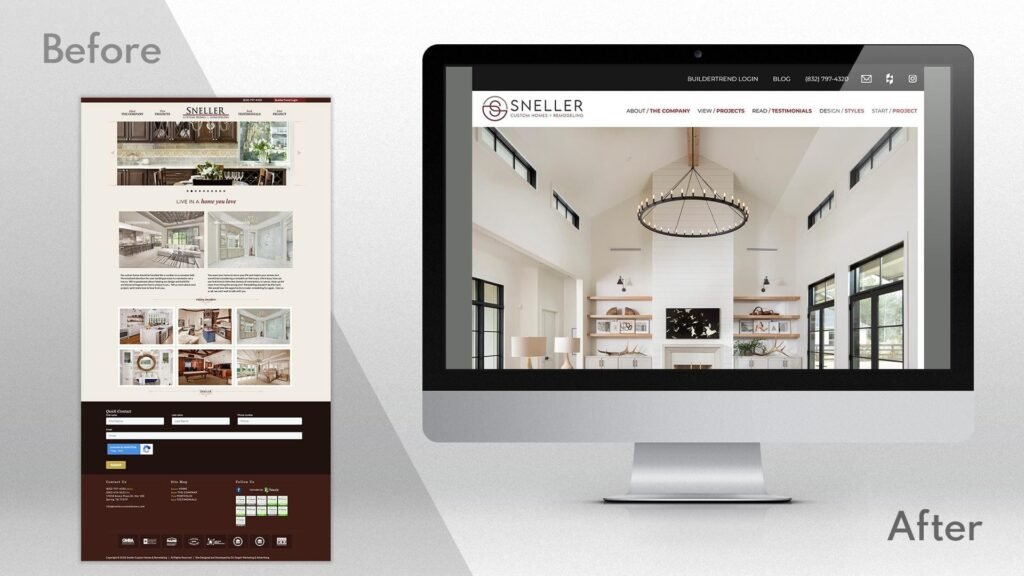
A website redesign isn’t always necessary because a website looks old.
Sometimes the strongest reasons are operational or commercial.
A roofing contractor may have expanded into commercial services but still have a website focused entirely on residential roof repairs.
A remodeling company may now specialize in high-value renovations, yet its website continues attracting inquiries for minor handyman projects.
An HVAC business may serve several Miami-Dade communities but lack clear service-area navigation.
A pool builder may have completed impressive projects that are poorly represented in an outdated portfolio.
These situations create a gap between the company’s current capabilities and how it presents itself online.
Your website no longer represents your business
Contractors evolve.
Services change, project values increase, teams expand, and companies begin serving different customers or geographic markets.
An older WordPress website may not communicate those changes clearly.
For example, a Miami remodeling company that originally handled small residential projects might now offer whole-home renovations, design-build services, and luxury interior remodeling.
Its website should reflect the work it wants to attract today, not simply the services it offered several years ago.
Mobile usability is limiting the customer experience
A prospective customer might discover your business while comparing roofing companies on a phone, browsing pool designs on a tablet, or searching for emergency plumbing assistance.
If the website requires constant zooming, has difficult navigation, or hides contact options, the experience becomes unnecessarily complicated.
Mobile-first WordPress redesign focuses on making important information accessible across screen sizes.
Your service pages are too generic
Many contractor websites use a single services page listing everything the company offers.
While that may provide a basic overview, it doesn’t always address the specific questions potential customers have.
Someone searching for a kitchen remodeling contractor may want to see kitchen renovation projects, understand the remodeling process, and request a consultation.
Someone searching for commercial HVAC installation may need information about equipment, building types, and service capabilities.
A redesigned website can organize services into clearer, more relevant pages.
Your website receives traffic but produces few qualified inquiries
Website traffic alone doesn’t establish business success.
A contractor might receive organic visits and paid clicks while struggling to generate suitable project inquiries.
The issue could involve traffic quality, service positioning, weak calls to action, poor mobile UX, or forms that don’t collect the right information.
Before recommending a redesign, these factors should be evaluated using available analytics and lead data.
What Makes WordPress Website Design Different for Miami Contractors?
Miami isn’t a single, uniform contractor market.
Construction and home improvement demand varies across neighborhoods, property types, project values, and customer expectations.
A residential remodeling company serving Coral Gables may need a different website experience from a commercial roofing contractor serving industrial properties in Doral.
A pool builder working on high-end residential projects may require extensive project galleries, while an emergency plumbing business may depend more heavily on mobile calls and rapid service inquiries. Explore our Miami and South Florida SEO services page.
Different property types require different content
Miami-area contractors may work on single-family homes, condominiums, multifamily buildings, commercial properties, and luxury residences.
Their websites should explain which property types they serve.
For example, a general contractor specializing in commercial tenant improvements shouldn’t rely entirely on residential renovation photography.
Similarly, a luxury home remodeling company should showcase projects that reflect the scope and quality of work it wants to attract.
Local conditions influence customer questions
South Florida construction projects may involve concerns related to humidity, heavy rainfall, coastal exposure, storm resilience, building requirements, and property-specific construction conditions.
These subjects should be discussed where relevant to the contractor’s actual services.
For roofing companies, customers may want to understand materials, installation methods, inspections, and applicable requirements.
For HVAC contractors, system performance, maintenance, and indoor comfort may be important.
For pool and outdoor living contractors, materials, drainage, landscape conditions, and long-term maintenance may influence project decisions.
A well-structured WordPress website gives contractors room to address these considerations without making unsupported claims about compliance or performance.
Service-area relevance should be accurate
Miami contractors may serve several communities, but not every business covers the same geographic area.
A website should make actual service coverage clear.
That might include Miami, Miami Beach, Coral Gables, Doral, Hialeah, Kendall, Aventura, Homestead, or other communities where the company genuinely operates.
Businesses extending into Broward County may also serve Fort Lauderdale, Hollywood, or nearby areas.
The objective isn’t to insert every city name into every paragraph.
It’s to help visitors understand whether the contractor serves their location.
WordPress Website Redesign Without Losing Existing SEO Rankings
One of the biggest mistakes an established contractor can make is treating a redesign as a completely fresh start.
A WordPress website may already have valuable search visibility, indexed pages, internal links, backlinks, and content that contributes to qualified inquiries.
Changing the design without evaluating those assets can create unnecessary SEO risks.
SEO preservation should begin before the redesign—not after rankings decline.
Audit your existing organic search performance
Google Search Console can help identify which pages receive impressions and clicks from organic search.
For a Miami contractor, these may include:
-
Main service pages.
-
City or service-area pages.
-
Blog articles answering customer questions.
-
Project portfolio pages.
-
Older informational resources.
-
The homepage and branded search pages.
Review the queries associated with these pages, their visibility trends, and their contribution to meaningful traffic.
Not every page needs to be preserved unchanged, but important assets should be identified before structural decisions are made.
Preserve valuable service URLs
Suppose a roofing company has an established page at:
/roof-replacement-miami/
If that page already receives relevant organic traffic, changing it to a different URL without a clear reason introduces additional work and potential risk.
A WordPress redesign can improve the page’s layout, images, mobile experience, and conversion elements while retaining its existing URL.
When a URL change is necessary, implement appropriate permanent redirects and update internal links.
Review content before removing it
Older contractor websites often contain service descriptions, FAQs, project details, and local information that may still be useful.
A redesign shouldn’t automatically delete these sections simply because the new design uses fewer blocks.
Instead, determine whether the content is accurate, relevant, and useful.
Where possible, improve readability and presentation while preserving important information.
Maintain internal linking relationships
Internal links help visitors and search engines discover related content.
A Miami general contractor website might connect its homepage with remodeling services, project portfolios, service areas, and consultation pages.
If those relationships disappear during a redesign, navigation and content discovery may suffer.
A redesign is an opportunity to improve internal linking, but it should begin with an understanding of the existing structure.
Check technical SEO before and after launch
Important considerations include:
-
Indexability and crawlability.
-
Canonical URLs.
-
XML sitemaps.
-
Redirects.
-
Metadata.
-
Heading structure.
-
Mobile rendering.
-
Structured data where appropriate.
-
Internal links.
-
Image accessibility and optimization.
For established contractor businesses, the goal is to improve website quality without unnecessarily disrupting existing organic visibility.
Mobile-First WordPress Redesign for Miami Roofing, HVAC & Plumbing Companies
Mobile usability matters across contractor industries, but the ideal customer experience differs by service.
An emergency plumbing customer may need immediate phone access.
A roofing replacement prospect may want to compare services and request an inspection.
A remodeling customer may spend time reviewing portfolios before contacting the company.
WordPress redesign should account for these different behaviors.
Make important services easy to find
A mobile visitor shouldn’t have to navigate through multiple menus to locate a relevant service.
Prioritize the company’s most important offerings in navigation and service-page architecture.
For an HVAC contractor, this might include AC repair, replacement, maintenance, and commercial services.
For a plumbing company, it may include drain services, leak repair, water heaters, and emergency assistance.
Use appropriate mobile calls to action
A clear CTA helps visitors understand what to do next.
Examples include:
-
Call for HVAC Service.
-
Request a Roof Inspection.
-
Schedule a Plumbing Appointment.
-
Discuss Your Remodeling Project.
-
Request a Pool Construction Consultation.
The action should match the service and the business’s actual availability.
Improve form usability
Long, complicated forms can create friction on mobile devices.
However, shorter forms aren’t always better for every contractor.
A luxury renovation company may need more information to qualify substantial projects.
A plumbing service may require only basic contact details and a description of the problem.
The form should collect useful information without making the process unnecessarily difficult.
Keep navigation and content readable
Responsive WordPress layouts should account for typography, spacing, touch targets, image dimensions, and accessibility.
The objective is to create a consistent experience across desktop and mobile devices rather than simply shrinking the desktop layout.
WordPress Redesign Strategies for Different Miami Contractor Industries
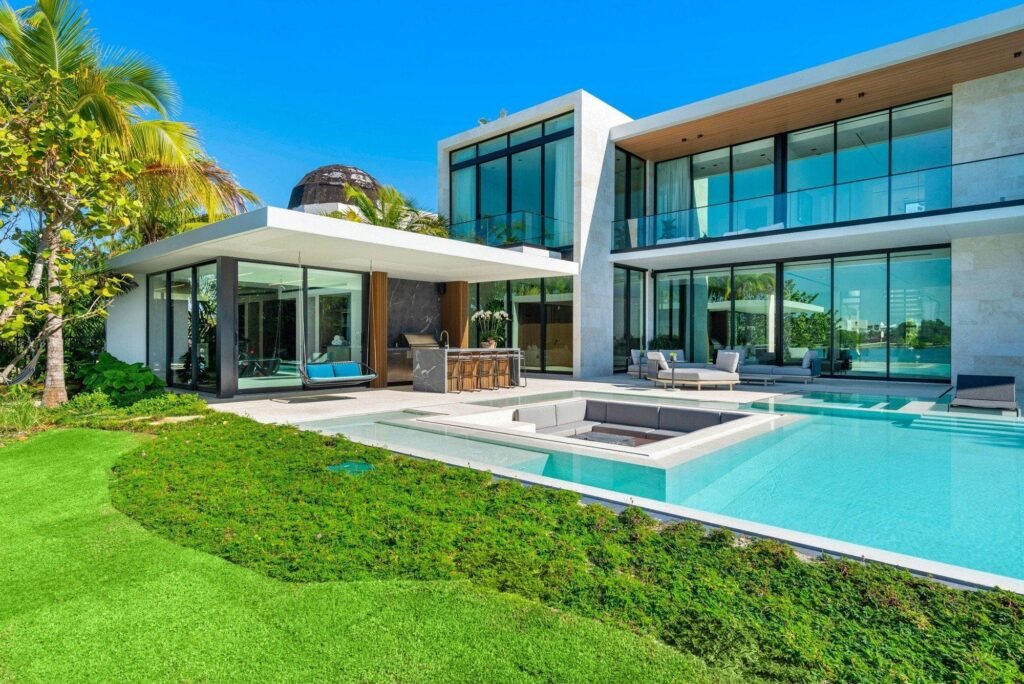
Different trades require different content, visual evidence, and conversion pathways.
A generic WordPress template may provide a starting point, but the final website should reflect the contractor’s services and customers.
Roofing contractors: Service clarity and credibility
Miami roofing companies may offer repairs, replacements, inspections, maintenance, or commercial roofing.
Their websites should clearly distinguish between these services.
A roofing redesign might prioritize relevant project photographs, roofing materials, inspection processes, service-area coverage, and estimate requests.
Where applicable, credentials and warranty information should be accurately represented.
For contractors serving commercial properties, content should address the relevant building types and project requirements.
HVAC contractors: Fast access to service information
HVAC websites often need to support both urgent service inquiries and longer-consideration replacement projects.
A redesigned WordPress website can create distinct experiences for AC repair, system replacement, maintenance, and commercial HVAC services.
Mobile contact options, clear service coverage, and appointment pathways may be particularly important.
Plumbing contractors: Organized services and straightforward contact
Plumbing businesses often serve customers with very different needs.
A homeowner experiencing a leak may want immediate assistance.
Someone planning a water heater installation may need more detailed service information.
WordPress service pages can separate these journeys while maintaining consistent navigation and branding.
General contractors: Communicating project capabilities
General contractors may handle residential construction, additions, renovations, commercial projects, or specialized construction work.
Their websites should make project capabilities clear.
A useful redesign may include dedicated service pages, project case studies, company credentials, and a consultation process appropriate to the work.
Luxury remodeling and design-build contractors: Project quality matters
Miami remodeling companies serving higher-value residential projects often need a more detailed visual presentation.
Completed kitchens, bathrooms, home additions, and whole-home renovations can help prospective customers evaluate design capabilities and workmanship.
A WordPress redesign may introduce structured project galleries, individual case studies, and clearer information about the remodeling process.
The goal is to attract inquiries aligned with the company’s preferred project scope.
Pool builders: Visual storytelling and project information
Pool construction is highly visual.
Potential customers may compare designs, finishes, water features, outdoor environments, and construction approaches.
A redesigned WordPress website can present completed projects through optimized galleries and detailed project pages.
Relevant service information should remain accessible alongside the imagery.
Landscaping and outdoor living contractors: Connecting related services
Landscaping companies may offer landscape design, hardscaping, patios, pergolas, outdoor kitchens, lighting, and other outdoor improvements.
A WordPress redesign can organize these services into a logical structure.
For example, an outdoor living company may benefit from a main services overview linking to dedicated pages for its most important offerings.
This helps customers explore related projects without overwhelming a single page.
Project Galleries That Help Miami Contractors Build Trust
Project photography is often one of the strongest assets a contractor can present online.
But a gallery shouldn’t simply be a collection of attractive images.
It should help visitors understand the type of work the company performs and whether it has relevant experience.
Organize projects by service
A remodeling contractor might group projects into kitchens, bathrooms, additions, and whole-home renovations.
A pool builder might organize projects by construction type, design features, or outdoor living scope.
This makes the portfolio more useful to customers researching specific services.
Add meaningful project descriptions
Where appropriate, include:
-
Project type.
-
General location.
-
Scope of work.
-
Materials or design features.
-
Challenges addressed.
-
Relevant service links.
Avoid disclosing private client information or exact residential addresses without permission.
Optimize project images for performance
High-resolution photography can contribute to slow loading when images aren’t properly sized or compressed.
WordPress supports responsive image delivery, but the implementation should still be tested.
Use appropriately sized files, modern image formats where suitable, and efficient gallery loading.
Connect projects to conversion opportunities
A visitor reviewing a completed kitchen renovation may be ready to discuss a similar project.
Relevant project pages can include links to remodeling services or consultation opportunities.
This creates a natural path from project inspiration to inquiry.
Core Web Vitals and WordPress Performance During a Miami Contractor Redesign
Website performance should be considered during the design process rather than treated as a final technical adjustment.
Contractor websites frequently use large images, project galleries, animations, maps, forms, and third-party integrations.
These features can be useful, but they need efficient implementation.
Largest Contentful Paint
Largest Contentful Paint (LCP) measures when the largest visible content element finishes rendering.
Google’s good-performance threshold is 2.5 seconds or less.
For a contractor website, the LCP element may be a hero photograph or prominent heading.
Optimizing image delivery, server response times, and critical resources can help improve loading performance.
Interaction to Next Paint
Interaction to Next Paint (INP) measures responsiveness to user interactions.
Google’s good threshold is 200 milliseconds or less.
Heavy JavaScript, complex widgets, and inefficient interactions can affect responsiveness.
A contractor website should respond smoothly when visitors open menus, use forms, or interact with project galleries.
Cumulative Layout Shift
Cumulative Layout Shift (CLS) measures unexpected visual movement.
Google’s good threshold is 0.1 or less.
Images without reserved dimensions, late-loading widgets, and font changes can contribute to layout instability.
A stable layout helps visitors read content and interact with buttons without unexpected movement.
Don’t optimize only for a score
PageSpeed Insights and Core Web Vitals provide useful technical measurements.
However, a perfect performance score doesn’t guarantee better rankings or more leads.
The website still needs relevant services, credible information, useful navigation, and effective conversion pathways.
For Miami contractors, performance improvements should support the overall customer experience.
Elementor and WordPress Redesign: Keeping the Website Flexible
Elementor can provide a flexible environment for building custom WordPress layouts, service pages, project portfolios, and responsive sections.
However, the quality of the implementation matters.
A redesign should avoid unnecessary complexity that makes the website difficult to maintain.
Use reusable design components
Consistent service-page components can help maintain visual quality across a contractor website.
These may include service introductions, project galleries, trust sections, FAQs, and contact blocks.
Reusable components also make future updates more manageable.
Avoid excessive widgets and animations
Complex layouts and unnecessary third-party extensions can increase website overhead.
Use animations selectively and prioritize the information visitors need.
Review mobile layouts individually
A desktop design may require adjustments for mobile devices.
Check image placement, typography, spacing, buttons, and forms rather than relying only on automatic responsive settings.
Keep future content expansion in mind
A Miami contractor may introduce new services, publish project case studies, or expand into additional service areas.
The WordPress architecture should support those changes without requiring another major redesign.
Local SEO and Miami Service-Area Architecture During a Redesign
A WordPress redesign can affect local SEO when important pages, navigation, and location information change.
Contractors should evaluate how their websites communicate geographic coverage.
Keep service and location intent distinct
A roofing contractor may have a main roof replacement page and additional content explaining service coverage in Miami-Dade communities.
Those pages should provide useful, distinct information rather than repeating identical content with city names changed.
Reflect actual service coverage
If a company serves Miami, Coral Gables, Doral, Kendall, and Miami Beach, the website can communicate that coverage clearly.
If the business also serves Fort Lauderdale or other Broward County locations, those areas should be included only when they are genuinely part of its operations.
Preserve useful local content
Older service-area pages may contain valuable project examples, FAQs, and location-specific information.
Evaluate their performance before removing or consolidating them.
Connect the website with Google Business Profile
A WordPress redesign should maintain consistent business information and relevant links to the company’s Google Business Profile.
However, redesigning the website doesn’t automatically improve Google Maps rankings.
Local visibility depends on multiple factors, including relevance, distance, and prominence.
For a broader look at this relationship, explore Nfinity Media’s local SEO services.
How WordPress Website Redesign Improves Contractor Lead-Generation Opportunities
A contractor website should make it easier for suitable customers to take the next step.
That doesn’t mean every visitor should be pushed immediately toward a form.
Different services require different levels of research and consideration.
Match CTAs to service intent
An emergency HVAC visitor may want to call.
A luxury home remodeling prospect may prefer to review projects before scheduling a consultation.
A pool construction customer may want to discuss design options and project requirements.
The website should support these different journeys.
Improve service-page conversion pathways
A conversion-focused service page may include:
-
Clear service descriptions.
-
Relevant project evidence.
-
Genuine trust signals.
-
Service-area information.
-
A logical consultation or estimate CTA.
-
A reliable contact form.
-
Clear expectations about the next step.
Connect forms with follow-up workflows
WordPress forms can integrate with email notifications, CRM platforms, scheduling tools, and automation systems.
These integrations can help contractors manage inquiries and reduce missed opportunities.
However, automated workflows should be configured carefully and tested before launch.
Measure qualified leads
Not every inquiry represents a suitable project.
Contractors should evaluate lead quality alongside conversion rates.
Useful metrics include consultation bookings, qualified estimates, project value, and customer acquisition costs.
A redesign should support these measurements where possible.
WordPress Redesign and Google Ads: Protecting Paid Traffic Performance
Contractors investing in Google Ads should consider how a redesign affects campaign landing pages.
Changing URLs, removing forms, or modifying page content can disrupt paid traffic experiences and conversion tracking.
Review existing Google Ads destinations
Identify the pages currently used by active campaigns.
Check whether those pages will remain available after the redesign.
If URLs change, update campaign destinations appropriately rather than relying only on redirects.
Preserve conversion tracking
Google Ads and GA4 conversion events should be reviewed during development and tested after launch.
Form submissions, qualified calls, and consultation bookings should continue to be measured accurately.
Align landing pages with campaign intent
A roofing advertisement should lead to relevant roofing information.
A remodeling campaign should direct visitors toward the advertised remodeling service.
Avoid sending every campaign to a generic homepage when a more relevant destination is available.
Nfinity Media’s Google Ads landing page optimization services explore the relationship between ad relevance, landing-page UX, and lead generation.
Should Miami Contractors Redesign Their Website or Improve the Existing One?
Not every website needs to be rebuilt.
Some established WordPress websites have strong content, useful service architecture, and existing rankings but need targeted improvements.
In those cases, technical optimization, design refinements, or conversion improvements may be more appropriate.
Consider targeted optimization when:
-
The website architecture is already effective.
-
Important pages rank for relevant searches.
-
Most usability problems affect only certain sections.
-
The design remains appropriate for the business.
-
Performance issues can be resolved without rebuilding the site.
-
Existing conversion paths can be improved through focused changes.
Consider a broader redesign when:
-
The website no longer reflects the company’s services.
-
Mobile usability problems are widespread.
-
Service pages lack clear structure.
-
The theme or page builder is difficult to maintain.
-
Major technical limitations affect performance.
-
The business needs a more scalable content architecture.
-
Project galleries and conversion pathways require substantial restructuring.
The decision should be based on an audit of the current website, not simply its age.
The Miami Contractor WordPress Redesign Checklist
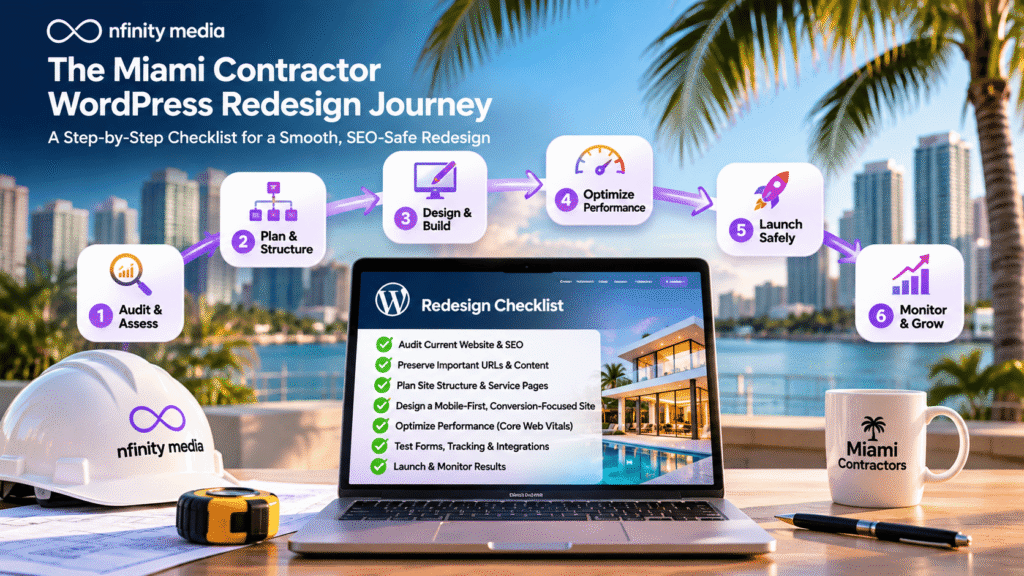
A structured redesign process helps reduce technical risks and keeps the project focused on measurable improvements.
Phase 1: Audit the existing website
Review current search visibility, important pages, technical issues, mobile usability, website speed, and conversion tracking.
Identify what already works and what should be preserved.
Phase 2: Define business priorities
Determine which services, project types, and geographic areas matter most.
Clarify whether the website should generate emergency service calls, project consultations, estimate requests, or another type of inquiry.
Phase 3: Plan the website architecture
Organize the homepage, service pages, project galleries, service areas, informational content, and contact pathways.
Preserve valuable URLs where possible.
Phase 4: Develop the WordPress design
Build responsive layouts that reflect the contractor’s brand and project quality.
Prioritize readable content, relevant imagery, and clear navigation.
Phase 5: Optimize performance
Review images, scripts, fonts, caching, hosting, Elementor components, and Core Web Vitals.
Avoid sacrificing useful functionality simply to improve synthetic performance scores.
Phase 6: Preserve technical SEO
Maintain important metadata, content relevance, internal links, canonical URLs, and structured data where appropriate.
Implement redirects for necessary URL changes.
Phase 7: Test conversion functionality
Verify forms, phone links, booking tools, CRM integrations, and analytics events.
Test important customer journeys on mobile and desktop.
Phase 8: Launch and monitor
After deployment, check indexing, redirects, analytics, page performance, and lead capture.
Monitor Google Search Console for unexpected changes.
A redesign is not complete simply because the new website is live.
How Much Should a Miami Contractor Budget for a WordPress Redesign?
Website redesign costs vary considerably based on the existing site’s condition, page count, functionality, design requirements, and SEO migration complexity.
A small contractor website with a handful of pages may require a different investment from an established construction company with dozens of service pages, project portfolios, location content, and integrations.
Important cost factors include:
-
Number and complexity of pages.
-
Custom design requirements.
-
Existing WordPress architecture.
-
SEO audit and migration work.
-
Content rewriting or consolidation.
-
Project gallery development.
-
Form and CRM integrations.
-
Performance optimization.
-
Conversion tracking.
-
Testing and launch support.
Rather than comparing redesign quotes solely by page count, contractors should examine what is included.
A lower-cost project that omits SEO migration, testing, or conversion tracking may create additional work later.
Similarly, a large redesign isn’t automatically necessary when targeted improvements would solve the business’s problems.
The appropriate scope should reflect the website’s current condition and the outcomes the contractor wants to support.
How to Measure Whether a WordPress Redesign Was Successful
A successful redesign should be evaluated against the objectives established before development.
For a Miami contractor, those objectives might include improved mobile usability, better service-page organization, preserved organic traffic, or stronger lead-generation performance.
Organic search performance
Compare Google Search Console impressions, clicks, queries, and landing-page visibility.
Account for seasonality, market changes, and other factors that may affect traffic.
Technical performance
Monitor Core Web Vitals, page loading, mobile responsiveness, and technical errors.
Compare representative pages rather than relying only on the homepage.
Conversion performance
Review estimate requests, consultation bookings, qualified phone calls, and lead quality.
Where possible, connect inquiries with actual project outcomes.
Website maintenance
Evaluate whether the redesigned WordPress site is easier to update.
A scalable architecture can reduce the effort required to publish new projects, update services, and maintain content.
Customer experience
Test navigation, forms, project galleries, and contact pathways on real devices.
Analytics can identify patterns, but practical usability testing remains valuable.
Common WordPress Redesign Mistakes Miami Contractors Should Avoid
Deleting ranking pages without evaluating them
Removing established service pages can eliminate content that already contributes to organic visibility.
Audit before deleting.
Changing every URL unnecessarily
A new design doesn’t require a completely new URL structure.
Preserve valuable URLs when possible.
Focusing only on visual appearance
A polished website still needs useful content, accessible navigation, technical stability, and reliable contact pathways.
Using generic project imagery
Stock photography may not accurately represent the company’s actual capabilities.
Use genuine project examples whenever possible.
Creating excessive location pages
Near-identical city pages can weaken the usefulness of a website.
Prioritize meaningful geographic relevance and actual service coverage.
Ignoring mobile usability
A redesign that works well only on desktop is incomplete.
Failing to test forms and tracking
Broken contact forms and missing conversion events can undermine the value of a new website.
Launching without monitoring
Review technical SEO, search visibility, and conversion performance after launch.
Problems are easier to address when they are identified early.
How Nfinity Media Approaches WordPress Website Redesign for Miami Contractors
At Nfinity IT Media, we approach contractor WordPress redesign as a combination of website design, technical SEO, user experience, content architecture, and lead-generation strategy.
For established businesses, the first step is understanding what the current website already does well.
That may include valuable Google rankings, service-page content, project photography, internal links, and established customer inquiry pathways.
A redesign should preserve those strengths while addressing genuine limitations.
Our approach considers:
-
WordPress website design and redesign.
-
Existing SEO visibility and content value.
-
Service-page architecture.
-
Mobile UX and responsive layouts.
-
Core Web Vitals and technical performance.
-
Project portfolios and visual presentation.
-
Local SEO and service-area relevance.
-
Conversion-focused contact pathways.
-
Google Ads landing-page compatibility.
-
Lead capture and follow-up integrations.
For Miami and South Florida contractors, the strategy should reflect the business’s actual services, target customers, geographic coverage, and project priorities.
A roofing contractor, HVAC company, luxury remodeling business, and pool builder should not receive identical website recommendations.
The objective is to create a WordPress website that communicates the business clearly, supports existing search visibility, and helps qualified customers take the next step.
Frequently Asked Questions About WordPress Website Redesign for Miami Contractors
1. Can a Miami contractor redesign a WordPress website without losing Google rankings?
Yes, a redesign can be planned to preserve existing SEO value, although rankings cannot be guaranteed. Important safeguards include auditing current pages, preserving valuable URLs and content, maintaining internal links, implementing necessary redirects, and monitoring Search Console after launch.
2. Is WordPress a good platform for Miami roofing and HVAC contractors?
WordPress can support service pages, project galleries, mobile-friendly layouts, estimate forms, SEO tools, and business integrations. Its suitability depends on the company’s requirements and how the website is implemented and maintained.
3. How long does a contractor WordPress redesign take?
The timeline depends on the number of pages, design complexity, content requirements, integrations, and SEO migration needs. A small website refresh may require less work than a complete redesign of a large contractor website with extensive service-area content.
4. Should Miami contractors keep their existing website URLs during a redesign?
Generally, valuable existing URLs should be retained unless there is a clear reason to change them. When changes are necessary, use appropriate redirects and update internal links to reduce disruption.
5. Can a WordPress redesign improve contractor lead generation?
A redesign can improve navigation, service clarity, mobile usability, forms, and conversion pathways. Whether those improvements increase qualified leads depends on traffic quality, customer intent, and the changes implemented.
6. Does Elementor affect WordPress website speed?
Elementor can be used to build efficient websites, but complex layouts, excessive add-ons, animations, and poorly optimized assets may contribute to performance issues. Proper implementation and testing are important.
7. Should Miami contractors create separate pages for every service area?
Not necessarily. Separate location pages should provide meaningful information and reflect genuine service coverage. Avoid creating near-identical pages solely to target additional city keywords.
8. What should a Miami remodeling contractor include in a redesigned website?
Useful elements may include detailed service pages, completed project galleries, remodeling process information, relevant credentials, service-area details, and consultation forms appropriate to the company’s project scope.
9. How can contractors measure WordPress redesign performance?
Google Search Console, GA4, Core Web Vitals, call tracking, form events, and CRM data can help evaluate search visibility, website usability, and lead-generation performance before and after launch.
10. Is it better to redesign a contractor website or improve the existing one?
That depends on the current website. If the architecture, design, and content remain effective, targeted improvements may be sufficient. A broader redesign becomes more appropriate when structural, technical, or usability problems affect much of the site.
Build a Better Miami Contractor Website Without Losing What Already Works
A WordPress website redesign should help your contractor business move forward without unnecessarily sacrificing the search visibility, content, and customer trust it has already developed.
For Miami roofing, HVAC, plumbing, remodeling, pool construction, general contracting, and outdoor living companies, that means balancing modern design with practical business requirements.
Your website should clearly explain your services, showcase relevant work, perform reliably on mobile devices, and provide appropriate paths for prospective customers to request an estimate or consultation.
Just as importantly, established service pages and existing SEO value deserve careful consideration before major changes are made.
Nfinity Media helps contractors connect WordPress website design, technical SEO, local visibility, user experience, and lead-generation strategy.
Whether your current website needs targeted improvements or a more comprehensive redesign, the first step is evaluating what already works, what should be preserved, and where improvements can create the most value.
Explore our local SEO services and Google Ads landing page optimization services to learn how website design fits into a broader digital growth strategy.
Ready to discuss your Miami contractor WordPress website?
Schedule a digital growth consultation with Nfinity Media to review your existing website, SEO visibility, WordPress performance, and opportunities for a more effective customer experience.